Illegal Gold Mining in Peru: Why Amazon Destruction Is Also a Forced Labor Story
Peru’s latest crackdown is exposing the environmental damage caused by illegal gold mining in the Amazon. Not For Sale argues that another documented layer deserves equal attention: forced labor and trafficking within the economy surrounding extraction.

GOLD MINING IN PERU
Peru’s latest crackdown on illegal gold mining has produced extraordinary images of environmental destruction inside the Amazon. That coverage matters. But it reveals only part of the story. Behind some illegal mining economies sits another form of exploitation that is much harder to capture from the air: forced labor, trafficking and the vulnerability of people whose work helps sustain the same system destroying the land around them.
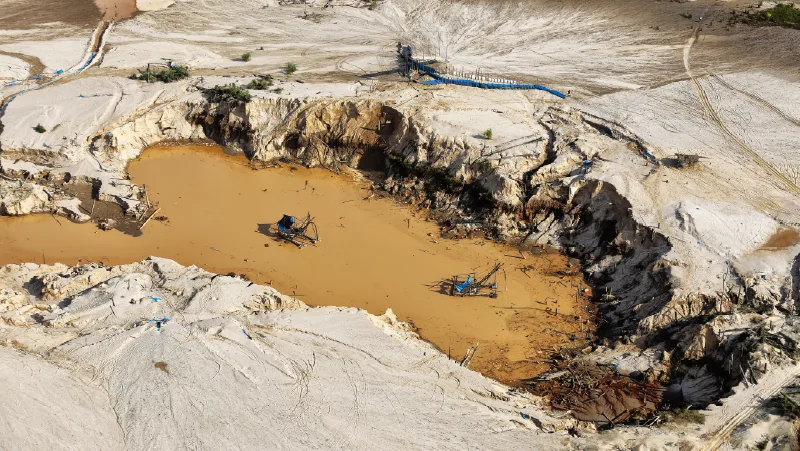
In August 2026, Peruvian navy personnel descended by helicopter into a damaged section of the Amazon in Madre de Dios, where illegal gold mining had spread along the Malinowski River and into Tambopata National Reserve. The images recorded during the operation are difficult to reconcile with what a protected rainforest should look like. Forest gives way to exposed earth and mining pools, engines and pumps sit beside discolored waterways, and improvised camps have appeared within one of the most biodiverse regions of Peru.
The fact that this is being documented matters. Reporting by the Associated Press and other international media is giving greater visibility to an illegal mining economy that has caused extensive deforestation, disturbed river systems and introduced mercury into environments relied upon by Indigenous and other local communities. Not For Sale welcomes that attention. Environmental destruction of this scale should be seen, investigated and reported.
But there is another layer to the story, and it is one that coverage of illegal mining can too easily leave outside the frame.
For decades, researchers and anti-trafficking organizations have documented forced labor and human trafficking risks in the gold economy of Madre de Dios. Deceptive recruitment, manipulated debt, withheld pay, restrictions on movement and sexual exploitation have all been identified in and around mining areas. That does not mean every person working at an illegal mine is a trafficking victim, nor is there evidence that every worker encountered during Peru’s latest operations was being coerced. What the evidence does show is that the exploitation of the Amazon and the exploitation of people can occur inside the same economy.
For Not For Sale, this is not a newly discovered connection. Since the organization began working against modern-day slavery nearly two decades ago, its work has increasingly confronted the same recurring pattern: environmental destruction can undermine the livelihoods that keep people safe from exploitation, while forced and vulnerable labor can become embedded within the industries carrying out that destruction. In the Peruvian Amazon, in mining regions of Central Africa and across the Mekong and Golden Triangle, the details differ, but the underlying cycle can look remarkably familiar.
That intersection is central to how Not For Sale understands ecocide and human exploitation. What looks from above like an environmental crime can look very different at ground level, where the person operating the machinery may have far less power than the financier, recruiter or buyer who ultimately profits from the gold.
Original video published by @AssociatedPress
What This Article Covers
This article looks at why Peru has intensified its fight against illegal gold mining in Madre de Dios, what the latest operations reveal about the destruction of the Amazon, and what decades of research tell us about the labor economy operating around the mines. It examines the documented links between gold extraction, forced labor and sexual exploitation, the way environmental degradation can increase vulnerability to trafficking, and why Peru’s response will ultimately need to target not only machinery in the forest but also the financial, criminal and labor systems that allow illegal mining to regenerate.
Key Takeaways
Peru’s intervention in Tambopata National Reserve is bringing important international attention to an illegal mining economy that continues to damage rainforest and waterways. The environmental reporting is significant, but it should sit alongside longstanding evidence that forced labor, deceptive recruitment and human trafficking have also occurred within the wider gold economy of Madre de Dios. Not every worker at an illegal mine is a trafficking victim, and responsible reporting must preserve that distinction, but ignoring labor conditions risks presenting only the most visible half of the story. For Not For Sale, which has spent almost two decades working at the intersection of economic vulnerability, trafficking and environmental destruction, the situation in Peru illustrates why these issues cannot always be addressed independently.
Why Illegal Gold Mining in Peru Matters Now
Peru has been attempting to contain illegal mining in Madre de Dios for years. Operation Mercury, launched in 2019, brought a major state presence into the region and succeeded in reducing mining activity in several heavily affected areas. Subsequent enforcement continued, but the economic incentives behind illegal extraction did not disappear. As enforcement capacity weakened during the COVID-19 pandemic and international gold prices increased, mining began returning to parts of the southern Peruvian Amazon.
The latest government operations show how serious that resurgence has become. Military personnel, police and prosecutors have entered mining areas inside Tambopata National Reserve and targeted camps, rafts, pumps, motors, fuel and other infrastructure required to extract gold. The Associated Press accompanied Peruvian forces during an August operation, producing footage that brought the scale and physical reality of the illegal mining economy to an international audience.
That visibility is valuable. Illegal environmental destruction becomes easier to ignore when it occurs far from major cities and beyond the daily experience of the people ultimately consuming the minerals being extracted. Showing the damaged waterways and the machinery operating inside protected rainforest makes an otherwise distant issue much harder to abstract.
At the same time, photographs and video inevitably show what is easiest to see. A dredge can be photographed. A river turned brown by mining sediment can be photographed. A clearing in the forest can be measured by satellite. Coercion, debt and deceptive recruitment are considerably harder to capture in an image.
That is the missing layer Not For Sale believes deserves equal attention.
The Story the Images Cannot Tell
Gold mining in the Amazon can cause environmental damage long after machinery has moved elsewhere. Mercury is commonly used in artisanal and small-scale mining because it binds with gold and enables miners to separate it from surrounding material. The method is comparatively inexpensive, but mercury released during processing can enter waterways and aquatic food chains, creating health risks for miners as well as communities living downstream.
For Indigenous and other forest communities, a contaminated river is not simply an environmental statistic. Rivers support fishing, food, transport and local economies, while forests provide resources that can sustain families outside the cash economy. When those systems are degraded, the effects can reach households with no direct involvement in mining.
Not For Sale has seen why that matters through nearly two decades of work in the Peruvian Amazon. Its work in Madre de Dios has focused not only on people vulnerable to exploitation but also on creating viable forest-based economies that make destructive extraction less economically attractive. That approach grew from a simple observation: stopping exploitation is much harder if the alternative offered to a family is poverty.
The same relationship appears in Not For Sale’s reporting on illegal mining in the Mekong region, where concerns about mining pollution in Myanmar and Laos extend downstream toward communities in northern Thailand. In rural areas where families rely heavily on small-scale farming, fishing or local waterways, environmental damage can quickly become economic pressure. When a harvest fails or land can no longer support a family, risky work, migration or deceptive employment offers can become harder to refuse.
This does not mean environmental damage automatically causes trafficking. The relationship is more complicated than that, and it would be misleading to present every person facing poverty as a future trafficking victim. What environmental destruction can do is remove choices, and traffickers and exploitative employers repeatedly benefit when people have fewer safe choices left.
What Illegal Mining Coverage Often Misses
Environmental reporting has rightly focused on the extraordinary damage illegal mining can inflict on the Amazon. The danger is not that journalists are telling the wrong story, but that the story can stop too soon.
When mining is framed principally as a battle between authorities and illegal extractors, the workforce itself can disappear into the background. People working at a mine may be treated collectively as participants in an environmental crime, even though the circumstances that brought them there can be very different. Some may be independent miners, some may work knowingly for illegal operators, and some may have entered employment through deception, debt or coercion.
Research in Madre de Dios makes that distinction impossible to dismiss. Studies by the International Labour Organization and International Organization for Migration have documented trafficking for labor exploitation in the region’s gold sector, including workers recruited from other parts of Peru with promises about jobs that were later not honored. Other research has examined forced-labor conditions and vulnerability in mining camps, while international trafficking reports have identified practices including debt-based coercion, isolation, withheld wages and restrictions on workers’ ability to leave.
Not For Sale’s broader investigation, From Illegal Mines to Forced Labor: How Corruption Connects Ecocide and Human Trafficking, examines why this is not simply a question of individual employers behaving badly. Illegal extraction can be supported by financial networks, corrupt intermediaries, recruiters, transporters and buyers capable of moving minerals into increasingly opaque supply chains. The person standing in the water with a pump may therefore be the most visible participant in the operation while holding comparatively little power within it.
That is why forced labor should not be treated as a secondary footnote to the environmental story. If coercion exists within the workforce extracting the resource, then understanding who is destroying the forest requires understanding who is controlling the people doing the work.
Forced Labor in the Gold Economy of Madre de Dios
Forced labor has a specific meaning. It is not synonymous with hard work, low pay, unsafe conditions or poverty. International labor standards define it around work that has not been offered voluntarily and is carried out under the threat of a penalty. Someone may enter employment willingly and still later become trapped if wages are withheld, debts are manipulated, documents are taken, threats are made or the person loses any practical ability to leave.
That nuance matters enormously in Madre de Dios. Mining attracts people because it can offer income in a region where secure work is limited, and choosing to accept a dangerous job does not by itself make someone a victim of trafficking. At the same time, economic vulnerability can make people easier to deceive, particularly when recruitment happens far from the eventual workplace and workers become dependent on employers for transport, food and accommodation.
Research has documented these patterns in Peru’s gold sector. Workers have been recruited from regions including Cusco and Puno through employment promises that subsequently changed, while debt systems have been identified in which money advanced for travel, equipment or living costs can leave a worker continuing to labor in an attempt to settle an obligation. Other reporting has described withheld wages, isolation and coercive practices within mining economies.
The distinction is important because it changes the question authorities need to ask. It is not enough to determine whether a mine is illegal. Investigators also need to establish how its workers arrived there, what they were promised, whether they are being paid, whether they owe money to the people controlling the site and whether they can leave safely.
Not For Sale’s work against human trafficking and forced labor has repeatedly shown that exploitation often survives precisely because these questions are harder to answer than whether a piece of machinery has the correct permit.
Sexual Exploitation Can Grow Around the Same Mining Economy
The trafficking risks surrounding illegal mining extend beyond workers extracting gold. Sex trafficking and sexual exploitation have also been documented around mining settlements in Madre de Dios, where remote geography, transient workforces and limited state oversight can create an environment in which exploitation is difficult to detect.
Authorities have previously conducted trafficking operations around businesses servicing mining areas, and international reports have identified women and girls subjected to sexual exploitation within the wider economy surrounding extraction. As with forced labor, careful language is essential. Commercial sex is not automatically trafficking, and adult consensual sex work must not be conflated with coercion. The issue is whether force, fraud, coercion, deception or abuse of vulnerability is being used to exploit someone.
Remote criminal economies can make those conditions easier to create. Transport, accommodation, employment and local businesses may be interconnected, while people arriving from elsewhere can find themselves far from family, authorities or support services. Where organized criminal groups already profit from illegal extraction, the same lack of accountability can create opportunities for other forms of exploitation.
Not For Sale has seen comparable overlap in its work around the Golden Triangle Special Economic Zone and the wider borderlands between Laos, Myanmar and Thailand. Illegal mining there sits within a much broader criminal economy that can include trafficking, scam compounds and money laundering. The circumstances are different from Peru, but the comparison shows why an illegal extractive industry should rarely be examined as though the mine exists independently of everything around it.
The Cycle Between Ecocide and Exploitation
For much of modern policy, environmental crime and human trafficking have occupied separate categories. One belongs to environmental agencies, conservation groups and climate policy; the other belongs to labor law, criminal justice and human rights. Nearly two decades of frontline work have increasingly convinced Not For Sale that this separation can obscure how the two forms of exploitation reinforce one another.
In the simplest version of the cycle, environmental destruction damages the resources on which a community relies. Farming becomes harder, fish stocks fall, land loses value or families are displaced. Economic insecurity increases, creating greater pressure to migrate or accept work that would previously have appeared too dangerous. Exploitative recruiters and criminal economies gain access to a larger pool of vulnerable labor, which can in turn be used in the extraction, clearing or processing that creates further environmental harm.
Not For Sale’s reporting on what ecocide means and its human cost examines this relationship in detail. Ecocide is an evolving legal concept and is not currently a standalone crime under the Rome Statute of the International Criminal Court, so using the term does not amount to a legal finding against an individual mine or operator. For Not For Sale, the framework is useful because it forces a wider question: when an ecosystem is being destroyed, what is happening to the people living inside it and the people whose labor is being used to destroy it?
Madre de Dios makes that question tangible. A polluted river can increase economic vulnerability among communities downstream, while a worker extracting the gold upstream may themselves be experiencing exploitation. The same economy can therefore create vulnerability and consume vulnerable labor at the same time.
Not For Sale has spent almost two decades trying to interrupt that cycle, from building alternative livelihoods in the Peruvian Amazon to confronting trafficking risks in Southeast Asia. The organization’s experience has increasingly reinforced a central idea: protecting people without protecting the economic and environmental systems that sustain them leaves the conditions for exploitation intact.
A Woman and Her Child Reveal the Complexity
One of the most revealing moments in the Associated Press report did not involve a dredge or an armed operation. During the August raid, authorities encountered a woman and her young child at a mining site. According to a prosecutor interviewed by AP, she had traveled from Cusco after failing to gain admission to university and needing employment after the father of her child left. She answered an advertisement for work as a cook and ended up preparing food for people at an illegal mine.
There is no evidence in the report that she was trafficked, and it would be wrong to describe her as a trafficking victim. Her story matters for a different reason. She demonstrates how an illegal mining economy draws in people who are not necessarily there because they have made an ideological or criminal commitment to destroying rainforest. Mining camps need food, transport, fuel, equipment and other services, and they can provide work in places where legal economic opportunities are limited.
The distinction matters for enforcement. Some people at an illegal site may be organizers or financiers, while others may be workers exercising genuine choice. Some may be there because they have few alternatives, and others may be subject to coercion. Treating every person encountered as though they occupy the same position in the economy risks missing both the people responsible for organizing the crime and the people most vulnerable to it.
Not For Sale’s work in Peru has been shaped by this reality. Creating durable alternatives to exploitation means strengthening economic choices before traffickers or illegal industries become the most attractive option available.
Why Not For Sale Welcomes Peru’s Intervention
There is a danger in discussing the limitations of enforcement that the argument can sound like criticism of the intervention itself. That is not Not For Sale’s position.
The Peruvian government is confronting illegal operations that exist in remote territory, have substantial financial backing and can present real security risks to communities and anyone attempting to interfere with them. Dismantling those operations requires powers and resources that charities, NGOs and community organizations do not have.
Mark Wexler, CEO and co-founder of Not For Sale, has visited Madre de Dios repeatedly and has seen illegal mining in the region firsthand. He argues that the scale and danger of the industry always meant civil society alone could never dismantle it.
“We’ve known for 20 years the only way you’re going to stop it was with military intervention,” Wexler said during a discussion of the latest Peru operation.
His point is not that military forces should become trafficking investigators or provide survivor care. Those responsibilities require specialized police, prosecutors, labor authorities, social services and organizations trained to work with people who may have experienced exploitation. Rather, the scale of the illegal mining economy requires state authority if the physical infrastructure and criminal networks behind it are to be confronted.
For that reason, Not For Sale welcomes Peru’s decision to step up enforcement. The machinery needs to be removed, protected land needs to be defended and the people financing illegal extraction need to face investigation. What should happen next is an expansion of the same determination toward the labor economy operating around the mines.
As Wexler put it in the same discussion, “There’s another layer to it that requires government intervention, and that’s stopping forced labor.”
That is the part of the story that must not disappear once the helicopters leave.
Destroying the Machinery Is Only One Part of the Response
Peruvian prosecutors appear increasingly aware that raids alone will not permanently solve the problem. Expensive equipment can be destroyed and then replaced if gold remains valuable enough and financiers are willing to fund new machinery. Authorities are therefore increasingly looking at the money behind illegal mining rather than treating each dredge as an isolated operation.
This shift is crucial because illegal gold does not end its journey beside a river. Once extracted, it can move through traders, transporters, exporters, refiners and other intermediaries before reaching formal markets. With each step, determining where it originally came from can become more difficult.
Not For Sale has explored this problem in How Human Trafficking, Environmental Destruction, and Critical Minerals Are Connected. The challenge is not unique to gold. Across minerals and metals supply chains, the conditions at the point of extraction can become almost invisible by the time the material appears inside a legitimate product.
A credible response therefore has to travel in both directions. Investigators must move upstream toward financiers and organizers while supply-chain actors move downstream toward greater traceability. At the same time, labor authorities need to examine who is working at the mine and on what terms.
Otherwise, enforcement risks removing the visible evidence while leaving the system that produced it intact.
What Still Needs to Change
Peru’s current intervention is important, but lasting progress will require enforcement that reaches beyond equipment. Financial investigators need to establish who purchases machinery and profits from the gold, while labor and anti-trafficking authorities need sufficient access to interview workers independently and determine whether coercion is present. People identified as trafficking victims need protection and viable alternatives, while Indigenous communities need effective safeguards against incursions onto their land and contamination of the ecosystems on which they depend.
International markets also have a role. Gold buyers, refiners and businesses using gold need credible systems for assessing provenance and human-rights risks rather than assuming that a commodity becomes legitimate simply because it has entered a formal supply chain. The possibility that illegally extracted gold can be laundered through paperwork or mixed with legitimate production is precisely why transparency beyond the mining site matters.
The harder challenge is economic. Closing an illegal mine does not automatically create another job, restore a failed farm or replace an income. That does not justify illegal mining, but it helps explain why the industry can return after enforcement operations.
Not For Sale’s approach has therefore focused on alternatives as well as intervention. Its work in the Amazon has helped develop forest-based livelihoods intended to make standing rainforest economically valuable to the communities protecting it. Its work in Thailand and elsewhere has similarly sought to strengthen the education, employment and community infrastructure that reduces the leverage traffickers gain over people with few options.
This is the cycle Not For Sale has been confronting for almost 20 years. Environmental destruction can deepen vulnerability; vulnerability can feed exploitative labor; exploitative labor can help drive further destruction. Breaking only one link leaves the rest of the system capable of rebuilding itself.
What Readers Can Do
The most useful response for readers far from the Peruvian Amazon is to understand that illegal mining does not remain isolated in the forest. Gold travels, and the further it travels from its original point of extraction, the easier it can become to lose sight of the people and landscapes involved in producing it. Consumers, companies and investors can ask more demanding questions about traceability, sourcing standards and human-rights due diligence, particularly where gold or other minerals originate in regions associated with illegal extraction or weak oversight.
It is equally important to support accurate reporting. The environmental journalism emerging from Peru is helping the world see destruction that might otherwise remain distant and largely invisible, and that coverage should continue. But the next question should be about the people inside the frame: who is doing this work, why are they there, what were they promised and are they free to leave?
That is where the environmental story becomes a human one.
Readers who want to understand the wider pattern can explore Not For Sale’s investigations into illegal gold mining and ecocide in the Amazon, corruption, forced labor and illegal mining, illegal mining in the Mekong region, the Golden Triangle Special Economic Zone and the broader relationship between human trafficking, environmental destruction and mineral supply chains.
The Story Cannot End With the Mine
The images emerging from Tambopata deserve the attention they are receiving. They show what illegal gold mining can do to one of the planet’s most important ecosystems and why governments have a responsibility to intervene when protected land is being systematically destroyed.
But a photograph of a ruined river can tell only part of what has happened there. It cannot show whether a worker was deceived into taking the job, whether wages have been withheld, whether debt is preventing someone from leaving or whether women and children are being exploited in the informal economy that has developed around the mine.
Almost two decades of Not For Sale’s work have increasingly brought those two stories together. The exploitation of the environment can create the vulnerability on which traffickers depend, while vulnerable and forced labor can be absorbed into industries that accelerate the destruction. One feeds the other until the two become difficult to separate.
Peru is right to confront the mines. The environmental destruction should be exposed, the machinery should be removed and those financing illegal extraction should be investigated. The opportunity now is to make sure the people hidden inside that same economy receive equal scrutiny.
The damaged Amazon is what we can see. The forced labor behind parts of its destruction is what we must learn to look for.
FAQ
What is happening with illegal gold mining in Peru?
Peruvian authorities have intensified operations against illegal gold mining in Madre de Dios, including activity affecting Tambopata National Reserve. Military personnel, police and prosecutors have targeted mining camps and equipment as part of a wider effort to protect the rainforest and disrupt criminal extraction networks.
Why is illegal gold mining in Peru receiving international attention?
Recent reporting has provided unusually direct footage of the environmental destruction caused by illegal mining, including damaged rainforest, mining pools, machinery and polluted waterways. The reporting has helped bring an issue occurring in remote parts of the Amazon to a wider international audience.
Is forced labor used in illegal gold mining in Peru?
Forced labor has been documented within Peru’s wider gold-mining economy, including in Madre de Dios. Research has identified deceptive recruitment, debt-related coercion, withheld wages and restrictions on workers’ ability to leave. This does not mean every illegal miner is experiencing forced labor, and individual cases must be assessed on evidence.
What does media coverage of illegal mining sometimes miss?
Environmental reporting understandably focuses on visible damage including deforestation, polluted rivers and mining machinery. What can be harder to identify is the labor system operating around the mine, including how workers were recruited, whether they are being paid as promised, whether they owe debts and whether they are free to leave.
How are forced labor and environmental destruction connected?
The relationship can operate in both directions. Environmental damage can remove livelihoods and increase economic vulnerability, while forced or exploitative labor can also be used within industries responsible for environmental destruction. Not For Sale examines this cycle in From Illegal Mines to Forced Labor.
Does illegal mining automatically mean human trafficking is taking place?
No. Illegal mining and human trafficking are different offenses, and the existence of an illegal mine does not prove that its workers have been trafficked. Evidence of coercion, deception or exploitation is required before an individual situation should be described as trafficking or forced labor.
Is sex trafficking linked to mining in Madre de Dios?
Sex trafficking and sexual exploitation have been documented around mining settlements in Madre de Dios. However, commercial sex should not automatically be described as trafficking. Investigators must establish whether the person is being exploited through mechanisms including force, fraud, coercion or abuse of vulnerability.
Why does illegal gold mining use mercury?
Mercury can bind with gold and make it easier to separate from surrounding material. It is relatively inexpensive and accessible but can contaminate waterways and aquatic food chains, exposing miners and communities to serious health risks.
What is Not For Sale’s connection to Peru?
Not For Sale has worked in the Peruvian Amazon since 2009, including with communities in Madre de Dios. Its work has focused on reducing trafficking vulnerability and building forest-based economic alternatives intended to protect both communities and rainforest. Readers can learn more about Not For Sale’s work in Peru.
Why does Not For Sale connect illegal mining with ecocide?
Not For Sale uses the ecocide framework to examine severe environmental destruction alongside its human consequences. Illegal mining can damage ecosystems and livelihoods while exploitative labor may also occur within the extraction economy. The organization explains the distinction between this framework and the developing legal concept in What Is Ecocide?.
Why are government authorities necessary to tackle illegal mining?
Illegal mining operations can operate in remote areas, involve organized criminal networks and possess resources beyond the capabilities of NGOs or local communities. State authorities are therefore needed to enforce environmental and criminal law, dismantle illegal infrastructure and pursue financiers, while specialist agencies are required to investigate forced labor and protect trafficking victims.
Topics in this story
See all topics
Katie Wilde
More from Katie Wilde