What is human trafficking?
Human trafficking is the use of force, fraud, or coercion to compel people into labor, sexual services, or other forms of servitude. It is one of the most prevalent forms of modern-day slavery, affecting millions of people worldwide.
Modern-day slavery is not a single crime. It is an umbrella term for a range of practices in which people are controlled, coerced, or deceived into working or living under conditions they did not freely choose and from which they cannot freely leave. The forms are distinct but interconnected, and all of them have one thing in common: they treat human beings as instruments of profit.
Human Trafficking
Human trafficking is the recruitment, transportation, harboring, or receipt of people through force, fraud, or coercion for the purpose of forced labor or sexual servitude. It is not always violent and it rarely looks the way popular culture depicts it. Traffickers exploit vulnerability, poverty, displacement, immigration status, debt, using deception, false promises, and manipulation as often as physical force.
Forced Labor
Forced labor is any work compelled through threat of punishment, violence, or coercion. It is the most common form of modern-day slavery globally, occurring in agriculture, fishing, construction, domestic work, manufacturing, and increasingly in illegal industries including mining and deforestation. Not For Sale has documented firsthand that victims of forced labor are frequently the ones carrying out environmental destruction, clearing forests, panning rivers for illegal gold, coerced into ecocide by the same systems that profit from their bondage.
Debt Bondage
Debt bondage traps a person through a loan or service whose terms are deliberately manipulated so the debt can never realistically be repaid. The person's labor becomes collateral, and the collateral never clears. It is one of the most common mechanisms traffickers use to maintain long-term control over victims in agriculture, domestic work, and extractive industries.
Sexual Exploitation and Sex Trafficking
Sex trafficking is the recruitment, transportation, harboring, or receipt of people through force, fraud, coercion, or abuse of power for the purpose of commercial sexual services. Traffickers control victims through violence, threats, debt, psychological manipulation, and the confiscation of identification or freedom of movement. All commercial sexual activity involving anyone under 18 is automatically considered trafficking, regardless of apparent consent.
Child Labor
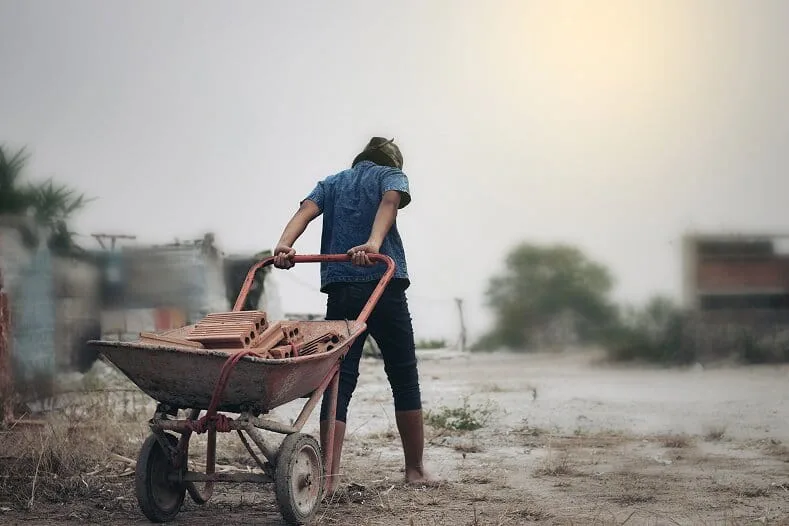
Child labor is the use of children in work that deprives them of their childhood, their education, and their healthy development, work that is mentally, physically, or morally harmful. It exists on a spectrum, from hazardous agricultural labor to forced participation in armed conflict. It is both a cause and a consequence of poverty, and it feeds directly into cycles of trafficking and forced labor in adulthood.
Domestic Servitude
Domestic servitude is a form of forced labor in which individuals, most often women and migrants, are made to work in private homes under coercive or abusive conditions, isolated from outside contact, and unable to leave freely. Its setting inside the home makes it among the most hidden and difficult to detect of all forms of modern-day slavery.
Forced Marriage
Forced marriage occurs when one or both parties enter into a marriage without full, free, and informed consent, through coercion, threats, or deception. It frequently intersects with other forms of modern-day slavery, functioning as a mechanism for labor control, sexual servitude, or the trafficking of women and girls across borders.
Child Soldiers and Forced Recruitment
The conscription, recruitment, or use of children under 18 by armed forces or groups, for combat, support roles, or sexual purposes, constitutes a severe form of modern-day slavery. It typically occurs through abduction or coercion and is concentrated in conflict zones where state authority has broken down and armed groups operate with impunity. Not For Sale has worked with communities affected by forced recruitment in Uganda and the Democratic Republic of the Congo.
Organ Trafficking
Organ trafficking involves the illegal removal, sale, or transplantation of human organs, tissues, or body parts, most often targeting people in desperate financial circumstances who are deceived or coerced into giving up organs, frequently for a fraction of the payment promised, or none at all.
State-Imposed Forced Labor
Some governments exact forced labor directly, through compulsory prison labor that does not meet international standards, or through the mobilization of civilian populations for political or military purposes under threat of penalty. It is a form of modern-day slavery that operates through official authority rather than criminal networks.
Supply Chain Exploitation
Products and raw materials move through global supply chains that span dozens of countries and hundreds of hands. At any point in that chain, on a farm, in a factory, in a mine, forced or trafficked labor may be present, hidden within industries and brands that have no direct knowledge of it. Supply chain exploitation is not a marginal phenomenon: it underpins some of the world's most profitable industries, including electronics, fashion, seafood, and cocoa.
No form of modern-day slavery exists in isolation. The systems that produce forced labor in a Peruvian gold mine are connected to the systems that produce debt bondage in a Thai fishing vessel and sexual servitude in a European city. Not For Sale works at the intersection of all of these, because that is where the system can be broken.
Provides direct support, rehabilitation, and long-term reintegration services for survivors.
Builds anti-trafficking networks and systems that reduce vulnerability at the community level.
Creates economic opportunity in vulnerable communities, preventing trafficking before it starts and supporting recovery after.
Confronts ecocide and forced labor as one connected crisis, protecting ecosystems and the communities that depend on them.
Drives social innovation through enterprise creation, supply chain accountability, and global advocacy.
Launches and scales mission-driven businesses, including REBBL, Dignita, and Regenerate Technology Global, that generate lasting economic dignity for survivors and at-risk communities.
Modern-day slavery and ecocide are not separate crises, they are two faces of the same extractive system. Not For Sale confronts both through survivor support, prevention, social innovation, and enterprise creation across six continents.
“Human trafficking” is the legal and internationally recognized term for the recruitment, transportation, or control of people through force, fraud, or coercion, and one of the most prevalent and documented forms of modern-day slavery under international law.