Europe’s Wildfire Displacement Crisis: How Climate Change, Ecocide and Exploitation Connect
More than 300,000 people have been forced from homes and holiday accommodation by wildfires in France and Spain, exposing how fossil-fuel-driven climate change, environmental decline and displacement can combine to place communities at greater risk of exploitation.

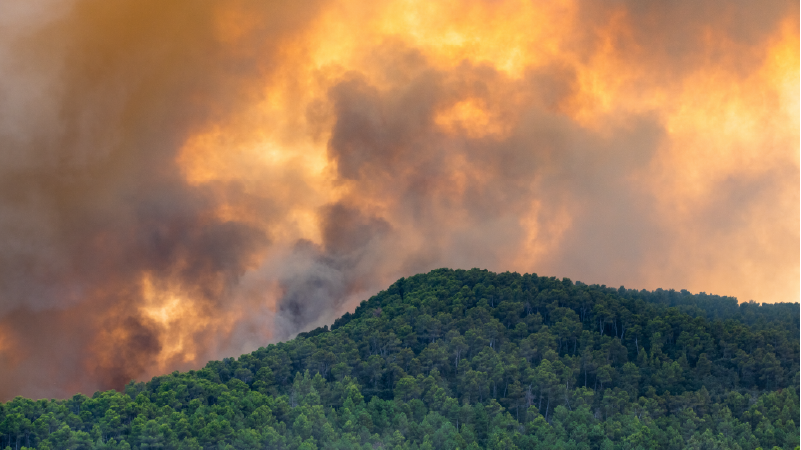
More than 300,000 people have been forced from homes and holiday accommodation by wildfires in France and Spain, exposing how fossil-fuel-driven climate change, environmental decline and displacement can combine to place communities at greater risk of exploitation.
Reporting current as of July 28, 2026. Evacuation totals, burned areas and damage assessments may change as authorities update their figures.
Europe’s wildfire displacement crisis has forced approximately 330,000 people from homes, campsites and holiday accommodation across France and Spain. It is one of the largest civilian evacuation operations in recent European history.
The emergency is being measured in evacuation orders, burned landscapes, damaged homes and exhausted firefighting services. Its deeper significance, however, lies in the conditions that have made fires of this scale increasingly difficult to contain.
Climate change does not necessarily ignite an individual wildfire. Fires may begin through lightning, machinery, infrastructure failure, negligence or deliberate acts. Climate change alters the conditions in which those fires burn. Rising temperatures, prolonged drought and increasingly dry vegetation allow an ordinary ignition to spread faster, burn more intensely and threaten far larger populations.
Those conditions are not natural in origin. The Intergovernmental Panel on Climate Change has concluded that human activity has unequivocally caused global warming, principally through more than a century of fossil-fuel use, damaging land-use change and unequal patterns of production and consumption. Coal, oil and gas account for more than 75 percent of global greenhouse gas emissions, according to the United Nations.
The wildfires should not automatically be described as ecocide. Ecocide concerns severe environmental destruction connected to identifiable conduct and a particular level of knowledge or culpability. The size of a burned area alone does not establish those legal elements.
The fires are nevertheless part of a wider system of climate and environmental harm. They raise urgent questions about the industries driving global warming, the political decisions allowing emissions to continue, and the unequal consequences experienced by people who contributed least to the crisis.
They also belong within Not For Sale’s wider work on the connection between environmental destruction and human exploitation. As explored in Not For Sale’s reporting on the climate crisis and modern-day slavery, environmental disasters can destroy homes, employment and community protections, creating conditions that traffickers and abusive employers may exploit.
What This Article Covers
- How many people have been evacuated by the wildfires in France and Spain
- Where the largest fires are burning and how much land has been affected
- The difference between an evacuation, disaster displacement and homelessness
- How fossil-fuel use and land degradation are intensifying climate and wildfire risk
- Why these fires should not automatically be classified as ecocide
- How displacement can increase vulnerability to trafficking and labor exploitation
- Where Not For Sale is combating climate change and environmental destruction
- What governments must do after the immediate firefighting operation ends
Key Takeaways
- Approximately 330,000 people have been driven from homes or vacation sites by fires in France and Spain, although not all have lost their permanent homes.
- France has evacuated approximately 220,000 people. Spanish authorities have evacuated around 79,000 and instructed approximately 30,000 more to remain indoors.
- By July 28, fires had burned approximately 116,000 hectares in France and 153,000 hectares in Spain during 2026, a combined total of around 269,000 hectares.
- Western Europe experienced its hottest June on record in 2026, with extreme heat and widespread dryness contributing to dangerous fire conditions.
- Fossil fuels are the principal driver of global climate change, while deforestation, agriculture, industry and damaging land-use change also contribute.
- Climate change does not necessarily ignite a fire, but it increases the heat, drought and vegetation dryness that allow fires to spread.
- The wildfires are not automatically ecocide. Establishing ecocide would require evidence of severe environmental harm connected to unlawful or wanton conduct and the required level of knowledge.
- No trafficking increase directly connected to the evacuations has been verified, but sudden displacement can increase exposure to fraudulent recruitment, unsafe work and other forms of exploitation.
- Not For Sale addresses these connected risks through rainforest protection, reforestation, regenerative livelihoods and efforts to redesign supply chains associated with forced labor and environmental destruction.
Why This Story Matters Now
On July 28, French authorities ordered nearly 4,000 additional evacuations from tourist accommodation and leisure sites along the Atlantic coast as returning heat threatened to destabilize efforts to contain the Gironde fire west of Bordeaux.
Approximately 220,000 people have been evacuated in France. Across the border in Spain, authorities have evacuated around 79,000 people and ordered approximately 30,000 more to remain inside their homes.
The combined number driven from homes, campsites, resorts and vacation accommodation has reached roughly 330,000. France’s interior minister said the operation was likely to be the largest civilian evacuation carried out in the country outside wartime.
The headline figure requires careful interpretation. Some of those evacuated were permanent residents. Others were tourists staying in campsites, hotels, vacation villages and second homes. Some have already returned, while others face damaged property, interrupted employment and a much longer period of displacement.
The number evacuated is therefore not the same as the number made homeless. It measures the scale of protective movement, not the final scale of housing loss.
This distinction should not minimize the emergency. It should help authorities understand the different needs that follow it. A tourist requiring transport home faces a different situation from a family whose permanent residence has burned down. A seasonal worker who has lost both employment and employer-provided accommodation may require a different form of protection again.
Conditions also remain unstable. The main Gironde fire was described as stabilized rather than extinguished. Residual heat, low humidity and changing winds can cause fresh outbreaks, even where people have been permitted to return.
In the Landes department, approximately 15,000 evacuees were allowed home after a separate fire stopped advancing. Authorities warned that hot spots and continuing drought could produce further flare-ups, requiring surveillance and damping-down operations for days or weeks.
The Background: What Is Disaster Displacement?
Internal displacement occurs when people are forced to leave their homes or places of habitual residence but remain within their own country. It may be caused by conflict, violence, human rights violations or disasters.
Wildfire displacement can begin before a building is damaged. Authorities may order people to leave because flames are approaching, smoke has made the area dangerous, roads may become impassable, power supplies are failing or evacuation routes are at risk of being cut off.
A precautionary evacuation can therefore be a form of forced movement, even when residents return within hours or days.
The Internal Displacement Monitoring Centre distinguishes between displacement movements and the number of people who remain displaced. One person may move several times during an emergency, while many people included in an initial evacuation total may return relatively quickly.
The presence of large numbers of tourists creates an additional complication in France and Spain. People ordered to leave temporary vacation accommodation have clearly been forced to move for safety, but they may not meet the usual definition of an internally displaced person because the campsite or hotel was not their habitual residence.
Accurate language matters because different groups require different responses. Tourists may need transport, information in multiple languages and help recovering travel documents. Permanent residents may need emergency housing, financial assistance, insurance support, replacement documentation and long-term reconstruction.
Seasonal workers may lose both income and accommodation at the same time. People working informally or without secure immigration status may avoid official shelters or assistance because they fear contact with public authorities.
Displacement is therefore not defined only by movement. Its consequences depend on the resources, legal protections and choices available after a person leaves.
What Is Happening in France?
The most severe French fire has affected the Gironde region west of Bordeaux, including forests, coastal communities, campsites and heavily visited vacation areas around the Arcachon Basin.
By July 28, the Gironde fire had burned approximately 420 square kilometers, equivalent to 42,000 hectares. Around 150 homes were reported destroyed in Le Porge, while 93 firefighters had been injured.
Nearly 220,000 people were evacuated across the affected areas. The evacuation operation covered permanent communities as well as campsites, vacation villages, tourist residences and leisure parks around the Atlantic coast.
At its most intense, the fire created a pyrocumulonimbus cloud. These towering fire-generated storm systems form when extreme heat drives smoke and moisture high into the atmosphere. They can generate powerful winds and lightning, potentially producing new fires beyond the original perimeter.
French authorities said it was the first pyrocumulonimbus event recorded in the country.
More than 116,000 hectares had burned across France during 2026 by July 28, according to figures cited by the Associated Press. That national total includes fires beyond Gironde.
Firefighters and military engineers have cut extensive firebreaks in an attempt to protect communities. Aircraft, helicopters and ground teams from other European countries and Türkiye have joined the response.
Although progress has been made in containing some fronts, officials remain concerned about renewed heat, falling humidity and the possibility that fires could escape existing control lines.
What Is Happening in Spain?
Spain has been fighting major fires in Ávila, the Madrid region, Guadalajara, Toledo and Castellón.
The fire in Ávila, west of Madrid, has burned more than 500 square kilometers, or 50,000 hectares, making it the largest wildfire in Spain’s recorded history. Other fires have threatened communities around Madrid and forced mass evacuations in Castellón.
Spanish authorities have evacuated approximately 79,000 people and instructed another 30,000 to remain inside their homes. At least 13 people had died in Spanish wildfires during 2026 by July 28, making it one of the country’s deadliest fire seasons in decades.
The Spanish government declared a national emergency over the fires. Hundreds of firefighters, military emergency brigades and water-dropping aircraft have been deployed.
Approximately 153,000 hectares had burned across Spain during 2026 by July 28.
The scale of the damage reflects more than extreme weather alone. Firefighters and land-management experts have also raised concerns about accumulated vegetation, rural depopulation and the decline of farming and grazing in some areas.
When agricultural land is abandoned, vegetation may spread without interruption between forests, scrubland and settlements. This creates continuous fuel through which a fire can travel.
Climate change intensifies the underlying danger, but land management, planning rules, emergency preparation and the location of new development remain critical parts of the story.
Have More Than 300,000 Hectares Burned?
Some early reports and social media posts have stated that more than 300,000 hectares have burned across France and Spain.
That combined figure had not been confirmed by the strongest available sources on July 28.
The latest figures cited by the Associated Press placed the area burned during 2026 at approximately 116,000 hectares in France and 153,000 hectares in Spain. Together, that produces a combined total of approximately 269,000 hectares.
The figure may rise as fires continue, new incidents begin and satellite assessments are revised.
For now, the verified headline is that more than 300,000 people have been evacuated, not that more than 300,000 hectares have definitively burned.
Maintaining this distinction is important in a fast-moving emergency. Overstated or confused figures can undermine otherwise credible reporting and make it harder for readers to understand the true scale of displacement.
What Is Driving the Climate Conditions Behind the Fires?
The physical cause of contemporary climate change is well established.
Greenhouse gases trap heat in the atmosphere. Human activity has increased the concentration of those gases, particularly carbon dioxide, methane and nitrous oxide, causing global temperatures to rise.
The largest source is the extraction and burning of fossil fuels. Coal, oil and gas are used to generate electricity, heat buildings, power transport, manufacture materials and operate industrial systems.
The United Nations states that fossil fuels account for more than 75 percent of global greenhouse gas emissions and nearly 90 percent of carbon dioxide emissions.
Climate change is also driven by deforestation, industrial agriculture, cement production and other forms of land-use and industrial change. Forests and soils store carbon. When they are cleared, burned or degraded, some of that carbon is released, while the damaged landscape loses part of its future capacity to absorb emissions.
The IPCC has concluded that unsustainable and unequal energy and land use, together with more than a century of burning fossil fuels, has unequivocally caused global warming.
Responsibility is not distributed equally. Some countries, industries, corporations and high-income populations have contributed far more to historical emissions than communities now experiencing the most severe consequences.
This inequality is central to understanding climate displacement. People forced from their homes by fire, drought, flooding or storms may have played little role in creating the underlying crisis.
How Climate Change Makes Wildfires More Dangerous
Climate change should not be described as the immediate ignition source of an individual fire unless evidence supports that claim.
It changes the background conditions.
Higher temperatures increase evaporation from soil and vegetation. Prolonged drought leaves trees, grass and scrub drier. Heatwaves reduce the moisture available in the landscape, allowing flames and airborne embers to spread more rapidly.
Strong winds can then move fire across large distances and transport burning material beyond existing control lines.
Western Europe experienced its hottest June on record in 2026. The average temperature across the region reached 20.74°C, approximately 3.05°C above the 1991 to 2020 average for June.
Extreme heat and widespread dryness contributed to the spread and intensification of fires in France and Spain. Europe is also warming faster than any other continent, at more than twice the global average rate.
Climate change is therefore a risk multiplier. It makes heatwaves more intense, dries combustible vegetation and extends the periods in which extreme fires can occur.
An ignition that might once have produced a localized fire can become a regional emergency when it occurs during extreme heat, drought and low humidity.
This does not remove the importance of local decisions. Vegetation management, controlled grazing, forest maintenance, building policy, emergency warnings and firefighting capacity all affect how much damage occurs.
Climate change magnifies weaknesses in each of those systems.
How This Connects to Ecocide
The fires have caused serious environmental destruction. Forests and habitats have burned, animals have been killed or displaced, smoke has affected air quality, and communities face damage to soil, water, agricultural land and local ecosystems.
Some habitats may recover naturally. Others may be altered for decades, particularly where repeated fires prevent forest regeneration, expose soils to erosion or allow invasive species to replace native vegetation.
That damage should not automatically be classified as ecocide.
As explained in Not For Sale’s complete glossary of ecocide and environmental harm, ecocide is increasingly used to describe severe, widespread or long-term destruction of ecosystems. Its proposed legal definition includes additional elements relating to unlawful or wanton conduct and knowledge of the likely environmental consequences.
An independent panel of legal experts convened by the Stop Ecocide Foundation proposed defining ecocide around unlawful or wanton acts carried out with knowledge of a substantial likelihood of severe and widespread or long-term environmental harm.
The European Union’s Environmental Crime Directive does not create a single EU offense formally called ecocide. It does, however, require member states to criminalize a wider range of serious environmental offenses and establish stronger penalties for conduct causing severe environmental damage.
For an ecocide allegation to arise from these fires, investigators would need to identify specific conduct, determine whether that conduct was unlawful or wanton, establish who was responsible and examine what they knew about the likely consequences.
Deliberate arson, illegal land clearance or grossly negligent activity could lead to criminal proceedings. The scale of the fire alone would not prove ecocide.
The wider climate crisis presents a more complex accountability question. Fossil fuels are known to be the principal driver of global warming. The consequences of continued warming, including more extreme heat, drought and wildfire danger, have been documented for decades.
That does not mean a particular company or government can automatically be held legally responsible for a specific wildfire. Causation and criminal responsibility would have to be established under the applicable law.
It does mean these fires cannot be understood solely as isolated natural disasters. They are occurring within a climate that human economic activity has measurably altered.
This is where the concept of ecocide becomes relevant, even when a legal threshold has not been met. It asks readers and policymakers to look beyond the flames toward the decisions, industries and financial systems that make severe environmental harm more likely and allow it to continue.
Not For Sale’s article on how ecocide fuels human trafficking explores this wider pattern. Environmental destruction can remove legitimate livelihoods, displace communities and expand illegal economies. At the same time, people subjected to forced labor may be made to clear forests, work in illegal mines or carry out other activities that deepen environmental damage.
How This Connects to Human Trafficking and Exploitation
There is currently no verified evidence that the France and Spain wildfires have caused a measurable increase in human trafficking.
It would be irresponsible to suggest that criminal networks are already systematically targeting evacuees without evidence.
The immediate concern is increased vulnerability.
Human trafficking occurs when people are recruited, transported, transferred, harbored or received through force, fraud, coercion or abuse of vulnerability for the purpose of exploitation. It does not always involve kidnapping, physical captivity or movement across an international border.
Disasters can remove several layers of protection at once. A person may lose housing, employment, income, identification documents, transport and access to trusted community networks within a matter of hours.
UNODC has found that climate-related events, environmental crime, displacement and economic insecurity can interact in ways that increase exposure to trafficking. Its Global Report on Trafficking in Persons also warns that climate disasters, conflict and displacement can create cascading vulnerabilities.
Potential exploitation risks following the fires could include:
- Fraudulent offers of emergency accommodation or transport
- Deceptive recruitment for cleanup or reconstruction work
- Unsafe or underpaid employment in agriculture, forestry or debris removal
- Employers withholding wages or identification documents
- Pressure to accept exploitative housing arrangements
- Children becoming separated from parents or guardians
- Migrant workers avoiding assistance because of concerns about immigration status
- Informal workers being excluded from compensation or employment protections
These are foreseeable prevention risks, not verified descriptions of what is currently happening in evacuation centers.
The distinction matters. Reporting should identify vulnerabilities without portraying displaced people as powerless or implying that trafficking is inevitable.
Most people displaced by these fires will not be trafficked. Communities, families and public institutions retain significant capacity to protect themselves. Risk grows where formal protection is weak, information is unreliable and people are denied safe economic choices.
Not For Sale has examined similar mechanisms in its reporting on the relationship between climate change and modern-day slavery and on how environmental change is fueling exploitation in the Peruvian Amazon.
Who Is Most at Risk?
A mass evacuation does not affect everyone equally.
People with savings, insurance, private transport, nearby family and flexible employment generally have more options than people who depend on public transport, live alone or cannot afford temporary accommodation.
Older people and those with medical conditions may lose access to medication, carers, mobility equipment or medical records. Disabled people may encounter inaccessible transport and shelters.
Families with young children may struggle to maintain privacy, routine and safe supervision in crowded accommodation. People responsible for pets or livestock may delay evacuation if they cannot find a safe place for the animals in their care.
Workers in tourism, hospitality, agriculture and forestry can lose both employment and accommodation, particularly when housing is provided by an employer.
Migrant workers may face language barriers or uncertainty about whether approaching public authorities could affect their immigration status. Undocumented workers may be reluctant to enter official shelters or report abusive employment practices.
People working informally may have no written contract, wage record or clear entitlement to emergency financial assistance.
Residents whose homes have been destroyed face the greatest risk of prolonged displacement. Returning to a community does not necessarily mean that a durable solution has been achieved.
A person may be physically back in their town while remaining unable to occupy their home, restore electricity, return to work or access healthcare.
The Systems Behind the Harm
The scale of the wildfire crisis cannot be explained by individual ignitions alone.
Fossil-fuel dependence
The global energy system remains heavily dependent on coal, oil and gas. Continued emissions increase temperatures and intensify the heat and drought conditions associated with destructive fires.
Emergency adaptation is essential, but firefighting aircraft and evacuation plans cannot substitute for reducing greenhouse gas emissions.
Development in fire-prone areas
Homes, campsites, hotels and vacation facilities have expanded around forests and coastal landscapes where fire is a recurring risk.
During the summer tourism season, the number of people requiring evacuation can be far larger than the permanent population anticipated by local emergency planning.
Rural abandonment
The decline of farming, grazing and active forestry can leave uninterrupted vegetation between forests and settlements.
Fire prevention therefore requires continuous landscape management, not only emergency intervention during the hottest weeks of the year.
Unequal recovery capacity
Insurance, income, legal status and access to secure employment shape what happens after evacuation.
Without sufficient public support, a temporary evacuation can develop into long-term housing instability, debt or dependence on unsafe work.
Pressure on emergency services
Longer and more severe fire seasons mean aircraft, pilots and specialist crews may be required across several countries at the same time.
The International Federation of Red Cross and Red Crescent Societies warned that emergency support systems in France and Spain were under increasing strain. European firefighting operators have also questioned whether existing aircraft capacity is sufficient for fire seasons that are becoming longer and more extreme.
These are examples of the systemic risks described in Not For Sale’s glossary of social innovation and systems change. Environmental emergencies become protection emergencies when housing, employment, public services and local infrastructure fail together.
The Human Impact
Evacuation is often represented as a single moment: an alert arrives, a bag is packed and a person leaves.
The consequences continue long after physical safety has been reached.
People must determine whether their homes still exist, whether roads are open and whether electricity, air and water are safe. Parents must locate relatives and make decisions about children. Patients need prescriptions and medical care.
Workers need to know whether employment will continue. Small businesses must assess lost stock, damaged equipment and insurance. Farmers may return to destroyed crops, fencing, machinery or livestock systems.
Temporary accommodation can provide immediate safety without meeting every longer-term need. Evacuees may experience overcrowding, limited privacy, interrupted sleep and uncertainty about how long they can remain.
The psychological consequences also extend beyond people whose homes were destroyed. Families returning to intact property may continue to fear renewed fires. Children may have witnessed smoke, flames and panic. Firefighters and emergency workers face exhaustion, injury and repeated exposure to dangerous conditions.
The effect on communities will not be captured by the number of people permitted to return.
Recovery must also be measured through stable housing, restored services, functioning livelihoods, access to healthcare and the ability to make informed choices about whether returning is safe.
What Governments and Institutions Are Doing
France has mobilized firefighters, police, military personnel, aircraft and engineering teams. Emergency accommodation has been established, firebreaks have been cut and evacuation zones have been repeatedly adjusted as conditions change.
Spain has deployed regional firefighters, national emergency brigades, the Military Emergency Unit and water-dropping aircraft. Its national emergency declaration has increased central government coordination.
The European Union activated its Civil Protection Mechanism in response to requests from France and Spain.
France received aircraft and helicopters from European partners and Türkiye. Spain received aircraft, personnel and vehicles. The Copernicus Emergency Management Service has provided satellite mapping to support the response.
These measures are essential, but they are primarily designed to suppress fires, evacuate threatened populations and protect property.
The next test is whether emergency coordination will be matched by long-term support for housing, employment, ecosystem recovery and people unable to return.
What Still Needs to Change
Displacement must be measured after evacuation
Authorities should publish not only cumulative evacuation totals but also the number of people unable to return, the number of homes rendered uninhabitable and the expected duration of displacement.
Without this information, a large emergency can disappear from public attention once roads reopen, even while families remain in temporary accommodation.
Alerts and shelters must be inclusive
Emergency information should be available in the languages commonly spoken by local communities, tourists and migrant workers.
Transport and shelters must be accessible to disabled people and those with medical or mobility needs.
Assistance should not depend on immigration status, formal employment or proof of home ownership.
Exploitation prevention must be part of recovery
Labor inspections should focus on reconstruction, debris removal, agriculture, forestry and other sectors likely to expand after the fires.
Workers must receive written terms, legal wages, appropriate protective equipment and the freedom to leave employment.
Public information should warn against fraudulent housing, transport and job offers without suggesting that displaced people are incapable of making their own decisions.
Returning must be genuinely safe
Residents should not be encouraged to return simply to reduce shelter numbers.
Return decisions must account for continuing fire risk, smoke, water quality, damaged structures, road access, electricity and healthcare.
Land management must continue throughout the year
Fire prevention requires management of vegetation, support for grazing and agriculture where appropriate, protection of natural firebreaks and careful planning around settlements.
These measures require sustained funding outside the immediate fire season.
Europe needs greater shared emergency capacity
European cooperation will become increasingly important as fire seasons overlap and individual countries can no longer assume that their aircraft and crews will be available to assist neighbors.
Investment must include maintenance, trained pilots, ground teams, early-warning technology and community preparedness, not only the purchase of additional aircraft.
Governments must address the climate driver
Climate adaptation cannot replace reducing emissions.
Governments must accelerate the transition away from unabated fossil fuels while ensuring that workers and communities currently dependent on those industries are not abandoned.
Forest restoration, resilient infrastructure and emergency planning are necessary, but they cannot indefinitely compensate for continued warming.
Environmental and labor protections must work together
Businesses should examine whether their supply chains contribute to deforestation, illegal extraction, pollution or forced labor.
The same mine, plantation, logging operation or supplier may be responsible for both environmental and human-rights harm.
Not For Sale’s investigation into how corruption connects illegal mining, ecocide and human trafficking shows why environmental and labor due diligence cannot be treated as separate exercises.
What Not For Sale’s Perspective Adds
Not For Sale works from the principle that environmental destruction and human exploitation are connected systems.
When forests are cleared, rivers contaminated or agricultural land degraded, the consequences extend beyond biodiversity. Communities may lose food, income, clean water, land rights and the ability to remain safely in their homes.
Displacement does not automatically result in trafficking. It can, however, increase the power of deceptive recruiters, exploitative employers and criminal intermediaries when people have lost housing, documentation and stable income.
This is the connection between Europe’s wildfire displacement crisis and Not For Sale’s mission.
There is no evidence that Not For Sale is suggesting these particular fires constitute ecocide or that trafficking is already occurring within evacuation centers. Its contribution is to identify the systems through which environmental damage can become human vulnerability and to develop practical alternatives before exploitation takes hold.
The organization’s approach combines direct protection with environmental restoration, dignified work, local ownership and supply-chain redesign.
As explained in How Does Ecocide Affect People as Well as Nature?, protecting a forest can be anti-trafficking work when it preserves livelihoods and reduces dependence on illegal extraction. Building an Indigenous-led cooperative can be anti-ecocide work when it gives communities a financial reason to keep an ecosystem standing.
The response must be as interconnected as the harm.
Where Not For Sale Is Combating Climate Change
Not For Sale addresses climate change where environmental destruction, economic insecurity and human exploitation meet. Its work combines ecosystem protection, reforestation, regenerative livelihoods and efforts to reform destructive supply chains.
Protecting 753 Square Miles of Amazon Rainforest
In Madre de Dios, Peru, Not For Sale supports the conservation of 753 square miles of Amazon rainforest each year.
The Indigenous-led AFIMAD cooperative brings together ten communities that sustainably harvest Brazil nuts under forest-management plans. Because Brazil nut trees depend on healthy, closed-canopy rainforest, the value of the product is directly connected to keeping the forest intact.
This model creates dignified income while reducing pressure from illegal gold mining, logging and predatory middlemen. Where forest has already been damaged, Not For Sale supports a reforestation center that has planted more than 60,000 trees across Madre de Dios and Loreto.
Explore Not For Sale’s work in Peru
Supporting Global Reforestation
Across its wider environmental work, Not For Sale reports supporting the planting of more than 505,000 trees in countries including Argentina, Tanzania, Nicaragua, Brazil, Colombia, Bolivia and the United States.
The projects are locally managed and designed to restore biodiversity while supporting community livelihoods. Not For Sale reports that they have collectively sequestered more than 13,000 tonnes of carbon dioxide.
Learn how Not For Sale connects environmental protection and human rights
Reforestation in the Democratic Republic of the Congo
Near Goma in North Kivu, Not For Sale works with its local DRC organization on a reforestation program that contributes to climate mitigation by planting trees in the region.
The environmental work sits alongside programs focused on agriculture, food security, cooperatives and alternatives to the mining economy. This is significant in a region where conflict, extractive industries, deforestation and forced labor can reinforce one another.
Explore Not For Sale’s work in the Democratic Republic of the Congo
Building Regenerative Local Economies
Not For Sale’s climate work is not limited to planting trees.
Its model seeks to build economies in which communities benefit from protecting ecosystems rather than destroying them. In Peru, that means creating a commercial supply chain for sustainably harvested Brazil nuts. Elsewhere, it includes agriculture, agroforestry and locally owned enterprise.
This matters because environmental protection is unlikely to last when communities have no secure source of income outside illegal mining, logging or damaging extraction.
Read about Not For Sale’s social innovation approach
Redesigning Global Supply Chains
Not For Sale also works on the demand side of environmental destruction.
Its partnerships and social enterprises examine how products including food, batteries and critical minerals can be sourced or recovered with less environmental destruction and lower forced-labor risk.
This work recognizes that climate technologies cannot be considered sustainable if their minerals are extracted through pollution, ecological destruction or human exploitation.
Read about illegal gold mining, ecocide and forced labor in the Amazon
Connecting Climate Action With Trafficking Prevention
Not For Sale’s environmental projects are also prevention programs.
Protecting a forest can preserve income, food security and land rights. Restoring damaged soil can help a family remain in its community. Building a legitimate cooperative can reduce dependence on illegal mining, exploitative recruiters and predatory lenders.
The purpose is not only to store carbon. It is to create communities in which neither environmental destruction nor human exploitation is the easiest route to survival.
What Readers Can Do
Follow official evacuation and travel guidance rather than relying on social media rumors. Avoid traveling into affected areas, where additional traffic can obstruct emergency services and evacuation routes.
Share information from fire services, local authorities and established news organizations. Check publication dates carefully because maps, road closures and evacuation instructions can change within hours.
Support established local emergency, housing and environmental recovery organizations rather than unverified fundraising accounts. Long-term assistance will be required after international attention moves elsewhere.
Treat unsolicited offers of transport, accommodation or work cautiously. Written terms, identifiable providers and clear payment arrangements are particularly important during emergencies.
Employers involved in cleanup, agriculture or reconstruction should provide legal contracts, appropriate protective equipment and lawful wages.
Consumers and businesses can also examine whether their energy use, investments and supply chains contribute to fossil-fuel dependence, deforestation, illegal extraction or forced labor.
Individual action cannot replace government and corporate responsibility. It can still contribute to a wider demand for transparent supply chains, climate policy and protection for displaced communities.
More than 300,000 people leaving homes, campsites and vacation accommodation is a measure of immediate danger, but it is not the full measure of this crisis.
The deeper consequences will emerge in homes that cannot be occupied, businesses that do not reopen, workers who lose both income and accommodation, and forests that take decades to recover.
The fires are not automatically ecocide, and climate change should not be described as the ignition source without evidence.
Neither should the emergency be separated from the fossil-fuel use, land degradation and political decisions altering the conditions in which fires burn.
Climate change turns environmental damage into a human protection issue. It can displace communities, destroy economic security and increase the power of people willing to exploit instability.
This is why Not For Sale treats modern-day slavery and ecocide as connected systems. Protecting people requires protecting the forests, water, land and livelihoods on which their independence depends. Protecting the environment requires confronting the labor exploitation and economic structures that continue to make destruction profitable.
The success of Europe’s response will not be measured only by how quickly these fires are extinguished.
It will also be measured by whether displaced people can rebuild without falling into insecurity, whether governments confront the forces making future fires more dangerous, and whether environmental accountability finally matches the scale of the harm.
Frequently Asked Questions
What is Europe’s wildfire displacement crisis?
Europe’s wildfire displacement crisis refers to the mass evacuation of residents and tourists caused by major fires in France and Spain during July 2026. Approximately 330,000 people were driven from homes, campsites, hotels, vacation villages and other threatened locations.
How many people have been evacuated in France and Spain?
Approximately 220,000 people have been evacuated in France. In Spain, authorities have evacuated around 79,000 people and instructed approximately 30,000 more to remain inside their homes.
Have more than 300,000 hectares burned?
That figure had not been confirmed by the strongest available sources on July 28, 2026. Approximately 116,000 hectares had burned in France and 153,000 hectares in Spain during the year, producing a combined total of roughly 269,000 hectares.
Are all 330,000 evacuees homeless?
No. Many were evacuated as a precaution, and some have already returned. The total also includes tourists removed from temporary vacation accommodation. The number of people whose permanent homes were destroyed or remain unsafe is substantially smaller and had not yet been fully established.
What is climate displacement?
Climate displacement describes movement associated with the effects of climate change, including extreme heat, drought, wildfire, flooding, storms and sea-level rise. Not every disaster displacement is caused solely by climate change, because land use, planning, vulnerability and local environmental conditions also affect the outcome.
Did climate change cause the fires?
Climate change should not be described as the specific ignition source without evidence. It increases heat, drought and vegetation dryness, creating conditions in which fires can spread faster, burn longer and become more destructive.
What is driving climate change?
Contemporary climate change is driven principally by greenhouse gas emissions from human activity. The largest source is the burning of coal, oil and gas for electricity, heating, transportation and industry. Deforestation, agriculture, industrial production and damaging land-use change also contribute.
Are the France and Spain wildfires ecocide?
Not automatically. Ecocide generally involves severe environmental harm connected to unlawful or wanton conduct and a required level of knowledge about the likely consequences. A large burned area alone does not establish those elements.
How are climate change and ecocide connected?
Climate change and ecocide are not the same. Climate change is the long-term alteration of the climate caused principally by greenhouse gas emissions. Ecocide is a legal and political concept concerning severe environmental destruction connected to identifiable conduct. Activities driving climate change could potentially form part of an ecocide case, but responsibility would have to be established under the relevant law.
How can wildfire displacement increase human-trafficking risk?
Displacement can interrupt housing, work, income, documentation and community support. These pressures may increase exposure to deceptive recruitment, unsafe employment, fraudulent accommodation and coercive arrangements. No trafficking surge directly connected to these fires has yet been verified.
Who is most at risk during a wildfire evacuation?
People facing heightened barriers can include children, older adults, disabled people, those requiring medication, residents without private transport, low-income households, migrant workers, undocumented people and workers whose accommodation is tied to employment.
What is the European Union doing?
The EU has deployed aircraft, helicopters, firefighters, vehicles and coordination support through its Civil Protection Mechanism. The Copernicus Emergency Management Service is also providing satellite mapping to support emergency planning.
How does Not For Sale combat climate change?
Not For Sale protects standing rainforest, supports reforestation, develops regenerative livelihoods and works to redesign supply chains connected to forced labor and environmental destruction. Its programs include Amazon conservation in Peru, reforestation in the DRC and community-led planting projects in several other countries.
What can readers do?
Readers can follow verified emergency information, avoid affected travel areas, support established recovery organizations and remain alert to fraudulent employment or accommodation offers. They can also ask businesses and governments to reduce fossil-fuel dependence, prevent deforestation and ensure climate and environmental policies protect workers and displaced communities.
Sources
Associated Press, “France orders 4,000 more evacuated as fires displace a third of a million across southwest Europe,” July 28, 2026
https://apnews.com/article/europe-wildfires-france-spain-bordeaux-0880421447ebd9ad4d2e505b37c54181
Reuters, “France, Spain make headway against huge blazes as new heatwave looms,” July 28, 2026
https://www.reuters.com/business/environment/firefighters-france-spain-scramble-contain-blazes-new-heatwave-looms-2026-07-28/
European Commission, “The EU sends planes and firefighters as wildfires ravage France and Spain,” July 27, 2026
https://civil-protection-humanitarian-aid.ec.europa.eu/news-stories/news/eu-sends-planes-and-firefighters-wildfires-ravage-france-and-spain-2026-07-27_en
World Meteorological Organization, “Western Europe has hottest June on record,” July 9, 2026
https://wmo.int/media/news/western-europe-has-hottest-june-record
United Nations, “Causes and Effects of Climate Change”
https://www.un.org/en/climatechange/science/causes-effects-climate-change
Intergovernmental Panel on Climate Change, Climate Change 2023: Synthesis Report
https://www.ipcc.ch/report/ar6/syr/
Internal Displacement Monitoring Centre, “Internal Displacement”
https://www.internal-displacement.org/internal-displacement/
Internal Displacement Monitoring Centre, “Displacement, Disasters and Climate Change”
https://www.internal-displacement.org/focus-areas/displacement-disasters-and-climate-change/
United Nations Office on Drugs and Crime, “Climate, Crime and Exploitation: The Gendered Links Between Climate-Related Events, Trafficking in Persons and Migrant Smuggling”
https://www.unodc.org/documents/human-trafficking/GLO-ACTII/UNODC_Climate-TIP-SOM_Policy_Paper.pdf
United Nations Office on Drugs and Crime, Global Report on Trafficking in Persons 2024
https://www.unodc.org/documents/data-and-analysis/glotip/2024/GLOTIP2024_BOOK.pdf
European Union, Directive (EU) 2024/1203 on the Protection of the Environment Through Criminal Law
https://eur-lex.europa.eu/eli/dir/2024/1203/oj
Independent Expert Panel for the Legal Definition of Ecocide
https://www.stopecocide.earth/legal-definition
Not For Sale, Peru Project
https://wearenotforsale.org/projects/peru/
Not For Sale, Democratic Republic of the Congo Project
https://wearenotforsale.org/projects/dr-congo/
Not For Sale, “How Does Ecocide Affect People as Well as Nature?”
https://wearenotforsale.org/learn/how-does-ecocide-affect-people-as-well-as-nature/
Not For Sale
Related Articles