How to Stop Deforestation: What Works and What Still Needs to Change
How to stop deforestation is often presented as a matter of planting more trees. Restoration has an important place, but it does…

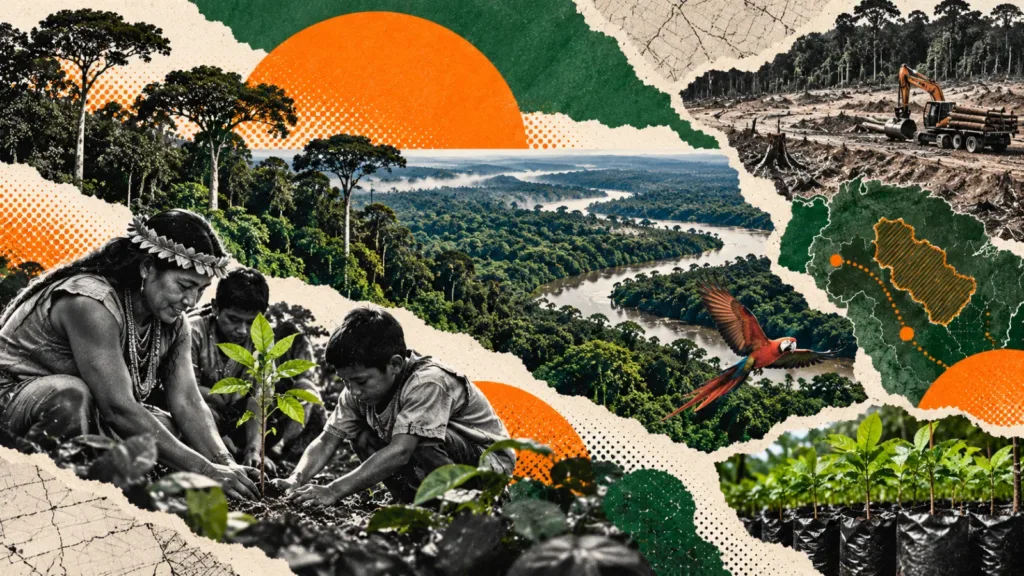
How to stop deforestation is often presented as a matter of planting more trees. Restoration has an important place, but it does not answer why existing forests are being cleared, who profits from that clearing or what happens to people whose lives depend on the land. A seedling planted today cannot replace the ecological complexity of an old forest, and a successful planting campaign cannot offset continuing destruction elsewhere. The most effective response begins before trees are felled: changing the policies, supply chains and economic incentives that make clearing profitable.
The scale remains considerable. The UN Food and Agriculture Organization’s Global Forest Resources Assessment 2025 found that deforestation averaged 10.9 million hectares per year during 2015–2025, down from 17.6 million hectares annually in 1990–2000. This is an improvement over the long term, but still represents vast areas of forest converted to other land uses. Independent satellite analysis provides another lens, and its measures should not be confused with FAO’s estimates. Understanding those differences is essential to deciding which solutions will work.
What This Article Covers
- What deforestation means and how the latest forest measurements differ.
- The role of agriculture, mining, logging and infrastructure in clearing forests.
- Which government, business and community interventions have a credible basis.
- Why Indigenous and local land rights matter to protection.
- How environmental crime and exploitative labor can intersect without being the same offense.
Key Takeaways
- FAO estimates deforestation averaged 10.9 million hectares a year during 2015–2025.
- Agricultural expansion is the leading global driver of deforestation in FAO remote-sensing research covering 2000–2018.
- Deforestation and tree-cover loss are different measures; a forest can suffer damage without permanent land conversion.
- Protecting standing forests requires enforceable land rights, credible monitoring and incentives that favor conservation.
- Reforestation matters, but it cannot substitute for preventing the loss of irreplaceable ecosystems.
First, Be Clear About What Is Being Lost
Deforestation is the conversion of forest into another land use, such as cropland, grazing land, roads or settlements. It is different from temporary tree-cover loss caused by logging or fire when land remains classified as forest and can regrow. The distinction is not pedantic. Figures based on satellite observations of disappearing canopy are often much larger than official estimates of permanent conversion, because they can include harvest cycles, storm damage and fires. Both forms of loss may be ecologically serious, but they answer different questions.
In its 2025 assessment, FAO reported that forests covered 4.14 billion hectares, around 32 percent of the world’s land area. The rate of net forest loss was smaller than gross deforestation because new forest growth and expansion partly offset clearing in the aggregate. That arithmetic does not mean a newly growing forest replaces an ancient tropical forest in ecological value. Forests differ in biodiversity, carbon stores, relationships with local communities and resilience. A net number can hide the loss of places that cannot be recreated on a human timescale.
World Resources Institute’s Global Forest Watch analysis, published in April 2026, found that tropical primary forest loss fell 36 percent in 2025 compared with an exceptionally damaging 2024, while still reaching 4.3 million hectares. Its tree-cover loss data use different definitions and methods from the FAO inventory. The appropriate conclusion is not that one organization is right and the other wrong, but that they are observing overlapping aspects of forest change. Serious reporting should specify the indicator before claiming improvement or deterioration.
The recent Forest Declaration Assessment likewise warned in October 2026 that one better year should not be mistaken for a durable reversal. Forest loss remained far from the path required to halt and reverse deforestation by 2030. This offers a useful warning against interpreting a short decline as permission to relax enforcement or conservation commitments.
Agriculture Is the Central Driver
FAO’s remote-sensing survey for 2000–2018 found agricultural expansion associated with almost 90 percent of global deforestation, with cropland and livestock grazing accounting for most of the conversion. This evidence explains why a credible forest strategy cannot concentrate only on illegal chainsaws. Demand for agricultural land is shaped by domestic food systems and international trade, and the pressure differs among countries, commodities and production methods.
Cropland expansion can clear forests directly when land is converted for crops. Cattle production can drive extensive conversion in some tropical regions. In other settings, small farmers may expand into forests because productive land, credit, secure tenure or alternatives are unavailable. It would be inaccurate to treat every farmer as an environmental criminal. Some clearing is illegal, some occurs under national law, and some reflects policies that reward expansion without accounting for ecological costs. Solutions must distinguish these circumstances rather than make conservation a burden imposed solely on communities with the least negotiating power.
Companies that buy agricultural goods have responsibilities beyond publishing a deforestation pledge. They should know the origins of high-risk commodities, trace sourcing beyond direct suppliers, evaluate land tenure and investigate discrepancies between claimed production and the area from which it could reasonably be sourced. The OECD-FAO guidance on deforestation and agricultural supply chains provides a framework for due diligence. Verification must include local knowledge and mechanisms for responding when harm is identified; a certificate alone does not settle contested land claims.
Consumers can reduce demand for products linked to destructive supply chains, but purchasing decisions are limited by incomplete information. Policy, corporate procurement and land governance shape options upstream. It is misleading to suggest that individuals can solve a system-level problem simply by changing one shopping habit while the market continues to reward forest conversion.
Land Rights and the People Who Depend on Forests
Forests are not empty landscapes waiting to be allocated to whichever use produces the greatest short-term revenue. They can be places of livelihood, culture, food production and ecological stewardship. Indigenous peoples and local communities often possess detailed knowledge of ecosystems and depend directly on their continued health. Conservation that excludes residents from decisions about their own land risks causing new injustices even where environmental intentions are sincere.
Secure land rights can create a stronger basis for resisting land grabbing and destructive activities, but formal recognition alone is not enough. Communities may need access to justice, conflict resolution, adequate finance and enforcement when powerful interests disregard their claims. Restrictions designed to protect a forest should not criminalize longstanding sustainable use without due process. The right approach recognizes both ecological goals and the rights of people whose lives are bound to the land.
Community-led enterprises can help make standing forests economically valuable without destroying them. Sustainable harvesting of certain forest products, compatible agroforestry and locally managed tourism or restoration may provide income where markets, environmental safeguards and community ownership are appropriate. These ventures can fail if producers capture too little value, buyers are unreliable or intermediaries impose debt. The economic structure matters at least as much as the environmental branding.
Not For Sale’s work in Peru offers a relevant example. The organization describes its partnership with Indigenous communities and the AFIMAD cooperative around Brazil nut livelihoods and the wider REBBL supply chain. Its stated goal is to support economic alternatives compatible with forest protection in the Madre de Dios region. This is a promising model to examine, not a universal formula or proof that every participant would otherwise have entered illegal mining. What matters is whether community members retain meaningful choice, benefit from the value chain and can sustain livelihoods over time.
Illegal Mining, Logging and Organized Crime
Deforestation may also be connected to illegal mining, timber trafficking and corruption. Enforcement is challenging when activities are carried out in remote areas, land titles are disputed or proceeds are routed through layers of apparently legitimate businesses. Environmental offenses can require investigators to follow permits, financial relationships, transport networks and ownership records as carefully as they inspect cleared land.
In October 2026, INTERPOL reported that its Operation Madre Tierra VIII across nine countries in Latin America and the Caribbean led to 233 arrests and identified 60,000 hectares of illegally cleared forest. The announcement also described seizures connected to wildlife trafficking and mining. These figures document an enforcement operation; they are not a measurement of all regional environmental crime, and arrests do not imply convictions. Nevertheless, they demonstrate why environmental protection requires cooperation across borders and agencies.
Illegal extraction and human exploitation can intersect. Workers may be recruited through debt, threats or deception into remote operations; pollution and land loss can undermine local incomes, which may in turn increase vulnerability to exploitative recruitment. But environmental crime is not automatically human trafficking, and a person working in mining is not automatically coerced. Each alleged link requires evidence about employment conditions and legal elements, alongside evidence of ecological damage.
The word ‘ecocide’ is also used in different ways, including campaigns for international legal recognition of severe environmental destruction. It is not a universal legal synonym for deforestation, and its legal status varies by jurisdiction. Responsible reporting should distinguish existing environmental offenses from political arguments about extending criminal law.
Why Planting Trees Is Not a Complete Solution
Forest restoration can return shade, improve habitat, stabilize soil and help recover ecological functions. Yet a plantation of a single fast-growing species may offer far less biodiversity than a naturally regenerating forest. Planting in the wrong location can damage grasslands or strain water supplies. Projects also fail when seedlings are not maintained, local people are excluded or land tenure remains unresolved.
The first question should be whether intact forest can be protected. Preventing destruction usually avoids losses that restoration cannot easily reverse. Where planting is suitable, native species, ecological design, local stewardship and survival monitoring matter more than one-day planting totals. Restoration programs should report hectares, species, survival over time and community benefits rather than simply count seedlings put into the ground.
Financial claims require equal care. Carbon projects and offset programs should not be assumed to deliver permanent climate benefits simply because credits are sold. Questions about additionality, leakage, permanence and rights deserve scrutiny. A company should not use a forest project to excuse preventable emissions or harmful sourcing elsewhere.
Climate change adds pressure through heat, drought and more severe fire conditions in some regions. Forest policy therefore needs both mitigation and adaptation, including fire management appropriate to local ecosystems. A forest saved from conversion may still face serious degradation if land management ignores changing climate risks.
What Actually Needs to Change
Stopping deforestation calls for a combination of enforceable land-use rules, credible supply-chain due diligence, transparent public records, community land security, anti-corruption measures and economic support for sustainable livelihoods. The balance differs among regions. Governments must make illegal clearing harder to conceal and less profitable, while recognizing that enforcement without alternative livelihoods can deepen hardship among people who are not directing environmental crime.
Businesses should disclose meaningful sourcing information and respond to identified harms rather than transfer responsibility to the next contractor. Financial institutions can examine the land-use impacts of projects they back. Conservation organizations need to assess whether their programs protect both ecosystems and the rights of residents. Citizens can support credible groups, ask elected representatives for stronger enforcement and reject unsupported claims that any single product or donation has ‘saved the rainforest.’
The best solution is not the one that looks most appealing in a photograph. It is the one that keeps a forest standing, makes the benefits and costs accountable, and gives people whose futures depend on that forest real influence over what happens next.
Frequently Asked Questions
What is the best way to stop deforestation?
There is no single global solution. Protecting land rights, reducing destructive agricultural expansion, enforcing laws and improving supply chains all matter, with solutions tailored to local conditions.
What is the biggest cause of deforestation?
FAO’s research covering 2000–2018 found that agricultural expansion accounted for almost 90 percent of global deforestation, especially cropland and livestock grazing.
How much forest is lost each year?
FAO estimates that deforestation averaged 10.9 million hectares annually over 2015–2025. Satellite tree-cover loss measures a different and often larger category of change.
Does planting trees stop deforestation?
Planting can support restoration when well designed, but it does not prevent existing forests from being cleared and cannot quickly recreate old-growth ecosystems.
Can buying sustainable products help?
Potentially, when sourcing claims are credible and backed by due diligence. Consumer choices work best alongside regulation and responsible corporate purchasing.
Why are Indigenous land rights important?
Secure and enforceable rights can support community stewardship and help resist unauthorized land conversion, while protecting people from exclusionary conservation practices.
Is illegal deforestation the same as ecocide?
No. Deforestation may violate environmental laws; ecocide is a term with distinct and evolving legal and policy uses, not a universal classification for any forest loss.
How can I support forest protection charities?
Examine governance, community participation, land rights and evidence of forest outcomes. Ask whether reported success measures long-term protection rather than trees planted only once.
Sources
- FAO, Global Forest Resources Assessment 2025: https://www.fao.org/newsroom/detail/global-deforestation-slows–but-forests-remain-under-pressure–fao-report-shows/en
- FAO, Agricultural expansion drives almost 90 percent of deforestation: https://www.fao.org/newsroom/detail/cop26-agricultural-expansion-drives-almost-90-percent-of-global-deforestation/
- World Resources Institute, Tropical rainforest loss slowed in 2025: https://gfr.wri.org/latest-analysis-deforestation-trends
- Forest Declaration Assessment 2026: https://forestdeclaration.org/resources/forest-declaration-assessment-2026/
- OECD/FAO, Deforestation and due diligence in agricultural supply chains: https://www.oecd.org/en/publications/2023/07/oecd-fao-business-handbook-on-deforestation-and-due-diligence-in-agricultural-supply-chains_4489399b/full-report/component-5.html
- INTERPOL, Operation Madre Tierra VIII, October 7, 2026: https://www.interpol.int/en/News-and-Events/News/2026/233-arrested-in-environmental-crime-crackdown-in-Latin-America-and-Caribbean
- Not For Sale, Peru: https://wearenotforsale.org/projects/peru/
Not For Sale
A global movement fighting modern-day slavery and ecocide in 33 countries. Building on the frontlines since 2007.