AllSaints and Not For Sale have been partners since September 2011, one of the longest-running corporate partnerships in anti-trafficking history. What began with a T-shirt line whose profits funded Not For Sale’s work has grown into a fifteen-year alliance spanning financial investment, employee engagement on the ground, ethical supply chain commitments, and a shared conviction that a fashion brand’s success should not come at the cost of human dignity.
In 2021, AllSaints marked a decade of partnership with Not For Sale, and pledged another ten years.
How It Started
The partnership was built on a personal connection that became an institutional commitment. Lyndon Lea, founder of Lion Capital, the private equity firm that acquired AllSaints in 2011, was introduced to Not For Sale’s mission and saw an opportunity to connect business and impact at scale. Under his leadership, AllSaints formed a long-term partnership with Not For Sale, integrating anti-trafficking commitment into its corporate identity, not as a marketing campaign but as a structural part of how the brand operates.
In summer 2011, AllSaints launched its first Not For Sale T-shirt line, with all profits going directly to Not For Sale’s global programs. That product was the beginning. Everything since, the field visits, the financial investment, the supply chain reforms, and the second-decade renewal, followed from it.
Where AllSaints’ Support Lands
AllSaints’ partnership has been most deeply felt in two countries: Thailand and Peru, the two programs where AllSaints teams have traveled, volunteered, and witnessed Not For Sale’s work firsthand.
Thailand
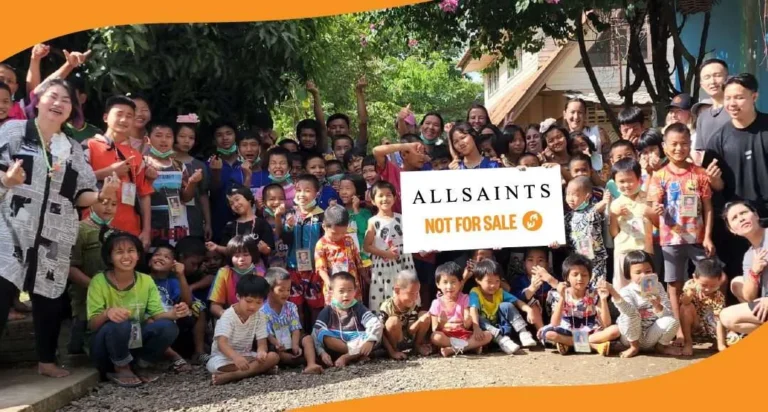
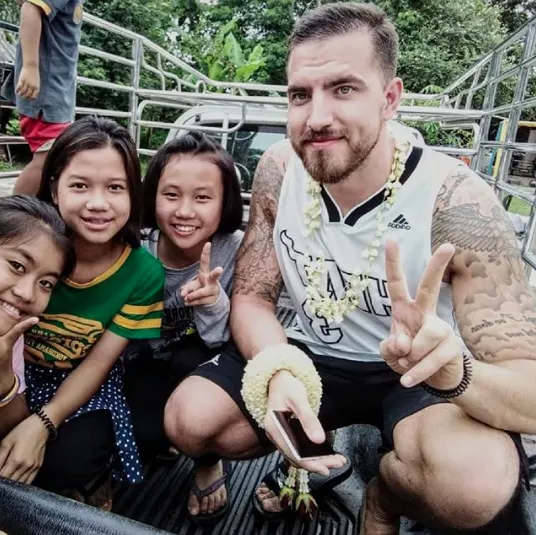
AllSaints employees have visited Not For Sale Thailand three times, in 2016, 2019, and 2022, working alongside the team at Baan Kru Nam, the children’s village in Chiang Rai that provides year-round safe housing, education, and care for up to 150 children at a time. These are children who are stateless, trafficked, or at extreme risk in the Golden Triangle, where the borders of Thailand, Myanmar, and Laos converge and trafficking corridors remain among the most active in the world.
AllSaints’ support has directly contributed to the programs that have reached 13,216 people since 2007: scholarships, housing, border outreach, and education enrollment for children who would otherwise be invisible to the systems meant to protect them. Not For Sale Thailand has been named a “model program” for the border regions by the Thai National Government.
AllSaints’ investment is also helping fund the construction of a new girls’ dormitory at Baan Kru Nam, purpose-built, trauma-informed accommodation for girls entering their teenage years, when vulnerability to sex trafficking increases sharply.
Peru
In 2022, AllSaints employees visited Not For Sale’s Peru program in Madre de Dios, ground zero for the ecocide-slavery nexus. There, they saw firsthand how illegal gold mining traps indigenous communities in debt bondage and forces them to destroy the very rainforest their families depend on.
They also saw the alternative Not For Sale has built: AFIMAD, an indigenous-led cooperative of ten communities that sustainably harvest Brazil nuts under organic (KIWA BCS) and Fair Trade (FLOCERT) certification. The cooperative gives communities ownership of their own supply chain and a direct economic stake in protecting the forest rather than destroying it. AllSaints’ financial support has helped sustain these programs, contributing to the protection of 753 square miles of Amazon rainforest every year and the support of 35,216 people since 2007.
AllSaints has also supported Not For Sale’s work in Romania (2014 visit), where trafficking networks move people into forced labor and sexual servitude across Western Europe.
Financial Investment
Since 2011, AllSaints has raised or donated over £310,000 to Not For Sale. These funds have directly supported Not For Sale’s global programs across twelve countries, providing safe housing, education, vocational training, economic empowerment, and environmental conservation for survivors of modern-day slavery and communities at risk.
On the Ground
This is not a logo-on-a-check partnership. AllSaints employees have traveled to the frontlines of Not For Sale’s work in Thailand (2016, 2019, 2022), Romania (2014), and Peru (2022), engaging directly with the communities the partnership supports. These immersive experiences are not PR exercises, they are the mechanism through which AllSaints’ internal culture stays connected to the human reality behind the numbers, and through which the brand’s commitment to ethical sourcing is reinforced at every level of the organization.
“For nearly 15 years, AllSaints has stood alongside Not For Sale to help protect vulnerable communities in Thailand and Peru. Their consistent support has provided shelter, education, and opportunity, proving that a fashion brand can be a powerful ally in the fight against human trafficking.”
Mark Wexler, CEO & Co-Founder, Not For Sale
Ethical Fashion and Supply Chain Accountability
AllSaints has made ethical sourcing and fair labor practices a corporate priority, maintaining transparent supply chain practices, implementing a strict code of conduct, and publishing annual Modern Slavery Act statements. The partnership with Not For Sale reinforces these commitments with on-the-ground reality: when AllSaints employees visit Baan Kru Nam or walk through Madre de Dios, they see the human cost of supply chains that prioritize cost over accountability, and they return to their work with that knowledge embedded.
What Comes Next
AllSaints and Not For Sale are exploring new ways to deepen the partnership, including a customer-facing donation initiative via Adyen that would give AllSaints shoppers the opportunity to support Not For Sale’s mission at checkout in U.S. stores and on the AllSaints U.S. website. If implemented, this would turn every transaction into a potential contribution to the fight against modern-day slavery and ecocide.
The goal for the next decade is clear: expand the partnership’s reach, deepen its integration into AllSaints’ operations, and continue to demonstrate that a global fashion brand can be more than a passive supporter, it can be an active participant in ending the system that produces both human trafficking and environmental destruction.