Myanmar’s Rare-Earth Mining Boom Exposes the Link Between Forced Labor and Ecocide
A new UN report shows how Myanmar’s expanding rare-earth mining economy is damaging ecosystems while exposing workers and communities to debt bondage, exploitation and forced labor risks.

MAYANMAR
A new United Nations report describes a human rights situation in Myanmar that has reached a “new low,” with illegal rare-earth mining, trafficking and other illicit economies compounding the country’s crisis. Behind the environmental destruction is another layer that deserves closer attention: the people working inside these extractive economies, and the conditions that can leave them trapped in debt, exploitation and forced labor.
The human rights situation in Myanmar has deteriorated to what the United Nations is calling a “new low,” more than five years after the military coup plunged the country into conflict, displacement and economic instability. The latest assessment from the Office of the UN High Commissioner for Human Rights documents continuing violence against civilians and Rohingya communities, but it also turns considerable attention toward another force reshaping the country: the growth of illicit economies built around rare-earth mining, drug production, human trafficking and industrial-scale scam centers.
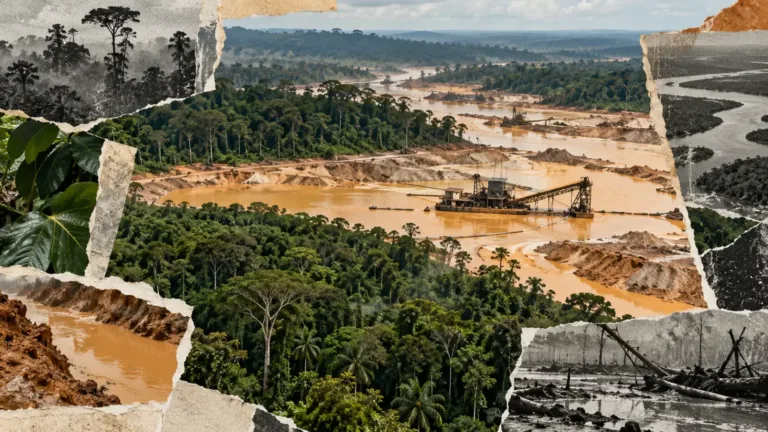
The environmental consequences of that expansion are already difficult to ignore. Mining operations in Myanmar have cleared forests, saturated hillsides with chemicals and contaminated rivers that continue across national borders into northern Thailand. Yet treating this only as an environmental story risks missing an equally important part of what the UN is documenting. The mining economy exists within a wider system of displacement, weak regulation, armed control and precarious work in which people can be pushed into dangerous employment, debt bondage and other forms of exploitation. For Not For Sale, that connection between harm to people and harm to the environment is central to understanding both modern-day slavery and ecocide.
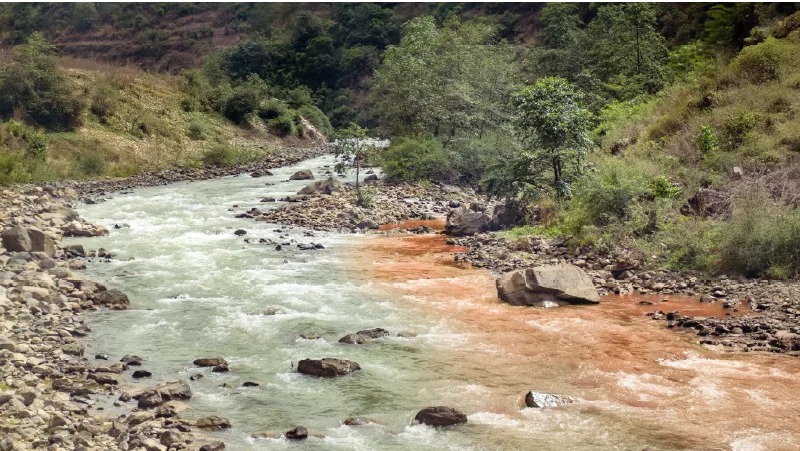
Rare earth mining processing cause pollution in river on southeast asia.
What This Article Covers
This article examines what the new UN findings tell us about the expansion of rare-earth mining in Myanmar, how the industry has become embedded within the country’s wider conflict economy, and why the human rights conditions surrounding extraction deserve as much scrutiny as the pollution it creates. It also looks at the consequences flowing downstream into Thailand, where Not For Sale has worked in the Golden Triangle for nearly two decades, and considers what Myanmar reveals about the wider relationship between environmental destruction, precarious livelihoods, forced labor and trafficking.
Key Takeaways
- The UN says Myanmar’s worsening human rights crisis is increasingly being compounded by illicit economies including rare-earth mining, drug production, human trafficking and scam centers.
- Rare-earth extraction has expanded substantially since the 2021 coup, particularly in Kachin and Shan States, while regulation, independent monitoring and transparency remain extremely limited.
- Researchers and UN reporting have identified dangerous working conditions, debt bondage, labor exploitation and heightened risks of sexual violence around mining areas.
- Chemical contamination from mining in Myanmar has become a cross-border issue, with pollution affecting waterways and livelihoods downstream in northern Thailand.
- The same instability, poverty and loss of viable livelihoods created by conflict and environmental degradation can also increase vulnerability to exploitative recruiters and traffickers.
- Myanmar provides an important example of why forced labor and ecocide should not always be treated as unrelated human rights and environmental stories.
Myanmar’s Human Rights Crisis Is Becoming an Economic System
The latest UN report covers the period from June 1, 2025 to May 31, 2026 and describes a country in which military violence, displacement and economic exploitation are increasingly reinforcing one another. It identifies illegal mining alongside trafficking, drug production and scam centers as part of a growing “conflict economy,” in which lucrative illicit industries can generate income for armed actors and criminal networks while civilians carry much of the cost. AFP’s reporting on the findings notes that rare-earth extraction alone generated trade flows estimated to have reached $1.4 billion at their 2023 peak.
This matters because the mining boom is not occurring within an ordinary, regulated labor market. Parts of Myanmar are fragmented between military control, ethnic armed organizations, militias and other authorities, while years of conflict have displaced communities and destroyed conventional sources of employment. In that environment, the boundaries between a mine, an armed economy and a criminal economy can become much harder to define. The UN has warned that illicit industries are financing conflict and strengthening transnational criminal networks, while previous OHCHR analysis found that mining revenues have also flowed to armed groups through taxation and control over extraction areas.
Not For Sale has explored this wider problem before in its reporting on gray zones across Southeast Asia, where weak governance, corruption, armed control and cross-border criminal networks can allow trafficking, forced labor, illegal extraction and other forms of exploitation to operate alongside apparently legitimate economic activity. Myanmar’s mining regions are another expression of the same underlying problem: where effective oversight disappears, both natural resources and vulnerable people become easier to exploit.
Rare-Earth Mining Has Expanded Rapidly Since the Coup
Rare earths are a group of 17 elements used across some of the world’s most strategically important technologies. High-performance rare-earth magnets are found in electric vehicles, wind turbines, industrial motors, robotics, aerospace and defense applications, while they are becoming increasingly important to AI data centers and other digital infrastructure. According to the International Energy Agency, demand for the four main magnet rare earths has doubled since 2015 and is expected to grow by more than 30 percent again by 2030 under current policy settings.
Myanmar has become an important source within that rapidly expanding market. OHCHR reported earlier this year that satellite analysis in Kachin State alone had identified more than 370 mining sites and 2,795 leaching pits, representing an increase of 194 percent since 2021. Other mining areas have developed across Shan State, including territories where independent monitoring is extremely difficult and environmental governance is weak or effectively absent.
The minerals extracted from these areas feed international supply chains rather than remaining within Myanmar. UN Special Procedures reporting on mining pollution in the Mekong region has described rare earths from operations in eastern Shan State being transported to China for refining and eventual use in products including electric vehicles and wind turbines. That international dimension is important because the human and environmental consequences at the point of extraction can become increasingly difficult to see as raw materials move through traders, processors, manufacturers and eventually into finished products used around the world.
Not For Sale has previously examined this problem in its analysis of human trafficking, environmental destruction and the critical minerals supply chain. The growth of clean energy and advanced technologies makes minerals such as rare earths increasingly important, but the environmental purpose of a final product cannot by itself guarantee that the supply chain behind it is environmentally or socially responsible.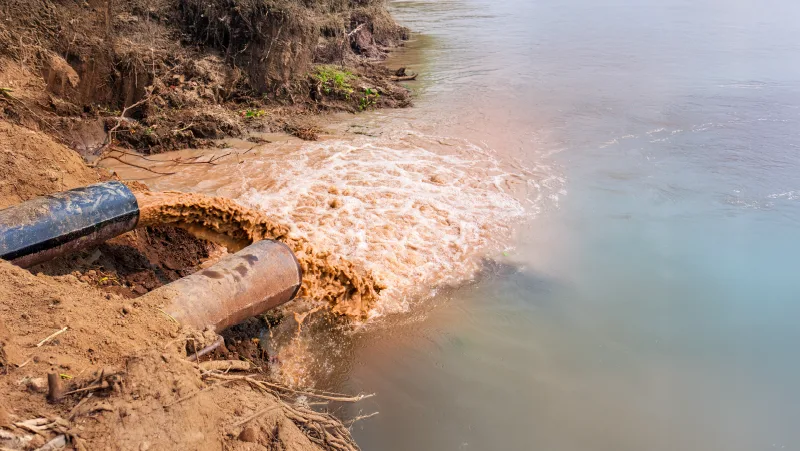
Rare earth mining processing cause pollution in river on southeast asia.
What the Environmental Coverage Can Miss
The pollution created by rare-earth extraction deserves the attention it is receiving. In-situ leaching, a technique widely used in Myanmar, involves drilling networks of holes into mineral-rich hillsides and introducing chemical solutions, commonly involving ammonium compounds, to separate rare-earth elements from the surrounding material. Researchers from the University of Warwick and the Kachinland Research Centre have documented workers carrying out different stages of this process, including drilling, pipe installation, chemical management and the continuous monitoring of leaching systems.
What is less visible from satellite images of stripped hillsides or photographs of contaminated rivers is the labor behind that extraction. The UN and other researchers have described a largely informal workforce operating with few conventional protections and limited ability to challenge employers or authorities. OHCHR reporting published this year described Burmese workers being pushed into high-risk conditions and trapped in debt bondage, while women and girls in mining communities face heightened exposure to sexual exploitation and violence.
This is the part of the story Mark Wexler, co-founder of Not For Sale, believes deserves greater attention. Discussing the new Myanmar reporting, he argued that while the environmental consequences should be covered fully, “the angle on this one is the human rights and the forced labor on the mines.” For Wexler, the significance lies in understanding that the destruction of ecosystems and exploitation of workers are not always separate problems happening coincidentally in the same place. They can be produced by the same underlying economic system.
That distinction matters. It is not accurate to describe every worker in Myanmar’s mining industry as a victim of forced labor, nor does the available evidence support such a sweeping claim. What the evidence does establish is an extractive economy characterized by significant labor abuses, coercive vulnerability and conditions in which exploitation can flourish. Not For Sale’s wider guide to human trafficking and forced labor explains why coercion can take forms that are much less visible than physical confinement, including manipulated debt, withheld wages, threats, dependency and abuse of a worker’s immigration or economic status.
Pollution From Myanmar Does Not Stop at the Border
The environmental consequences of mining are particularly significant because northern Myanmar sits upstream from communities across the Mekong region. Earlier this year, UN Special Rapporteurs raised concerns about “serious, ongoing and inadequately addressed” transboundary environmental and human rights harm linked to mining contamination. Their communications pointed to polluted waterways, threats to drinking water and losses affecting farming, fishing and tourism in areas downstream of extraction sites.
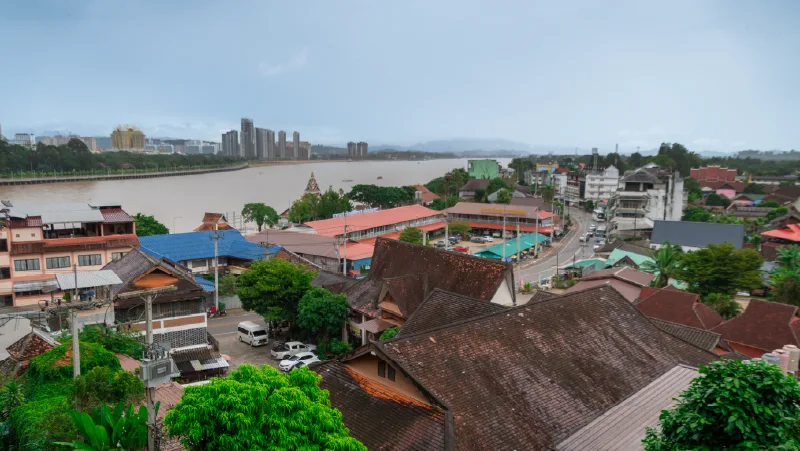
Northern Thailand is already experiencing those consequences. The Kok River flows from Shan State in Myanmar into Thailand, crossing Chiang Rai province before joining the Mekong. Pollution linked to upstream mining has become a growing concern for communities that depend on the river for agriculture, fishing, tourism and everyday water use. The problem is especially difficult to address because the activity producing the contamination may lie beyond the jurisdiction of the people dealing with its consequences downstream.
This is a region Not For Sale knows closely. Its Thailand project operates in the Golden Triangle, where Thailand, Myanmar and Laos converge and where migration, statelessness, trafficking networks and environmental change routinely cross political borders. The organization has also previously reported specifically on illegal mining across the Mekong region and the way polluted waterways and damaged rural livelihoods can deepen vulnerabilities already experienced by communities in northern Thailand.
Wexler describes what is happening in Myanmar and Laos as an “upstream problem” for Thailand, a phrase that captures both the geography and the wider social consequences. A mine may be located in another country, but the water does not recognize the border. Neither do the economic consequences when a family can no longer rely on the land or river that previously sustained it.
When Livelihoods Disappear, Vulnerability Grows
Environmental destruction does not automatically cause human trafficking, and it is important not to simplify that relationship. People affected by polluted rivers, damaged farmland or displacement do not inevitably become trafficking victims. What environmental degradation can do, however, is remove some of the protections that allow people to resist exploitation in the first place.
A family with secure land, reliable crops, access to clean water and a sustainable income has options. When those options begin to disappear, migration can become necessary and informal work can become more attractive. Families may borrow money to survive, workers may rely on brokers to reach jobs elsewhere and young people may accept opportunities that would previously have seemed too risky. Traffickers and exploitative recruiters frequently operate inside precisely these moments of economic pressure, offering work, transport or opportunity to people whose alternatives have narrowed.
This is why Not For Sale’s work on ecocide has increasingly focused on the human consequences of environmental harm. Its broader guide to what ecocide means and how it affects people examines the repeated pattern seen in extractive economies around the world: valuable resources attract poorly regulated or illegal extraction, ecosystems are damaged in the process, workers can be subjected to dangerous or coercive conditions, and the loss of local livelihoods creates new vulnerabilities around the industry itself.
The organization has documented similar patterns beyond Southeast Asia. Its investigation into how corruption connects illegal mining, forced labor and ecocide examines the mechanisms that allow abusive extraction to continue, from weak inspections and forged documentation to bribery, opaque ownership and the laundering of illegally produced minerals into legitimate markets. The geography and commodities may change, but the economic logic can be remarkably consistent.
Scam Centers and Mines Belong to the Same Wider Story
Myanmar’s mining boom also needs to be considered alongside another illicit industry that has expanded rapidly throughout the region: cyber-scam compounds. These operations recruit people from across Asia and beyond with promises of legitimate work before forcing some of them to conduct online investment fraud, romance scams and other forms of digital crime under coercion.
Not For Sale has investigated this system in detail in Myanmar’s Digital Slavery: How Scam Centers Turn Crypto Fraud Into Forced Labor. The importance of that reporting here is not that scam compounds and rare-earth mines are identical businesses, but that both are capable of thriving within the same political and economic environment. They rely on weak oversight, inaccessible territories, cross-border recruitment, financial networks and authorities that are unable or unwilling to protect vulnerable people.
The new UN report places mining, trafficking and scam centers within the same wider conflict economy for precisely this reason. Looking at each only through its immediate output can obscure the system that allows all of them to operate. A scam center produces fraud, a mine produces minerals and a trafficking network moves people, but the underlying structures enabling those industries may overlap through corruption, armed protection, displacement, informal recruitment and the absence of effective legal remedies.
Recognizing those connections changes how the problem should be approached. Anti-trafficking responses cannot focus only on identifying individual traffickers if the economic conditions that continually create vulnerable workers remain untouched. Environmental regulation cannot concentrate solely on chemical contamination while ignoring the people carrying out the extraction. Likewise, responsible sourcing cannot end once a company establishes the geographic origin of a mineral if it knows little about the labor conditions or environmental damage behind its production.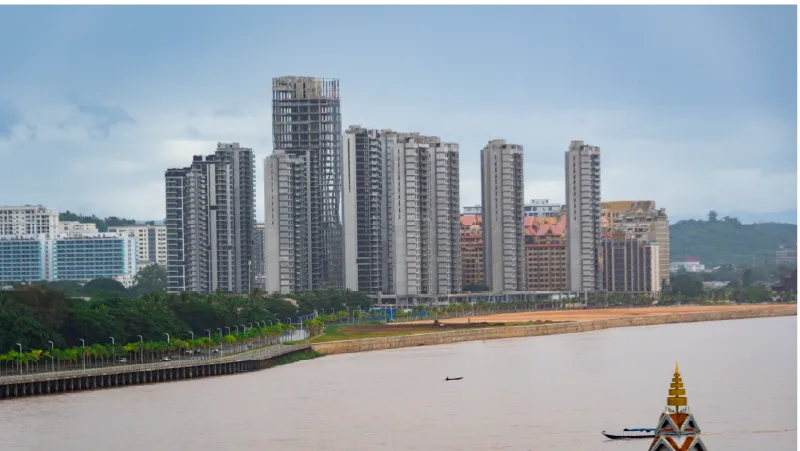
Across the water, scam centers thrive
The Global Demand Behind a Local Crisis
Rare earths are valuable precisely because the world increasingly depends on them. The International Energy Agency expects demand to continue rising as electric vehicles, renewable energy systems, advanced manufacturing, robotics and data infrastructure expand. At the same time, rare-earth supply chains remain highly concentrated, making new sources strategically attractive to governments and industry.
That creates a difficult but necessary question for the energy and technology sectors. A wind turbine or electric vehicle may contribute to reducing fossil-fuel dependence, but that does not automatically make every material inside it responsibly produced. A transition that depends on minerals extracted through severe environmental harm or abusive labor conditions simply moves part of the social and environmental cost further upstream.
The answer is not to reject critical minerals or the technologies that require them. It is to make the origin of those materials harder to ignore. Companies involved in purchasing, financing, processing and manufacturing need credible supply-chain due diligence that examines labor rights, environmental impacts, ownership and the role of armed or criminal actors. Governments need to improve traceability and enforcement while supporting recycling and alternative sources that reduce dependence on destructive primary extraction.
For readers trying to understand why Not For Sale increasingly discusses these issues together, the organization’s work on critical minerals and human trafficking provides the wider context. The smartphone, electric vehicle or energy technology at the end of the chain may appear far removed from a remote mine in Myanmar, but global supply chains connect them.
Why Not For Sale Sees Ecocide and Modern-Day Slavery as Connected
Not For Sale began by confronting human trafficking and modern-day slavery. Nearly two decades of working in communities affected by exploitation have increasingly pushed the organization further upstream, toward the economic and environmental conditions that determine why certain communities become vulnerable in the first place.
Myanmar illustrates that evolution particularly clearly. Illegal or weakly regulated mining damages rivers and farmland, creating environmental harm that moves into neighboring countries. The mining industry itself depends heavily on precarious workers, some of whom are exposed to debt bondage, unsafe working conditions and other forms of exploitation. Meanwhile, communities losing conventional livelihoods exist within the same regional economy as trafficking networks and scam compounds seeking people who can be recruited, coerced or controlled.
Wexler has described this relationship as something Not For Sale needs to make increasingly central to its work and its reporting. In the discussion that led to this article, he argued that some of the people carrying out the world’s most destructive environmental activity are themselves living under forms of bondage or exploitation. That does not mean every environmental crime is driven by forced labor, but it does challenge the assumption that the exploitation of nature and exploitation of people belong in entirely separate conversations.
This is also why Not For Sale’s approach in Thailand has focused not only on protection after trafficking occurs, but on education, safe housing and economic alternatives that make people less dependent on recruiters and exploitative industries. The principle is straightforward: when communities have stable livelihoods and genuine choices, traffickers have less vulnerability to exploit.
What Needs to Change
The situation in Myanmar cannot be solved through consumer behavior alone. Meaningful change requires action from governments, armed authorities, businesses, investors and the countries receiving minerals extracted from the region. The UN has repeatedly called for stronger environmental protections, greater transparency and meaningful human rights due diligence by companies connected to Myanmar’s extractive industries. Special Rapporteurs have also emphasized that businesses linked to mining have responsibilities to prevent and address environmental and human rights harm regardless of weaknesses in national regulation.
There is also a need for the international response to stop compartmentalizing the harm. Investigators examining mining pollution should be equipped to recognize indicators of forced labor and trafficking. Organizations responding to trafficking need to understand how environmental degradation and displacement shape recruitment risk. Companies conducting mineral due diligence need to examine both environmental practices and labor conditions, while governments downstream from pollution require mechanisms for addressing harm that begins outside their borders.
Myanmar’s rare-earth mining crisis demonstrates why this joined-up approach matters. If a river is poisoned but nobody asks who is working at the mine, part of the story is missing. If workers are being exploited but nobody asks what economic system their labor is sustaining, part of the story is missing again. Understanding the entire chain is the first step toward changing it.
A Crisis That Flows Downstream
The warning that Myanmar’s human rights situation has reached a new low should command international attention on its own. Civilians continue to live with conflict, displacement and severe restrictions on their rights, while illicit economies have grown in the spaces created by instability.
The rare-earth mining boom adds another dimension because its consequences do not end where the minerals leave the ground. Chemicals move into streams and rivers, damaged ecosystems weaken traditional livelihoods, minerals move into global markets and workers remain largely invisible inside the process that created them. Those effects can eventually appear hundreds or thousands of miles apart, even though they began within the same economic system.
That is the layer of the story Not For Sale believes deserves greater attention. Illegal mining in Myanmar is an environmental crisis, but the evidence increasingly shows why it must also be understood as a human rights and labor issue. When exploitation of people and exploitation of the planet occur within the same economy, reporting them separately can prevent us from seeing the system responsible for both.
Frequently Asked Questions
What is happening with rare-earth mining in Myanmar?
Rare-earth mining has expanded rapidly in Myanmar since the 2021 military coup, particularly in Kachin and Shan States. The UN has linked that expansion to the country’s broader conflict economy and has raised concerns about environmental destruction, weak oversight, armed actors, labor exploitation and the role of transnational economic networks.
Is forced labor being used in Myanmar’s rare-earth mines?
Evidence supports serious concerns around labor exploitation, debt bondage and coercive conditions within parts of Myanmar’s mining economy. It would be inaccurate to claim that every rare-earth mine uses forced labor or that every worker is trafficked, but UN reporting has documented conditions that place workers at significant risk of coercion and exploitation.
How is rare-earth mining linked to human trafficking?
Mining areas can create conditions in which trafficking becomes easier to conceal, particularly where workers are recruited informally, migration is poorly regulated and armed or criminal actors control access to territory. More broadly, environmental damage and displacement can reduce livelihood options and increase reliance on recruiters or unsafe migration, creating vulnerabilities that traffickers can exploit.
How is mining in Myanmar affecting Thailand?
Mining pollution from Myanmar has become a transboundary issue because rivers originating in mining regions flow into northern Thailand. UN Special Rapporteurs have raised concerns about contamination in the Mekong subregion and its effects on drinking water, agriculture, fishing, tourism and local livelihoods.
Why are rare-earth elements important?
Rare-earth elements are used in high-performance permanent magnets and other technologies found in electric vehicles, wind turbines, industrial machinery, robotics, AI data centers, aerospace equipment and defense systems. Rising global demand has made secure and responsible rare-earth supply chains increasingly important.
What is ecocide?
Ecocide is commonly used to describe severe, widespread or long-term environmental destruction. It is increasingly being discussed as a potential international crime, although it is not currently a standalone crime under the Rome Statute of the International Criminal Court. Not For Sale uses the term more broadly in its reporting to examine how extreme environmental harm affects the people and communities dependent on damaged ecosystems.
Why does Not For Sale connect ecocide with modern-day slavery?
Not For Sale’s work focuses on the conditions that create vulnerability to human trafficking. In some regions, environmental destruction removes livelihoods at the same time that extractive industries create demand for cheap, precarious or coercively controlled labor. Understanding those relationships makes it possible to address some of the conditions producing exploitation rather than responding only after trafficking has occurred.
What can companies do about forced labor in mineral supply chains?
Companies can conduct stronger human rights and environmental due diligence, investigate the origin and ownership of minerals, examine recruitment and working conditions, identify links to armed or criminal actors and ensure that suppliers meet credible labor and environmental standards. Greater traceability, transparency and investment in recycling can also reduce reliance on high-risk extraction.
Sources
This article draws primarily on the August 25, 2026 report from the Office of the UN High Commissioner for Human Rights on the human rights situation in Myanmar and the relationship between violence, rare-earth mining and the country’s conflict economy. Additional environmental evidence comes from 2026 communications by UN Special Procedures concerning transboundary mining contamination across the Mekong region.
Labor and mining-process context is supported by research from the University of Warwick and Kachinland Research Centre into rare-earth mining practices and working conditions in Kachin State. Global supply-chain and demand context is drawn from the International Energy Agency’s 2026 research into rare-earth elements and critical minerals. The original news hook was reported by AFP following publication of the UN findings on August 25, 2026.
Topics in this story
See all topics
Mark Wexler
Mark Wexler is Co-Founder and CEO of Not For Sale and a longtime builder of alternatives to the systems that enable modern-day slavery and ecocide.
More from Mark Wexler