From Illegal Mines to Forced Labor: How Corruption Connects Ecocide and Human Trafficking
How corruption allows illegal mining, forced labor and environmental destruction to enter legitimate global supply chains.

Human trafficking and severe environmental destruction are often treated as separate crimes. In illegal mining and extractive supply chains, corruption can bind them together, protecting those who exploit workers, destroy ecosystems and move illicit minerals into legitimate global markets.
The relationship between corruption, human trafficking and ecocide is not incidental. Corruption can determine who receives a mining concession, which environmental rules are enforced, whether labor inspections occur, how minerals cross borders and whether criminal proceeds enter the legitimate economy.
A mine does not need to be hidden to operate illegally. Permits can be forged. Officials can be bribed. Production figures can be manipulated. Gold from an unauthorized site can be mixed with lawful supplies, refined and sold into international markets with its origin obscured.
The same system can conceal forced labor, child labor, trafficking, sexual exploitation and displacement. It can also protect environmental destruction severe enough to contaminate rivers, clear forests and undermine the ability of communities to remain on their land.
In 2025, the United Nations Office on Drugs and Crime warned that growing demand for minerals was amplifying risks of crime, corruption and instability. Its research found that actors involved in illegal mining and mineral trafficking use fraud, corruption and money laundering to obtain concessions, avoid enforcement and introduce illegally sourced materials into legitimate markets. Local populations may experience forced labor, sexual exploitation or displacement as a result.
The central issue is therefore not only what is being extracted. It is the system that makes exploitation profitable and accountability avoidable.
What This Article Covers
- How corruption enables illegal mining, environmental destruction and labor exploitation.
- How illicit minerals are moved from unauthorized mines into legal global supply chains.
- The relationship between illegal mining, forced labor, child labor and human trafficking.
- Why environmental destruction can increase displacement and exploitation risk.
- How gold, cobalt and other mineral supply chains illustrate different parts of the problem.
- What governments, investigators and companies are doing to improve accountability.
- What must change if the world is to obtain minerals without sacrificing people and ecosystems.
Key Takeaways
- Corruption can enable both human trafficking and environmental crime by weakening licensing, inspections, policing, customs and judicial accountability.
- Illegal mining is associated with deforestation, water contamination, soil erosion, money laundering, organized crime and serious labor abuses.
- Not every instance of child labor, informal mining or poor working conditions legally constitutes human trafficking. Trafficking requires specific elements of recruitment, coercion, deception, abuse of vulnerability or exploitation.
- Illegally mined minerals can be mixed with lawful production and laundered through traders, exporters, refiners and shell companies.
- Gold is particularly attractive to criminal networks because it is valuable, portable, difficult to trace after refining and readily exchanged.
- Demand for critical minerals could deepen existing corruption, labor and environmental risks unless supply-chain governance improves.
- Effective prevention must combine anti-corruption enforcement, labor protection, environmental accountability, transparent ownership and viable livelihoods for mining communities.
Why This Story Matters Now
The transition toward renewable energy, electric transport, digital infrastructure and battery storage is increasing demand for a wide range of minerals. The OECD warns that mineral supply for clean-energy technologies may need to quadruple by 2040. It also cautions that, without responsible management, the rush for transition minerals could worsen conflict, corruption, human rights abuses and environmental damage.
Gold presents a related but distinct problem. It remains a major store of value and a highly liquid international commodity. UNODC found that organized crime groups have embedded themselves in gold supply chains because of the metal’s profitability and rising value. In parts of Latin America, drug-trafficking organizations have expanded into illegal gold mining using routes and infrastructure already developed for narcotics. In several African contexts, gold revenues have been used to finance armed activity or deepen conflict.
The enforcement response is becoming increasingly international. In January 2026, police and prosecutors from Brazil, French Guiana, Guyana and Suriname conducted their first joint transnational operation against illegal gold mining. More than 24,500 checks led to 198 arrests, while authorities seized gold, mercury, cash, firearms and drugs. The operation included arrests connected to alleged gold smuggling and money laundering.
These interventions matter, but raids alone cannot dismantle the economy surrounding illegal extraction. Criminal operations may involve landowners, financiers, transporters, exporters, corrupt officials, complicit companies and international buyers. Removing workers or equipment from one site may simply move extraction elsewhere unless the money, ownership and protection behind it are addressed.
The Background
What is illegal mining?
Illegal mining includes mineral extraction that violates national law. This may involve operating without a valid license, entering protected or Indigenous territory without authorization, breaching environmental requirements, using prohibited chemicals, evading taxes, falsifying production records or transporting minerals through unauthorized channels.
Illegal mining should not be treated as synonymous with all artisanal and small-scale mining. Millions of people depend on small-scale mining for their livelihoods, often because few viable alternatives exist. Some operations are lawful and organized through permits or cooperatives. Others remain informal because regulatory systems are inaccessible, expensive, inconsistent or poorly adapted to local conditions.
Criminal organizations can exploit this informality. They may control access to land, equipment, finance, mercury, transport or buyers. In some regions, miners work independently but are forced to sell through criminally controlled networks. Elsewhere, organized groups directly control sites and workers.
INTERPOL states that illegal mining drives deforestation, soil erosion and water pollution while providing criminal groups with opportunities to establish territorial control and exploit people dependent on local resources. It also links illegal mining revenues to corruption, armed conflict, human trafficking, forced labor and global money laundering.
What is forced labor?
The International Labour Organization defines forced labor as work or service exacted under the threat of a penalty and not offered voluntarily. Threats may include violence, debt, dismissal without payment, document confiscation, denunciation to immigration authorities or harm to family members.
The ILO estimates that 27.6 million people are in forced labor worldwide. Migrant workers face approximately three times the risk experienced by non-migrant workers, while forced labor in all sectors generates an estimated $236 billion in illegal profits each year.
Poor conditions alone do not automatically amount to forced labor. The relevant questions include whether a worker entered freely, can leave safely, receives the agreed payment and faces threats or penalties for refusing the work.
When does mining exploitation become human trafficking?
Human trafficking occurs when a person is recruited, transported, transferred, harbored or received through prohibited means such as force, fraud, coercion or abuse of vulnerability for the purpose of exploitation.
In mining areas, trafficking may involve deceptive recruitment, transportation to remote sites, debt imposed for travel or tools, confinement, withheld wages or threats that prevent workers from leaving. Children may be moved into mines for forced labor. Women and girls may also be trafficked into sexual exploitation in settlements that grow around extraction sites.
Child labor must be described carefully. Not every child working constitutes a trafficking victim, although hazardous mining is among the worst forms of child labor. Trafficking is present when the legal elements of movement, recruitment or control for exploitation are established.
What does ecocide mean?
Ecocide is commonly used to describe severe and extensive destruction of the natural environment. It has been proposed as a new international crime, but it is not currently a separate offense under the Rome Statute of the International Criminal Court. UNEP described the proposed international definition in 2021 as part of a wider movement toward stronger environmental law.
In 2025, the ICC Office of the Prosecutor adopted a policy explaining how environmental damage may be addressed through crimes already within the Court’s jurisdiction. This does not mean that ecocide has become a fifth Rome Statute crime.
For this article, ecocide is used as a framework for understanding grave environmental harm. It should not be read as a legal conclusion that every illegal mining operation meets a settled criminal definition.
What Is Happening
The journey from an illegal mine to a legal product can involve several layers of concealment.
At the extraction stage, operators may bribe officials to obtain concessions, enter restricted land or prevent inspections. Environmental assessments can be falsified or ignored. Workers may remain unregistered, making injuries, deaths and labor abuses easier to conceal.
At the trading stage, minerals can be accompanied by forged permits or documents that misstate their place of origin. Production from an illegal site may be declared as coming from an authorized mine. Gold may be purchased through informal intermediaries and mixed with legally produced material.
At the export stage, quantities, values or classifications can be manipulated to evade taxes and customs controls. Shell companies and nominee owners can conceal the people who control trading or exporting businesses. Once gold is melted and refined, identifying its original mine becomes substantially more difficult.
UNODC found that illegal actors and otherwise legitimate businesses can exploit regulatory loopholes, bribe officials, forge permits and use money laundering to bring illegal minerals into lawful markets. It also found that similar methods allow illegally logged timber to enter legitimate supply chains through fraudulent documentation, bribery and complicit businesses.
The role of gray zones
Many illegal mines operate in what can be understood as gray zones: places where state authority, legal jurisdiction or enforcement is weak, contested or compromised.
A gray zone may be a remote border region, conflict-affected territory, protected forest or area where several authorities claim responsibility but none provides effective oversight. Legitimate businesses, informal economies, armed groups, political interests and criminal networks may coexist.
Not all weakly governed areas are corrupt, and an absence of enforcement does not by itself prove official complicity. However, ambiguity can create favorable conditions for criminal actors. It can make it easier to move workers, minerals, chemicals and money while making it harder for communities to identify which institution is responsible for protecting them.
How Corruption Connects Illegal Mining to Human Trafficking
Corruption does more than conceal exploitation after it occurs. It can make the exploitation possible.
A trafficker may rely on border officials to ignore irregular movement, local authorities to overlook a remote camp or police to return workers who attempt to leave. Mine operators may evade labor inspections or pay intermediaries who recruit workers through deception.
Corruption can also distort the local economy. When criminal networks control mining rights, transport and purchasing, workers may have no safe or lawful market through which to sell what they produce. Debt and dependency can deepen, particularly where employers also control accommodation, food, tools and transport.
The United States Department of Labor has identified forced mining of gold, tin, tantalum and tungsten among the worst forms of child labor in the Democratic Republic of the Congo. It also reports that children are involved in dangerous cobalt and copper mining. These findings do not mean all Congolese minerals are produced through exploitation, but they demonstrate documented risks in parts of the sector.
A detailed study commissioned by the Department of Labor found forced labor to be widely present among adult cobalt miners surveyed in the DRC. The study examined indicators including involuntary work and menace of penalty, while emphasizing the need to distinguish individual indicators from the complete legal definition. It also found that many respondents worked at sites where children were reported to be present, particularly in artisanal and small-scale mining.
The United States government’s 2025 trafficking assessments also report children being exploited in forced labor in artisanal gold mining in Mali and Burkina Faso, and in illegal gold mining in Gabon. Such country reports are evidence of identified patterns and risks, not proof that every mining site or trader in those countries participates in trafficking.
Sexual exploitation around mining economies
Mining operations can attract rapid population movement into remote areas where housing, policing, health services and worker protections are limited. Informal settlements, bars, transport businesses and commercial sex markets may develop around extraction sites.
UNODC’s 2025 minerals research found that local populations in illegal gold-mining regions may face sexual exploitation alongside forced labor and displacement. The risk is particularly serious where armed actors or criminal groups control territory and where women and girls have limited access to documentation, income or safe reporting mechanisms.
Responsible reporting should avoid presenting every woman in a mining settlement as exploited or every commercial-sex arrangement as trafficking. Trafficking requires coercion, deception, force or the exploitation of a child. The surrounding conditions, however, can make such abuse harder to detect and easier for those in power to conceal.
How Corruption Connects Illegal Mining to Ecocide
Mining changes land. Even properly regulated operations can create major environmental impacts requiring assessment, mitigation and long-term remediation. Illegal mining removes many of those safeguards.
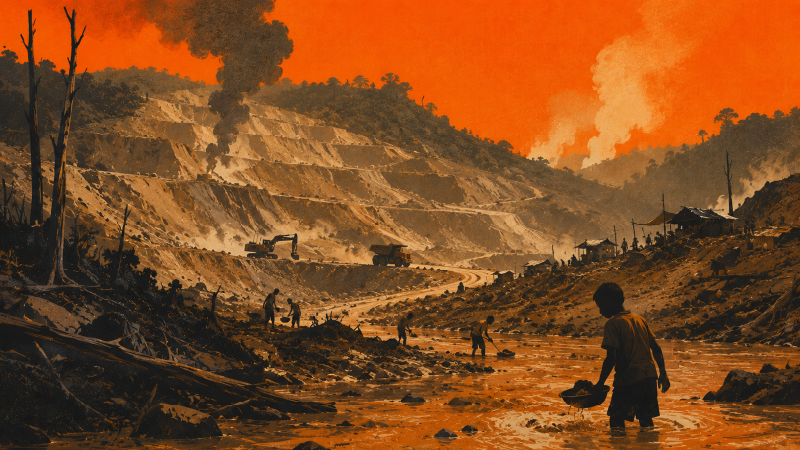
Forests may be cleared to expose deposits, build roads or establish camps. Riverbeds can be dredged. Tailings and sediment can alter waterways. Mercury and cyanide used in gold extraction can contaminate water, soil and food chains.
The OECD’s environmental due-diligence handbook identifies impacts across extraction, processing, smelting, refining and recycling. It calls on companies to identify, prevent, mitigate and remedy environmental harm throughout their mineral supply chains rather than treating responsibility as ending at the point of purchase.
In artisanal and small-scale gold mining, mercury is used because it binds with gold and allows extraction with relatively simple equipment. The resulting amalgam is heated, releasing mercury. Exposure can harm miners, their families and communities, while contamination can travel through air, rivers and food systems.
UNEP estimates that artisanal and small-scale gold mining supports the livelihoods of close to 20 million people across more than 80 countries, including millions of women. The challenge is therefore not solved by treating every miner as a criminal or closing informal sites without providing alternatives. Formalization, safer technology, access to lawful markets and community participation are central to reducing harm.
Illegal gold in the Amazon
The Amazon shows how environmental crime, corruption and organized crime can reinforce one another.
Illegal mining has entered protected forests and Indigenous territories, causing deforestation and river contamination. UNODC has identified Brazil’s Munduruku Indigenous Land as one of the territories heavily affected by illegal mining and has supported territorial surveillance and community responses there.
INTERPOL reports that criminals may melt and refine illegal gold, then claim it originated from a legitimate source. Brazilian investigators have developed forensic techniques that compare impurities and physical characteristics in seized gold to help identify where it was mined.
This is an important point. Traceability is not only a paperwork exercise. Where documents can be purchased, forged or manipulated, investigators may need financial intelligence, satellite imagery, geological evidence and beneficial-ownership data to test whether the declared origin is credible.
Who Is Most at Risk
Artisanal and informal miners
Many miners work outside formal systems because they lack access to licenses, finance, equipment and legal buyers. Their informal status can make them vulnerable to extortion, arbitrary enforcement and exploitative intermediaries.
Formalization should provide rights, safety and market access. It should not simply introduce fees and administrative requirements that push already marginalized workers further underground.
Children
Children may enter mining because of household poverty, school costs, displacement or a shortage of adult employment. They may carry heavy loads, sort ore, enter unstable tunnels or handle toxic substances.
Child labor must be addressed through education, social protection, decent adult employment and remediation, not only by removing children from a worksite. Without changes to household income and community services, a child may move into another dangerous form of work.
Migrant and displaced workers
Mining regions often attract workers who have traveled far from home. Migrants may lack local language skills, documentation, family support or knowledge of their rights. The ILO estimates that migrant workers face three times the forced-labor risk of non-migrants across the global economy.
Conflict and environmental destruction can increase this vulnerability. People who have lost land, livelihoods or security may accept work through recruiters they would otherwise distrust.
Indigenous peoples and forest communities
Illegal mining frequently targets remote territories whose inhabitants depend directly on forests, rivers and land. Environmental damage can affect food, water, health, cultural practice and the ability of communities to remain in place.
Communities may also face threats for opposing extraction. Their knowledge is essential to identifying unauthorized activity, but reporting can expose leaders and environmental defenders to retaliation.
Women and girls
Women may work as miners, processors, traders, food providers and business owners. Their contribution is often overlooked in mining policy. They may also face discriminatory access to licenses, finance and safer equipment.
Women and girls can experience distinct risks, including sexual exploitation, exclusion from decision-making, exposure to mercury during processing and unpaid work supporting mining households.
The Systems Behind the Harm
The most visible offender may be the person digging illegally, but the system often extends far beyond the mine.
Global demand
Consumer electronics, jewelry, vehicles, energy technology and financial markets create demand for minerals. The final buyer may be several transactions and countries removed from the original site.
This distance can create plausible deniability. Companies may know the refiner but not the mine. Refiners may rely on documents supplied by traders. Traders may aggregate material from numerous sources.
Opaque company ownership
Anonymous companies can hide conflicts of interest, political relationships and the real beneficiaries of mining licenses. The Extractive Industries Transparency Initiative identifies beneficial-ownership disclosure as one of the most effective tools for preventing corruption in extractive industries.
In 2025, EITI countries expanded ownership disclosures and began using the data to examine licensing, suspicious transactions and irregular financial flows. Progress remains uneven, and published information is useful only when it is accurate, verified and connected to enforcement.
Weak traceability
Minerals can pass through many intermediaries before reaching a smelter or refiner. Each transaction creates an opportunity to obscure origin, blend legal and illegal material or change documentation.
The OECD identifies smelters and refiners as important control points because minerals from numerous upstream sources converge there. Downstream businesses cannot rely solely on supplier assurances. They must assess risk, investigate red flags and account publicly for how impacts are addressed.
Fragmented enforcement
Environmental agencies may inspect pollution while labor authorities investigate workers and financial-intelligence units examine money laundering. Customs, police, mining ministries and anti-corruption bodies may hold different parts of the evidence.
Criminal networks benefit when those institutions do not share information. A labor inspection may find undocumented workers but miss the company’s ownership. A customs investigation may seize gold without examining trafficking indicators. An environmental raid may destroy equipment without tracing the financiers.
The criminalization of poverty
Enforcement can fail when it concentrates on low-level miners while leaving financiers, officials, exporters and buyers untouched.
Some workers knowingly participate in illegal extraction. Others have few alternative livelihoods or operate under the control of stronger actors. Accountability should distinguish between the people directing and profiting from the system and those whose poverty or coercion is being exploited.
The Human Impact
Environmental destruction and labor exploitation do not occur in separate compartments.
When a river is contaminated, families may lose fish, clean water and agricultural productivity. When forest access is restricted by armed groups or illegal operators, communities may lose food, medicine, transport routes and cultural sites.
The resulting economic pressure can increase migration and debt. Recruiters may then offer work elsewhere, sometimes using deception or coercion. Children may leave school to replace household income. Women may take on additional unpaid care or enter unsafe work.
Workers inside mines face tunnel collapse, dust, heavy loads, toxic substances and inadequate protective equipment. Those suffering coercion may also be denied wages, threatened or prevented from leaving.
Governments lose tax and royalty income when production is concealed or exported illegally. That lost revenue could otherwise support schools, health systems, environmental remediation and labor enforcement.
Corruption therefore creates more than financial loss. It redistributes risk. Criminal actors and protected businesses retain the profit, while workers and communities absorb the injury, pollution and instability.
What Governments and Institutions Are Doing
Cross-border law enforcement
INTERPOL supports operations against illegal mining, smuggling, money laundering and associated crimes. Its January 2026 South American operation demonstrated the value of coordination between countries sharing forest, river and mineral systems.
UNODC’s AURUM project in Brazil supports institutional responses to illegal gold mining and mercury trafficking in the Amazon. Its work includes law-enforcement coordination, Indigenous territorial protection and improved care for communities affected by mercury exposure.
Mineral supply-chain due diligence
The OECD provides a five-step framework for companies sourcing minerals from conflict-affected and high-risk areas. It expects companies to establish management systems, identify risks, respond to them, arrange independent audits at key points and report publicly.
The European Union’s Conflict Minerals Regulation has applied since January 2021. It requires covered EU importers of tin, tantalum, tungsten and gold to conduct due diligence intended to prevent their sourcing from financing conflict, forced labor and related abuses. The European Commission began a formal review process for the regulation in 2026.
The United States’ conflict-minerals disclosure rule requires certain publicly traded companies to examine whether tin, tantalum, tungsten or gold necessary to their products originated in the DRC or an adjoining country and to report on their due diligence.
These rules have improved attention to sourcing, but their scope is limited. They do not cover every mineral, company, product or geographic risk. Disclosure also does not guarantee that abuse has been prevented.
Ownership and revenue transparency
The 2023 EITI Standard strengthened requirements addressing corruption risks, licensing, beneficial ownership, contracts and extractive revenues. Its purpose is to make it harder to conceal who benefits from natural-resource extraction and how public income is managed.
Mercury reduction
The Minamata Convention on Mercury requires countries with more than insignificant artisanal and small-scale gold mining to develop national action plans. These plans must include strategies to reduce and, where feasible, eliminate mercury use, end the worst practices and improve regulation and formalization.
What Still Needs to Change
Corruption must be investigated as part of environmental and trafficking cases
Authorities should ask who obtained the license, who owns the trading company, which officials approved the operation and who prevented enforcement. Corruption should not be treated as a separate administrative issue once forced labor or environmental crime has been identified.
Financial investigations must begin earlier
Investigators should follow payments, company ownership, equipment financing, mineral sales and export records from the beginning of a case. Asset freezes and confiscation can be more disruptive to criminal networks than repeated seizures of low-level mining equipment.
Recovered assets should, where the law permits, support survivor compensation, community repair and environmental restoration.
Traceability must extend beyond paperwork
Documents are necessary but insufficient where corruption can produce apparently valid permits. Companies should test information against production capacity, trade volumes, satellite data, ownership records, site assessments and worker testimony.
Companies must examine both labor and environmental harm
A mineral should not be classified as responsible merely because no armed group was identified. Due diligence should examine forced labor, child labor, unsafe recruitment, pollution, land rights, water use, community consent and environmental remediation together.
Artisanal mining communities need viable routes into lawful markets
Blanket withdrawal from high-risk regions can remove responsible buyers and leave workers more dependent on criminal intermediaries. Companies should use risk-based due diligence, improve conditions and disengage only where serious harm cannot be prevented or mitigated.
Formalization should include affordable licensing, safer equipment, cooperative organization, legal buying channels, health services and meaningful participation by workers and communities.
Survivors and affected communities need remedy
Removing a worker from a mine does not repair unpaid wages, injury, debt or lost education. Closing an illegal site does not restore a poisoned river or replace a community’s livelihood.
Remedy must reflect both the human and environmental harm. That can include compensation, medical care, education, legal assistance, land restoration and long-term monitoring.
What Not For Sale’s Perspective Adds
Not For Sale approaches modern-day slavery and ecocide as connected outcomes of systems that prioritize extraction while weakening protection.
In mining regions, prevention cannot begin and end with identifying a trafficker or closing an unauthorized site. It must address the conditions that make exploitation repeatable: corrupt governance, unsafe work, land loss, inaccessible regulation, weak public services and the absence of dignified livelihoods.
To out-create these conditions means building alternatives that are more durable than the criminal economy. These can include community-owned enterprises, responsible cooperatives, regenerative livelihoods, transparent supply chains and systems designed with frontline leaders and affected communities.
This is not an argument against mining communities or the workers whose labor supplies the global economy. It is an argument for an economy in which the value of a mineral cannot depend on hiding what happened to the land and the people who produced it.
What Readers Can Do
Readers can ask jewelry, electronics, automotive and energy companies how they identify the mines, traders, smelters and refiners in their supply chains. A general commitment to ethical sourcing is less useful than clear information about risk assessment, corrective action and remedy.
Investors and procurement teams can examine whether companies disclose beneficial ownership risks, environmental impacts and labor conditions rather than relying only on certifications.
Consumers can extend the life of electronic devices, use reputable repair and recycling services and avoid treating constant replacement as inevitable. Recycling will not remove the need for mining, but it can reduce pressure for primary extraction.
Readers can support survivor-centered anti-trafficking organizations, Indigenous territorial protection, environmental defenders and programs helping artisanal miners enter safer and lawful markets.
Verified information should be shared without portraying entire countries, commodities or communities as criminal. The objective is accountability, not stigma.
An illegal mine begins with a hole in the ground, but it survives through systems built far beyond it.
Someone supplies the equipment. Someone controls the land. Someone purchases the mineral. Someone certifies its origin, transports it across a border, refines it and sells it into the world economy.
At each stage, corruption can convert visible harm into apparently legitimate commerce.
That is how a contaminated river can become a gold bar. It is how coerced labor can disappear inside a battery or electronic device. It is how the destruction of a forest can be separated, on paper, from the company and consumer benefiting from what was taken.
Human trafficking and ecocide are connected not because every mine contains both, but because the same failures of governance can enable each of them. Corruption weakens the boundary between legal and illegal extraction, between voluntary work and coercion, and between commercial development and environmental destruction.
Breaking that connection requires more than cleaner paperwork or occasional raids. It requires transparent ownership, traceable trade, protected workers, enforceable environmental standards and economies in which communities do not have to choose between exploitation and survival.
Frequently Asked Questions
How does corruption cause human trafficking in mining?
Corruption can allow traffickers and mine operators to avoid labor inspections, move workers across borders, retain documents, use fraudulent permits and prevent victims from receiving police or judicial protection. It can also protect businesses that benefit from forced labor.
How is illegal mining connected to human trafficking?
Illegal mining can involve workers recruited through deception, debt, coercion or abuse of vulnerability. Children and adults may be forced to extract or process minerals, while women and girls may be trafficked into sexual exploitation around mining settlements.
Is all artisanal mining illegal?
No. Artisanal and small-scale mining can be legal, informal or illegal depending on national law and licensing. Millions of people rely on it for income. Effective reform should formalize and improve the sector rather than criminalize communities indiscriminately.
Does child labor in a mine always constitute trafficking?
No. Child labor and trafficking are related but legally distinct. Trafficking requires recruitment, movement, transfer, harboring or receipt for exploitation. Hazardous mining can still constitute one of the worst forms of child labor even when trafficking is not established.
What is mineral laundering?
Mineral laundering is the process of concealing the illegal or abusive origin of minerals so they can enter legitimate markets. Methods may include forged permits, false declarations, mixing minerals from different mines, shell companies and corrupt certification.
Why is gold attractive to organized crime?
Gold is valuable, portable and internationally traded. It can be melted, refined and mixed with other supplies, making its original source difficult to identify. It may also be exchanged or used to move value outside conventional banking systems.
How does illegal mining damage the environment?
Illegal mining can cause deforestation, river dredging, soil erosion, habitat destruction and water contamination. Gold mining may also release mercury or cyanide, creating long-term risks for ecosystems and human health.
Is illegal mining ecocide?
Not automatically. Ecocide is not currently a separate crime under the Rome Statute, and there is no single universally applied legal definition. Some mining operations may cause severe or extensive environmental damage, but a legal conclusion depends on the applicable law and evidence.
What are conflict minerals?
Conflict minerals commonly refer to tin, tantalum, tungsten and gold linked to conflict-affected or high-risk areas. Their trade can finance armed groups, corruption, forced labor and other abuses. The term does not mean every mineral from a conflict-affected country is illicit.
How can companies prevent forced labor in mineral supply chains?
Companies should map their supply chains, identify high-risk mines and intermediaries, consult workers and communities, examine recruitment practices, verify ownership, audit key control points and provide remedy when harm is found. Simply asking a direct supplier for assurances is not sufficient.
What is beneficial ownership transparency?
Beneficial ownership transparency reveals the individuals who ultimately own or control a company. It can expose conflicts of interest, hidden political relationships and corruption risks in mining licenses, contracts and commodity trading.
Can consumers avoid all minerals connected to exploitation?
Complete certainty is difficult because modern products contain complex global supply chains. Consumers can choose companies that publish credible due-diligence information, keep products longer, repair and recycle devices and ask businesses how they respond when abuse is identified.
Sources
United Nations Office on Drugs and Crime, Minerals Crime: Illegal Gold Mining, 2025
https://www.unodc.org/documents/data-and-analysis/Crimes%20on%20Environment/ECR25_P2b_Minerals_Crime.pdf
UNODC, Rising Demand for Minerals Heightening Risks of Crime, Corruption and Instability, 2025
https://www.unodc.org/unodc/en/press/releases/2025/May/unodc_-rising-demand-for-minerals-heightening-risks-of-crime–corruption-and-instability.html
UNODC, Forest Crimes: Illegal Deforestation and Logging, 2025
https://www.unodc.org/documents/data-and-analysis/Crimes%20on%20Environment/ECR25_P2a_Deforestation.pdf
INTERPOL, Illegal Mining
https://www.interpol.int/Crimes/Environmental-crime/Illegal-mining
INTERPOL, 198 Arrests in Cross-Border Illegal Gold Mining Operation, 2026
https://www.interpol.int/News-and-Events/News/2026/198-arrests-in-cross-border-illegal-gold-mining-operation-in-South-America
International Labour Organization, Data and Research on Forced Labour
https://www.ilo.org/topics/forced-labour-modern-slavery-and-trafficking-persons/data-and-research-forced-labour
U.S. Department of Labor, Forced Labor in Cobalt Mining in the Democratic Republic of the Congo
https://www.dol.gov/sites/dolgov/files/ILAB/DRC-FL-Cobalt-Report-508.pdf
U.S. Department of Labor, Child Labor in the Democratic Republic of the Congo, 2024 Findings
https://www.dol.gov/agencies/ilab/resources/reports/child-labor/congo-democratic-republic-drc
ILO, How Labour Governance Is Key to Securing Critical Mineral Supply Chains, 2026
https://www.ilo.org/resource/article/how-labour-governance-key-securing-critical-mineral-supply-chains
OECD, Due Diligence Guidance for Responsible Mineral Supply Chains
https://www.oecd.org/en/publications/oecd-due-diligence-guidance-for-responsible-supply-chains-of-minerals-from-conflict-affected-and-high-risk-areas_9789264252479-en.html
OECD, Handbook on Environmental Due Diligence in Mineral Supply Chains
https://www.oecd.org/content/dam/oecd/en/publications/reports/2023/09/handbook-on-environmental-due-diligence-in-mineral-supply-chains_ed05507f/cef843bf-en.pdf
Extractive Industries Transparency Initiative, Progress Report 2025
https://eiti.org/eiti-progress-report-2025
European Commission, Conflict Minerals Regulation Explained
https://policy.trade.ec.europa.eu/development-and-sustainability/conflict-minerals-regulation/regulation-explained_en
U.S. Securities and Exchange Commission, Conflict Minerals Disclosure
https://www.sec.gov/resources-small-businesses/small-business-compliance-guides/conflict-minerals-disclosure
Minamata Convention on Mercury, National Action Plans for Artisanal and Small-Scale Gold Mining
https://minamataconvention.org/en/parties/national-action-plans
World Health Organization, Mercury Exposure and Health Impacts in Artisanal and Small-Scale Gold Mining
https://www.who.int/publications/m/item/mercury-exposure-and-health-impacts-among-individuals-in-the-artisanal-and-small-scale-gold-mining-%28asgm%29-community
UN Environment Programme, How New Laws Could Help Combat the Planetary Crisis
https://www.unep.org/news-and-stories/story/how-new-laws-could-help-combat-planetary-crisis
International Criminal Court, Policy on Addressing Environmental Damage Through the Rome Statute, 2025
https://www.icc-cpi.int/sites/default/files/2025-12/2025-env-eng.pdf
Not For Sale
Related Articles