Spain Wildfire: What We Know About the Deadly Los Gallardos Fire in Almería
A fast-moving wildfire in Almería has killed at least 12 people and forced hundreds to evacuate. Here is what authorities have confirmed and what remains under investigation.

Reporting updated: July 10, 2026, 6:30 p.m. CEST
At least 12 people have died and 23 remain unaccounted for after a fast-moving wildfire swept through communities in Almería province in southern Spain. The fire remains active, hundreds of emergency personnel are working across difficult terrain, and the cause has not been formally established.
What this article covers
This article explains where the Los Gallardos wildfire began, which communities have been affected, what authorities have confirmed about the deaths and injuries, how the emergency response is developing, and why investigators are examining a fallen electricity cable. It also considers the wider environmental context and the relationship between ecological destruction, displacement and vulnerability to human trafficking.
Key facts at a glance
Location: Los Gallardos, Almería province, Andalusia, with Bédar, Lubrín and surrounding rural communities also affected.
Fire began: Thursday, July 9, 2026.
Confirmed deaths: At least 12, in a provisional official count.
People unaccounted for: 23. Authorities have cautioned that this number may include people already evacuated, injured or among those who died.
Injuries: Eight, including four people reported to be seriously injured.
Evacuations: Approximately 1,000 people, although figures have varied as further communities have been cleared.
Area burned: At least 3,200 hectares according to regional reporting. A later estimate based on European wildfire data placed the affected area at approximately 3,800 hectares.
Fire status: Active. Conditions were reportedly improving on the eastern side on Friday afternoon, while the western flank remained a concern because of wind, ravines and inaccessible terrain.
Emergency response: Hundreds of regional firefighters, 32 aircraft, Guardia Civil personnel and approximately 200 members of Spain’s Military Emergencies Unit were involved by Friday afternoon.
Cause: Under investigation. A fallen electrical cable is one line of inquiry, but no company, property owner or individual has been found responsible.
What happened in Los Gallardos?
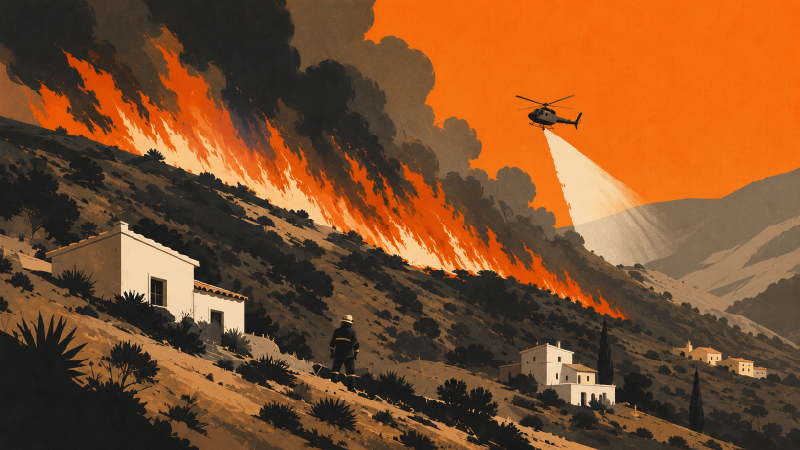
The wildfire began on Thursday in the municipality of Los Gallardos, in the eastern part of Almería province. The area lies inland from the Mediterranean coast, near Mojácar and Garrucha, and includes scattered homes, small villages, agricultural land and steep hills covered in scrub and esparto grass.
Strong winds pushed the fire rapidly through extremely dry vegetation. Andalusian regional president Juan Manuel Moreno said the flames traveled approximately 15 kilometers in two hours, describing it as one of the fastest and most complex fires the region had experienced in recent years.
The terrain made the response more difficult. Heavy vehicles could not reach parts of the fire because of steep slopes, narrow roads and deep ravines. By Friday afternoon, crews were concentrating on stopping the fire from advancing toward cultivated land and the community of El Marchal, where another 50 residents were ordered to leave as a precaution.
Los Gallardos itself has a population of just over 3,000 people. Nearby Bédar is smaller and includes many detached homes spread through rural and wooded areas. That pattern of development created a complicated emergency in which different households faced different instructions. Some were advised to leave by designated routes, while others were told that remaining inside was safer because the fire had already moved too close to roads.
This distinction is important. A shelter-in-place order may appear counterintuitive when flames are visible, but attempting to drive through smoke, falling debris or a moving fire front can be more dangerous than remaining inside a protected building. Instructions can also change quickly as the wind changes direction.
What is known about the people who died?
Regional authorities had confirmed 12 deaths by Friday afternoon. Eight other people were injured, four seriously, and 23 people were still described as unaccounted for. Officials stressed that the list of 23 was not necessarily a separate list of missing victims. It could include people who had reached shelters, were receiving medical treatment, had lost phone contact or were already included in the provisional casualty figures.
Several victims were found in or near vehicles after attempting to leave the affected area. Four bodies were discovered inside one vehicle, while others were found after apparently abandoning their cars and continuing on foot.
Regional emergency chief Antonio Sanz said some people had taken a dry riverbed or another route that was not part of the evacuation plan. He described the route as a trap once the flames changed direction. That account is part of the authorities’ preliminary reconstruction and should not be treated as a complete explanation of the victims’ decisions.
Residents were facing smoke, blocked roads, intermittent communications and a fire moving across the landscape at exceptional speed. Some may have received different instructions at different times. Others may have believed that staying inside was no longer possible. A full assessment will require emergency call records, witness testimony and a detailed reconstruction of when warnings were issued and received.
Many of those affected are believed to be foreign residents. Officials have said the dead may include British and Belgian nationals, but the identities and nationalities of all victims had not been formally established at the time of writing. The presence of a right-hand-drive vehicle led officials to believe four victims might be British, but a vehicle’s configuration alone does not confirm the nationality of its occupants.
DNA testing and other identification work are continuing. Until that process is completed and families have been informed, provisional assumptions about identity should not be reported as confirmed fact.
How large is the emergency response?
The wildfire triggered a major regional and national deployment. By Friday afternoon, reports said 32 aircraft and approximately 271 personnel from INFOCA, Andalusia’s forest-fire service, and other firefighting bodies were involved. Spain’s Military Emergencies Unit had deployed around 200 service members and 70 vehicles. Guardia Civil officers were carrying out evacuations, controlling roads and searching burned properties and surrounding land.
Around 1,000 people had been evacuated, with temporary accommodation established in Los Gallardos, Bédar, Lubrín and other nearby locations. The total has fluctuated as authorities have ordered further precautionary evacuations and reconciled information from separate municipalities.
Four seriously injured patients were transferred by helicopter to Hospital Universitario Virgen del Rocío in Seville. Search teams were also examining homes in areas already crossed by the fire to determine whether anyone remained inside.
The fire remained active on Friday evening. Reports indicated that its eastern side was developing more favorably, but the western sector remained difficult because it was moving through more rugged terrain toward El Marchal. Wind continued to be the main operational concern.
Descriptions such as “controlled,” “contained” or “extinguished” should not be used unless emergency authorities formally change the fire’s classification.
Why was no general mobile-phone alert sent?
The Andalusian authorities have faced questions about why the ES-Alert emergency system was not used to send a general warning to every mobile phone in the wider area.
Moreno and Sanz said a broad alert could have created confusion because the required action was not the same in every location. Some residents needed to evacuate, some were instructed to remain inside, and available escape routes differed between communities. Officials also said the area’s dispersed population and damage to telephone infrastructure complicated communication.
That is the regional government’s explanation. Whether the warning system, local evacuation planning or communication process functioned as effectively as it could have done is likely to become part of the wider review. It is too early to draw a conclusion while the fire is still active and the search for missing residents continues.
What caused the Los Gallardos wildfire?
The cause has not been established.
The Guardia Civil is investigating whether a fallen electricity cable ignited vegetation beside a road. Regional officials have publicly identified that as an early working hypothesis, based partly on initial observations and witness accounts.
That does not establish who owned the cable, whether it was carrying electricity, why it fell or whether it caused the fire. Reuters reported that an Endesa spokesperson disputed the suggestion that an energized company cable was responsible. Other reporting said Endesa and electricity-grid operator Redeia denied ownership of the identified line and said it had not been active for years.
Those statements matter because an unresolved ignition theory can rapidly become an accusation against a company or property owner. At present, there is no official finding of negligence, criminal conduct or legal liability.
Investigators will need to inspect the suspected ignition point, examine electrical equipment, establish ownership and maintenance responsibilities, analyze weather and fire-spread data, and compare physical evidence with witness accounts. Until that process is complete, the incident should be described as a wildfire of undetermined cause.
The immediate role of heat, wind and vegetation
The conditions in Almería on July 9 created an environment in which a small ignition could become a large, fast-moving fire.
AEMET, Spain’s national meteorological agency, had issued a high-temperature warning for parts of Almería, with temperatures of up to 41 degrees Celsius forecast in some areas. Observations from Almería airport also recorded strong wind gusts during the afternoon. Regional officials said winds around the fire reached approximately 50 kilometers per hour.
Winter rainfall had encouraged vegetation growth across parts of the region. That vegetation then dried during the spring and early-summer heat, creating additional fuel. In the affected area, scrub and esparto grass allowed flames to move quickly across open ground before reaching wooded slopes, roads and dispersed homes.
Ignition and fire behavior are different questions. Investigators may eventually establish how the fire began, while meteorologists and fire specialists can explain why it spread with such speed and intensity.
Did climate change cause this fire?
It is not scientifically responsible to say that climate change caused the specific ignition in Los Gallardos.
The cause may ultimately be traced to damaged equipment, an accident, deliberate action or another source. Climate change does not determine whether a particular cable falls or a particular spark reaches vegetation.
It does, however, alter the wider conditions in which fires develop. The Intergovernmental Panel on Climate Change has found that increasing heat waves, drought and land-use change reduce fuel moisture around the Mediterranean, increasing fire risk and extending the duration of fire seasons. It also assesses that human-driven climate change has increased drought severity in the region.
Copernicus reported that June 2026 was western Europe’s hottest June on record and that dry conditions contributed to wildfire activity on the Iberian Peninsula. AEMET also described spring 2026 as Spain’s second-warmest spring in its national series. These conditions do not prove the cause of the Los Gallardos fire, but they form part of the environment in which it spread.
The relationship is therefore best stated carefully: climate change may not have supplied the original spark, but increasingly hot and dry conditions can make Mediterranean landscapes more receptive to ignition and allow some fires to spread faster, burn more intensely and become harder to control.
Is the Los Gallardos wildfire ecocide?
It would be premature to describe this wildfire as ecocide.
Ecocide is not a general synonym for a large fire, flood, industrial accident or other environmental disaster. Legal and proposed definitions normally require evidence of conduct that causes severe and either widespread or long-term environmental damage. Depending on the jurisdiction, questions of unlawfulness, intention, knowledge or serious negligence may also be central.
The European Union’s 2024 Environmental Crime Directive created a category of qualified environmental offenses for intentional conduct that causes destruction or irreversible or long-lasting environmental damage. The directive’s recitals state that such offenses can include conduct comparable to ecocide. That does not mean every severe wildfire is automatically a criminal environmental offense.
For the term to be considered responsibly in relation to Los Gallardos, investigators would first need to determine the cause, whether unlawful conduct occurred, the level of knowledge or culpability involved, and the eventual scale and duration of the environmental harm.
For now, the appropriate description is a deadly wildfire and an unfolding environmental emergency. Using the word ecocide as a settled legal conclusion would go further than the available evidence permits.
Environmental disasters and vulnerability to human trafficking
There is no verified evidence that the Los Gallardos wildfire has caused human trafficking. It is important to state that clearly.
At a broader level, however, environmental disasters can create conditions that traffickers and abusive recruiters seek to exploit. Homes may be lost, businesses may close, wages may disappear and families may become dependent on emergency accommodation or temporary work. Identification documents can be destroyed, community networks disrupted and displaced people approached with offers of transport, housing or employment that are not what they appear to be.
The International Organization for Migration has described climate change as a factor that strains livelihoods, increases displacement and can heighten vulnerability to human trafficking. The United Nations Office on Drugs and Crime likewise identifies natural disasters, climate change, poverty, migration and displacement among the conditions that can enable trafficking.
This does not mean that people displaced by the Almería fire will become victims of human trafficking. Most will receive support from relatives, communities, public services and recognized aid organizations. It does mean that recovery planning should protect people from fraudulent employment, unsafe informal work and individuals attempting to profit from loss or confusion.
The greatest protection is often practical: secure accommodation, replacement documents, accurate information in the languages residents understand, access to legitimate employment and a recovery process that does not leave people isolated.
How this connects to the work of Not For Sale
Not For Sale works to out-create modern-day slavery and ecocide by addressing the systems that allow harm to people and harm to the environment to reinforce each other.
That connection should not be overstated in the context of Spain. Not For Sale has not said it is responding directly to the Los Gallardos fire, and the organization should not be presented as part of the emergency operation unless that changes.
The relevance lies in what happens after environmental destruction. When land, homes and livelihoods disappear, people can face choices shaped by economic pressure rather than genuine freedom. In many of the places where Not For Sale works, environmental damage is connected to unsafe migration, deceptive recruitment, forced labor and human trafficking.
The relationship also operates in the opposite direction. People subjected to forced labor may be made to clear forests, mine protected land, pollute rivers or carry out other environmentally destructive work. Addressing modern-day slavery without addressing the economic systems damaging the environment can leave the original source of vulnerability in place.
Not For Sale’s approach is based on building locally led alternatives, including dignified livelihoods, responsible supply chains, ecological restoration and stronger community resilience. The objective is not to arrive after every disaster with a single solution. It is to help create economic and social conditions in which people are less exposed to coercion when a crisis occurs.
The Los Gallardos fire is first and foremost a human tragedy and an active emergency. The immediate priorities are to protect residents, locate those still unaccounted for, support bereaved families, care for the injured and bring the fire under control. The wider lesson is that environmental protection and human protection cannot always be separated. When an ecosystem is damaged, the consequences move quickly into homes, workplaces and lives.
What happens next?
Firefighters will continue trying to secure the perimeter and prevent the western flank from reaching further communities. Searches will continue across burned homes, roads, ravines and rural properties.
Forensic teams face the difficult task of identifying the dead and giving families reliable information. Authorities will also need to reconcile the list of people who remain unaccounted for with hospital, shelter and evacuation records.
Only after the immediate emergency has eased can a fuller investigation examine the suspected ignition point, ownership and condition of any electrical infrastructure, the evacuation process, the decision not to issue a general mobile alert and the environmental damage.
The casualty count, burned-area estimate and fire status remain subject to change. Information published while the fire is active should therefore be treated as provisional and checked against the latest statements from Spanish emergency authorities.
Frequently asked questions
Where is the wildfire in Spain?
The fire began near Los Gallardos in Almería province, part of Andalusia in southeastern Spain. It has affected rural areas around Los Gallardos, Bédar and Lubrín.
Is the wildfire near Mojácar?
Yes. Los Gallardos is inland from Mojácar and Garrucha. That does not mean every part of the coastal area is directly threatened. Residents and visitors should follow instructions from local authorities rather than rely on regional descriptions.
How many people have died?
At least 12 deaths had been confirmed as of 6:30 p.m. CEST on July 10. The figure is provisional.
How many people are missing?
Authorities said 23 people remained unaccounted for. That total may include some of those who died, were injured or reached shelters without immediately making contact.
Are British nationals among the victims?
Officials believe some victims may be British, but formal identification was still underway. Nationality should not be treated as confirmed until the relevant authorities and families have been notified.
Is the fire under control?
No. It remained active on Friday evening. The eastern side was reportedly developing more favorably, while the western flank continued to cause concern.
What caused the fire?
The cause remains under investigation. A fallen electricity cable is one line of inquiry, but electricity companies have disputed responsibility for the line described in early reports. No legal responsibility has been established.
Did climate change cause the wildfire?
Climate change cannot currently be identified as the cause of the ignition. Scientific evidence shows that rising temperatures, drought and drier vegetation are increasing wildfire risk and worsening fire-weather conditions across the Mediterranean.
Is the fire an example of ecocide?
It cannot responsibly be classified as ecocide on the available evidence. That would require findings about the cause, conduct involved, legal responsibility and severity and duration of the environmental damage.
Has this wildfire caused human trafficking?
There is no verified evidence that it has. Environmental disasters can increase vulnerability to fraudulent recruitment, unsafe work and human trafficking, but risk should not be confused with evidence that trafficking is occurring.
Sources and further reading
All sources were accessed on July 10, 2026. Because this is a developing story, casualty figures, evacuation totals and fire status should be checked again immediately before publication.
Breaking news and official developments
Reuters, “Twelve killed, 23 missing in one of Spain’s deadliest wildfires”
https://www.reuters.com/business/environment/wildfires-southern-spain-kill-12-emergency-agency-says-2026-07-10/
Reuters, “Spanish wildfire victims burned in cars as roads turned into death traps”
https://www.reuters.com/business/environment/spanish-wildfire-victims-burned-cars-roads-turned-into-death-traps-2026-07-10/
Associated Press, “Spain’s deadly wildfires in Almeria claim 12 lives amid heat wave”
https://apnews.com/article/spain-wildfire-almeria-760ecfff1316d56837888de4ab9efa21
EFE, “El incendio de Almería deja doce personas fallecidas”
https://efe.com/espana/2026-07-10/incendio-los-gallardos-almeria/
El País, live coverage of the Los Gallardos wildfire
https://elpais.com/espana/2026-07-10/ultimas-noticias-del-incendio-forestal-de-los-gallardos-almeria-en-directo.html
El País, “La Guardia Civil investiga la caída de un cable eléctrico”
https://elpais.com/espana/2026-07-10/la-guardia-civil-investiga-la-caida-de-un-cable-como-desencadenante-del-incendio-en-los-gallardos.html
elDiario.es, live coverage and evacuation figures
https://www.eldiario.es/andalucia/ultima-hora-incendio-gallardos-ume-suma-trabajos-fuego_133_13370167.html
RTVE, live coverage of the Almería wildfire
https://www.rtve.es/noticias/20260710/incendio-almeria-directo-ultima-hora-resumen/17151086.shtml
Weather, wildfire and climate sources
AEMET, forest-fire danger forecasts
https://www.aemet.es/es/eltiempo/prediccion/incendios
AEMET, weather warnings for Almería
https://www.aemet.es/es/eltiempo/prediccion/avisos?k=and&p=04
AEMET, spring 2026 climate summary
https://www.aemet.es/es/noticias/2026/06/resumen_primavera2026
Copernicus, June 2026 heat and drought conditions
https://climate.copernicus.eu/copernicus-record-heatwave-brings-hottest-june-western-europe-during-second-warmest-june-globally
European Forest Fire Information System, seasonal burned-area statistics
https://effis.jrc.ec.europa.eu/apps/effis.statistics/seasonaltrend
Intergovernmental Panel on Climate Change, Mediterranean region assessment
https://www.ipcc.ch/report/ar6/wg2/chapter/ccp4/
Intergovernmental Panel on Climate Change, Europe assessment
https://www.ipcc.ch/report/ar6/wg2/chapter/chapter-13/
Ecocide and environmental law
Council of the European Union, Environmental Crime Directive overview
https://www.consilium.europa.eu/en/press/press-releases/2024/03/26/environmental-crime-council-clears-new-eu-law-with-tougher-sanctions-and-extended-list-of-offences/
Directive (EU) 2024/1203 on the protection of the environment through criminal law
https://eur-lex.europa.eu/legal-content/EN/TXT/PDF/?uri=CELEX:32024L1203
Human trafficking, displacement and climate vulnerability
International Organization for Migration, “The Climate Change–Human Trafficking Nexus”
https://publications.iom.int/system/files/pdf/mecc_infosheet_climate_change_nexus.pdf
United Nations Office on Drugs and Crime, climate change and human-trafficking fact card
https://www.unodc.org/pdf/blueheart/tools/BH-Factcard-Climate-change.pdf
United Nations Office on Drugs and Crime, “8 facts you need to know about human trafficking”
https://www.unodc.org/unodc/en/frontpage/2024/May/8-facts-you-need-to-know-about-human-trafficking-in-the-21st-century.html
International Organization for Migration, protecting migrant rights in disasters
https://environmentalmigration.iom.int/protecting-migrants-rights-context-climate-change-environmental-degradation-and-disasters
Not For Sale background reading
Not For Sale, “Ecocide Meaning: How It Fuels Human Trafficking”
https://wearenotforsale.org/ecocide/ecocide-meaning-how-it-fuels-human-trafficking/
Not For Sale, “Ecocide Terms and Definitions”
https://wearenotforsale.org/human-trafficking/ecocide-terms-definitions/
Not For Sale, “How Human Trafficking, Environmental Destruction, and Critical Minerals Are Connected”
https://wearenotforsale.org/human-trafficking/how-human-trafficking-environmental-destruction-and-critical-minerals-are-connected/
Not For Sale, organizational overview
https://wearenotforsale.org/about/