Indonesia’s Peat Fires Are Threatening Water, Health and Wildlife
Indonesia’s peat fires are putting water, health and forest livelihoods under pressure. The evidence shows why recovery must address drainage, protection and long-term restoration.

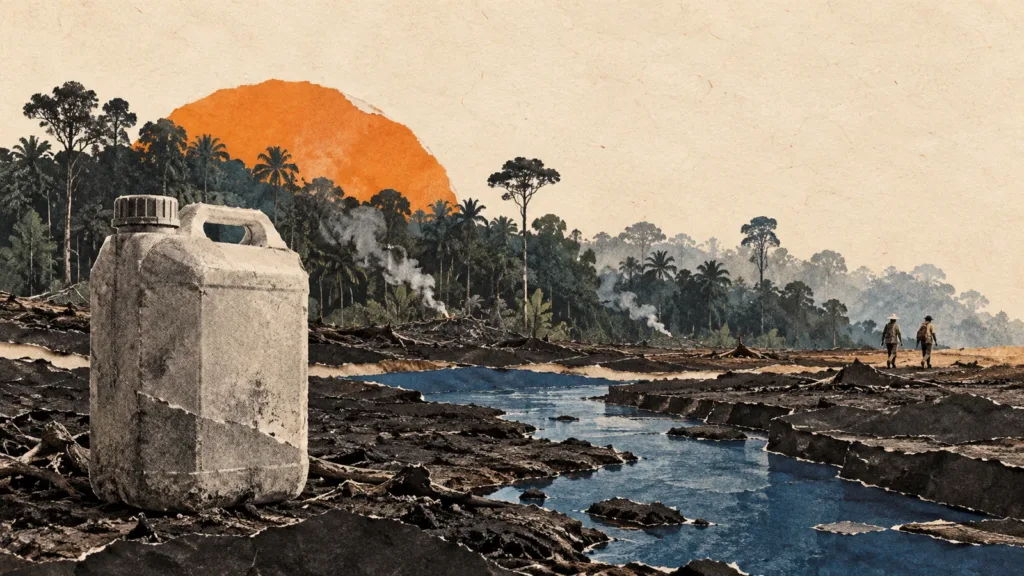
Water scarcity puts households and firefighters under pressure at the same time: communities need safe supplies, while crews need water to cool burning peat. Editorial illustration.
New reporting from Borneo shows how drought and damaged peatlands are undermining everyday water access. Emergency firefighting must be followed by recovery that restores the landscape’s ability to support people and wildlife.
Indonesia peat fires are disrupting life beyond the fire line. New Associated Press reporting describes water and livelihood pressures in West Kalimantan. The account follows a September 29 update from Indonesia’s disaster agency, BNPB, which reported continuing operations across six priority provinces and identified limited water supplies as an obstacle to suppression.
The connection matters: water is needed both to sustain households and to keep peat from burning. The evidence points to an emergency whose duration cannot be measured only by the number of visible flames. Protecting residents now requires safe water and health support; reducing the risk of another destructive season requires attention to drainage, land use and the people who depend on those decisions.
What This Article Covers
- What recent reporting and official updates establish about the continuing emergency.
- How drainage changes peat, and why underground fires resist suppression.
- Who faces the greatest practical barriers to protection from smoke and lost livelihoods.
- What wildlife rescue and earlier research reveal about recovery after a fire.
- How community participation, restoration and accountability can reduce future harm.
Key Takeaways
- Indonesia’s September 29 disaster update reported firefighting progress while identifying continuing problems with water access, smoke and underground peat combustion.
- Peat is accumulated organic material. Draining it changes a wet landscape into one that can become highly combustible in dry conditions.
- Wildfire smoke can harm people far from burning land; health risks and the ability to avoid exposure are unevenly distributed.
- Wildlife rescue counts describe the animals reached by particular teams, not the total ecological toll.
- Research in Indonesian peat forest shows that ecological damage can persist for years and repeated burning can interrupt recovery.
- The sources reviewed do not establish a fire-related increase in human trafficking. The supported connection is between environmental damage, lost security and the need for protection.
As October begins, the cost is reaching households
The October 1 Associated Press account describes increased water costs and disrupted river livelihoods. These reported experiences do not constitute a survey of every affected community.
Independent evidence of that pressure comes from organizations providing assistance. In a September 18 field update, the International Fund for Animal Welfare, or IFAW, said its partner Conservation Action Network Indonesia had delivered water to ten drought-affected villages and food and essential supplies to 173 families whose gardens had burned or harvests had failed. Those are the organization’s reported operational figures, not national totals or an assessment of present-day need.
The gap between those two kinds of information is significant. A record of deliveries establishes that help reached particular communities. It does not establish how many other households need support, how long supplies will last or whether an income has recovered. Reporting the response honestly means asking those questions alongside counting the work already done.
Why a wet forest can become fuel
Peat forms when plant material accumulates faster than it decomposes in wet conditions. Over long periods, that material becomes a substantial store of carbon. UNEP’s 2022 Global Peatlands Assessment explains that peatlands cover roughly 3–4 percent of the world’s land surface yet hold up to a third of its soil carbon. Their importance is therefore much larger than their footprint suggests.
Drainage changes the conditions that maintained that store. UNEP’s explanation of Indonesian peat fires identifies agricultural and forestry drainage, land-clearing fires and land disputes among the pressures involved. Dry peat can sustain fire below the surface for months. This helps explain why a fire may demand continuing attention after its most obvious surface activity has diminished.
That distinction also separates weather from responsibility. Drought increases danger, but it does not explain every drainage decision or ignition. An investigation into an individual fire must establish where it began, what happened beforehand and who controlled the relevant land. A regional emergency alone does not prove that any particular company or farmer committed an offense.
El Niño increases risk without explaining every fire
Indonesia’s meteorological agency, BMKG, warned on September 7 that dry conditions and El Niño continued to complicate fire control. It also noted that localized rainfall had not relieved drought evenly. This is an important distinction for readers following scattered reports of rain: an improvement in one place cannot safely be treated as the end of a wider emergency.
BMKG described weather modification as dependent on atmospheric conditions, with operations adapted to local circumstances. That places a practical limit on any expectation that aircraft can simply produce rain whenever it is needed. Weather information should guide decisions, while people and institutions responsible for land management address the conditions within their control.
The article does not assign a quantified share of this season’s damage to climate change. That would require evidence specific to the event and the outcome being measured. The documented interaction between dry conditions and degraded peat is sufficient to explain why prevention must reach beyond seasonal forecasts.
Smoke protection depends on more than knowing the risks
The World Health Organization’s July 2026 wildfire fact sheet explains that smoke contains fine particles and other pollutants and can affect health well beyond the immediate fire zone. Children, older adults, pregnant women and people with existing heart or lung conditions face particular risks. Housing, employment and access to care also influence exposure and protection.
Those differences should shape assistance. Advice to remain in cleaner indoor air has limited value without somewhere suitable to go. An outdoor worker also needs arrangements that make reducing exposure economically possible. These are practical implications of the evidence, rather than claims that every affected household faces the same circumstances.
A useful response would track whether information reaches people, whether they can act on it and whether essential services remain accessible. Health messaging and material support should be assessed together. Otherwise, the responsibility for protection can fall most heavily on those with the fewest choices.
Communities are responding, not simply waiting
Local residents are part of the response infrastructure. IFAW’s September reporting describes community members identifying new fires, water sources and access routes. It also records an injured community firefighter and dangerous conditions that forced responders to shelter until movement was safer. These accounts show why local knowledge matters and why participation needs equipment, training and protection.
A separate Reuters report from September 23 documented a women’s volunteer network in West Kalimantan known as The Power of Mama. Trained through YIARI, participants patrol communities, address small fires and encourage safer practices; their role does not extend to fighting large blazes. The distinction recognizes organized local action without presenting dangerous improvisation as a solution.
Public institutions and commercial land users should not treat volunteer commitment as an unlimited resource. The relevant question is what enables people to participate safely and sustain that work. A response that depends on exhausted residents absorbing mounting risks needs stronger support, even when their efforts are effective.
Rescuing an orangutan does not restore its home
International Animal Rescue’s current response account, checked October 2, reports 38 orangutans rescued by its partner YIARI. It describes animals isolated by fire and others requiring veterinary care. The organization’s dated entries also document releases into suitable protected forest where that was possible. These are its own rescue records and should not be combined casually with totals from other organizations.
The account makes the practical problem clear: an animal’s medical condition and the availability of suitable habitat are separate questions. A successful evacuation creates a chance of survival. It does not manufacture the food, shelter or connected forest required for a safe return. Conservation therefore needs work on the surrounding landscape as well as the capacity to treat individual animals.
Earlier research helps explain why those needs can persist. A Rutgers study reported in 2018 followed four adult male orangutans during the 2015 fire season. Researchers observed altered activity and increased signs of fat breakdown despite higher calorie intake. Its small sample does not quantify the health effects on today’s entire population, but it demonstrates why surviving exposure should not be equated with remaining unaffected.

Recovery has to be measured over years
A 2024 study in the Proceedings of the National Academy of Sciences used 16 years of data from an Indonesian tropical peatland to examine fire impacts. Burned forest remained structurally altered, with reduced tree cover and changes in biodiversity. Some vegetation recovery was evident over twelve years, while repeated fire threatened that progress.
That finding changes the appropriate timescale for accountability. Counting hectares treated or seedlings planted can describe activity, but recovery also needs evidence that vegetation survives, water conditions improve and the landscape avoids repeated burning. The study concerns a particular monitored ecosystem; it should inform questions about this emergency without being presented as a forecast for every affected site.
There is also a difference between a greener-looking surface and recovered ecological function. Restoration plans need clear objectives, a baseline and continuing observation. Without them, a project may be declared successful before the conditions that made the land vulnerable have changed.
What the official response shows, and what it cannot show
In its September 29 operational update, BNPB described ground crews, aerial support, peat cooling and efforts to improve water access. It reported progress against fires being handled in six priority provinces. It also identified constraints including smoke-reduced visibility, difficult access, wind and underground combustion.
These operational measures are necessary. Their effectiveness, however, answers a narrower question than whether residents can resume ordinary life or whether the landscape is less likely to burn next year. A suppression update should not be used as a nationwide seasonal damage estimate. Nor should improving conditions at monitored fire sites be treated as proof that every household’s water supply has recovered.
The FAO and UNEP Global Fire Management Hub places prevention, preparedness, knowledge and institutional capacity within a broader approach to fire management. That provides a useful standard for assessing the next stage: whether emergency resources are followed by sustained work before the next period of high risk, with responsibilities that can be checked publicly.
Restoration must work for the people living on the land
UNEP documented a community peatland restoration program in North Sumatra in 2021 that combined water-level monitoring, canal blocking, native planting and livelihood support. The example predates this emergency and is not evidence that current fire-affected locations have recovered. Its relevance lies in the design: changing land management was accompanied by practical work on household income.
That pairing deserves attention. A restoration instruction can impose costs before any new livelihood produces a return. People need a workable transition, with clarity about land rights, maintenance, training and who bears the financial burden. Asking residents to protect a landscape while leaving those questions unresolved can undermine the very cooperation that restoration requires.
The policy test should therefore include both environmental performance and household security. Who maintains water-control structures? Who receives support, and on what terms? Can communities raise concerns and influence decisions? Those questions turn a restoration promise into something that residents, funders and public authorities can assess.
The link to exploitation needs precision
Lost income and disrupted services raise protection concerns, but the sources reviewed here do not establish an increase in human trafficking caused by these fires. Environmental damage should not be used as a shortcut to an unsupported criminal claim. Nor should people whose livelihoods are affected be described as inevitable victims.
Not For Sale’s work on the relationship between climate pressure and modern-day slavery provides a wider prevention context. For this emergency, the responsible questions concern safe income, accessible help and the terms on which people find replacement work. Any allegation of coercive recruitment, debt bondage or forced labor would require its own evidence.
This is also why the language of ecocide must be used carefully. The documented ecological harm warrants scrutiny, but this article does not report a court finding of ecocide or attribute criminal responsibility for particular fires. Keeping that boundary clear strengthens the case for investigating damage and accountability.
What Not For Sale’s perspective adds
For Not For Sale, the relevant question is how environmental destruction narrows people’s ability to live securely and make meaningful choices. Prevention requires attention to the conditions around a person, including dependable income, access to services and the ability to seek help. This article does not claim that Not For Sale is running the Indonesian fire response.
The organization’s explanation of social innovation offers another useful lens: practical alternatives need to work within people’s lives. In a peatland landscape, that means examining whether conservation and recovery arrangements support the people expected to sustain them. The value of that perspective is the question it asks of institutions, rather than a claim to speak for affected communities.
What readers can do
Readers can share dated reporting and distinguish a particular organization’s rescue or relief figures from regional totals. When supporting emergency work, check the organization’s stated role, location and current activities. Funding for wildlife rescue, community water provision and long-term protection serves different purposes; a clear appeal should explain which work it supports.
Businesses sourcing from affected landscapes can ask suppliers for specific evidence about land management, fire prevention and grievance processes, rather than relying on a broad sustainability statement. Readers considering restoration projects can ask how outcomes are monitored and how local residents participate. These are proportionate questions that follow from the evidence without alleging misconduct by an unexamined supplier.
What an end to the emergency should mean
The public test of recovery should reach beyond extinguished flames. It should ask whether households have dependable water, whether work and services are accessible, and whether damaged forests have a credible path to recovery. Each requires evidence over a different timescale. Treating them as one finished task risks overlooking people and places still carrying the cost.
The central lesson is practical: emergency response and prevention have to meet on the same land. Firefighters need support now, while the decisions that determine drainage, livelihoods and restoration must remain subject to scrutiny after smoke disappears from the headlines.
FAQ
What are peat fires?
Peat fires burn accumulated organic material in the ground, rather than only vegetation above it. When peat has dried, combustion can persist beneath the surface. That makes detection, cooling and continuing monitoring important even after visible flames have diminished.
What is new about Indonesia’s fire emergency?
The latest reporting describes continuing household disruption, following late-September official firefighting updates. This is an ongoing emergency; the fires did not begin this week.
Does El Niño cause every peat fire?
No. El Niño can contribute to dry conditions that make fires harder to control. It does not establish how an individual fire started. Understanding responsibility also requires evidence about ignition, drainage, land management and local conditions.
Who faces particular risks from wildfire smoke?
WHO identifies children, older adults, pregnant women and people with existing health conditions as groups facing particular risks. Exposure also depends on work, housing and access to protection. People in affected areas should follow current local health and emergency guidance.
Why are orangutans being rescued?
Response organizations describe animals isolated by fire or in need of veterinary care. Rescue is followed by an assessment of health and suitable habitat. An animal that survives an evacuation may still require treatment or a safe place to return.
How long does a burned peat forest take to recover?
There is no single recovery period for every site. A long-term Indonesian study found some vegetation recovery over twelve years, alongside lasting structural damage. Conditions, the severity of fire and whether burning recurs all matter when assessing a particular landscape.
What does peatland restoration involve?
Restoration can include rewetting, managing drainage, replanting appropriate native vegetation and monitoring conditions. Community participation and viable livelihoods matter because structures and planting require continuing care. The approach needs to fit the local landscape rather than follow a universal prescription.
Have the fires caused human trafficking?
The sources reviewed for this article do not establish that claim. Damage to livelihoods raises prevention questions, but vulnerability is not proof that trafficking occurred. Specific claims about coercion, recruitment or exploitation require separate investigation and supporting evidence.
Is Not For Sale delivering fire relief in Indonesia?
This article makes no claim that Not For Sale is delivering that response. It examines the emergency through the organization’s concern with exploitation and environmental harm. The donation link supports Not For Sale’s wider mission, without an asserted allocation to this event.
Sources
- Edna Tarigan and Victoria Milko, Associated Press, “Indonesian villagers on Borneo struggle for water as El Niño intensifies peatland fires,” October 1, 2026, syndicated report.
- BNPB, “Perkembangan Situasi Terkini Penanganan Karhutla di 6 Provinsi Prioritas,” September 29, 2026. Operational conditions and response; Indonesian original.
- BMKG, “Dampak El Niño Masih Perlu Diwaspadai, BMKG Perkuat Dukungan Pengendalian Karhutla,” September 7, 2026. Weather context; Indonesian original.
- IFAW, “Pangolins and other wildlife reveal the wider toll of Indonesia’s fires,” September 18, 2026, including the September 16 response entry.
- International Animal Rescue, “Urgent Fire Crisis Fund,” response account and dated rescue entries, checked October 2, 2026.
- Reuters, “The women volunteers of Borneo battling worst wildfires in 11 years,” September 23, 2026.
- World Health Organization, “Wildfires,” July 31, 2026, sections on health impacts and populations at risk.
- UNEP, “Why peatlands matter,” October 23, 2019, peat combustion and land-use context.
- UNEP, “Global Peatlands Assessment: The State of the World’s Peatlands,” November 17, 2022.
- UNEP, “Community Based Peatlands Restoration: Protecting the Ancestor Legacy,” October 15, 2021.
- Ken Branson, Rutgers University, “Wildfires May Cause Long-Term Health Problems for Endangered Orangutans,” May 14, 2018, reporting the study of four adult males during the 2015 fires.
- Harrison and colleagues, “Impacts of fire and prospects for recovery in a tropical peat forest ecosystem,” PNAS, April 15, 2024, abstract and significance statement.
- FAO and UNEP, Global Fire Management Hub: “What we do,” checked October 2, 2026.
Topics in this story
See all topicsNot For Sale
A global movement fighting modern-day slavery and ecocide in 33 countries. Building on the frontlines since 2007.