Slavery and Human Trafficking: A Historical Timeline
Explore the events, laws and acts of resistance that shaped slavery, human trafficking and the struggle for freedom, from ancient records to 2026.

The history of slavery is also a history of people resisting it. Enslaved people escaped, built communities, challenged owners in court and led revolutions. Their actions belong alongside the laws, empires and commercial networks that determined who could be bought, sold or compelled to work.
This timeline traces major developments across regions, from surviving records in ancient Mesopotamia to human trafficking investigations in 2026. It distinguishes slavery, in which powers of ownership are exercised over a person, from forced labor, in which work is extracted through coercion. Trafficking concerns recruitment and other acts undertaken for exploitation, using prohibited means such as force or deception where the person is an adult. These practices overlap, but they are not interchangeable.
Entries are ordered by their starting year, so longer periods overlap. The dates identify the events or periods discussed, not universal beginnings and endings. “c.” means approximately.
c. 3000–2000 BCE
Written records document slavery in Mesopotamia
Clay tablets from Mesopotamia, in present-day Iraq and neighboring areas, preserve some of the earliest written evidence of slavery. They record people being bought and sold and labor placed under another person’s control. By the end of the third millennium BCE, the Laws of Ur-Namma regulated aspects of slaveholding. These records establish that slavery already existed. They cannot tell us when it began.
c. 1750 BCE
Hammurabi records judgments governing a slaveholding society
The judgments collected under Hammurabi, king of Babylon, addressed slavery alongside property, marriage and trade. Inscribed on a stone monument more than two meters tall, they prescribed penalties for concealing fugitives and rewards for returning them. The collection treated an owner’s claim to a person as an interest the law should protect.
c. 1637 BCE
A Babylonian tablet records the sale of a person
A clay tablet measuring just eight by five centimeters records the sale of an enslaved person, probably in Sippar, in present-day Iraq. Three cylinder seals were impressed on its surface. Preserved in the Metropolitan Museum of Art, the tablet gives material form to a transaction almost 3,700 years old: the transfer of a person from one owner’s possession to another’s.
c. 594 BCE
Solon restricts debt enslavement in Athens
An Athenian borrower could lose their freedom, and expose their family to enslavement, by falling into debt. Solon’s reforms canceled debts and prohibited loans secured against the borrower’s person. The later Athenian Constitution also preserves his claim to have brought home Athenians sold abroad. The reforms protected members of the Athenian community while leaving the enslavement of others intact.
c. 500–300 BCE
Enslaved labor supports Athenian democracy
Male citizens debated and decided public affairs in Athens while enslaved people worked in households, workshops, fields and mines. Those workers had no share in the political rights celebrated by the city. Their labor helped sustain a democracy whose definition of citizenship excluded the people its citizens owned.
c. 300 BCE–500 CE
Roman conquest supplies markets for enslaved people
Roman armies carried captives from conquered territories into a trade that supplied farms, mines, households and skilled occupations. Slavery also reproduced itself within families: children born to enslaved women inherited their status. Some people obtained freedom, and inscriptions preserve the lives of freedmen and freedwomen. For those who remained enslaved, work, family relationships and the prospect of release were subject to an owner’s power.
206 BCE–9 CE
Western Han China uses state and private slavery
During China’s Western, or Former, Han dynasty, the government and private households both held enslaved people. Slavery existed alongside taxation and compulsory service imposed on the free population. These obligations could all supply labor to the state, but they conferred different legal positions: owing service did not necessarily mean being owned.
73–71 BCE
Spartacus leads an uprising against Rome
Spartacus and fellow gladiators escaped from captivity at Capua and gathered an army that defeated successive Roman forces. Enslaved people joined the rebellion, as did some free agricultural workers. Crassus eventually defeated it in 71 BCE. The surviving narratives were written long afterward by Roman-era historians, leaving the rebels’ own accounts of their aims largely inaccessible.
c. 300–900 CE
Chinese law regulates inherited slavery
Medieval Chinese legal codes distinguished people owned by the state from those held in private households. Captivity, punishment and the sale of children could lead to enslavement, and status could pass between generations. Laws prescribed how owners could treat enslaved people without removing their ownership claims.
c. 500–1500 CE
South Indian records document slavery and other forms of dependence
In the Tamil-speaking regions of southern India, inscriptions and religious literature record people bound to landholders, households and temples. Some were enslaved; others owed service without being treated as property. The distinctions matter in a society where landholding, caste and religious institutions shaped access to work and freedom. Neither an occupation nor a caste designation, by itself, establishes a person’s legal status.
c. 700–900 CE
Enslaved people are traded across the Sahara
Routes across the Sahara connected communities south of the desert with North Africa and markets farther east. Merchants transported enslaved people through these networks, linking their sale to the commerce of African and Mediterranean economies. The routes, participants and scale changed over subsequent centuries. Long before European Atlantic expansion, captivity and trade were moving people over substantial distances within and beyond Africa.
c. 800–1100 CE
Viking raids supply markets for enslaved people
Viking raiders seized people in the British Isles and eastern Europe and carried them into networks that reached trading centers such as Hedeby and Bolghar. Captives worked in households and agriculture and could face sexual exploitation. Enslavement also followed punishment within Scandinavian societies. A rune stone at Hørning preserves an unusual personal record: a craftsman commemorated the man who had given him his freedom.
869–883
The Zanj rebellion challenges the Abbasid caliphate
A rebellion in southern Iraq drew enslaved African workers and other disaffected groups into a prolonged war against the Abbasid state. Its forces operated from the marshlands and resisted repeated military campaigns before their defeat in 883. Historians dispute the origins and status of all those described as Zanj. The revolt cannot be reduced to a single, uniform group, although the recruitment of enslaved workers was central to its beginnings.
1250
Formerly enslaved soldiers establish Mamluk rule in Egypt
Military men recruited through slavery overthrew Egypt’s Ayyubid ruler and established the Mamluk sultanate. The system trained enslaved recruits, freed them and allowed some to rise to command. Former captives could become rulers without ending the purchase of new recruits. Military advancement and the continued institution of slavery were part of the same political order.
c. 1300–1800
Ottoman slavery supplies households and institutions of state
Slavery in the Ottoman Empire encompassed household service, commercial markets and recruitment into military and administrative institutions. Some enslaved recruits acquired authority close to the ruler; others remained subject to household owners with little opportunity to advance. Markets linked the empire to the Mediterranean, Black Sea and neighboring regions. Conditions differed considerably across its territories and over the centuries covered here.
1441–1444
Portuguese expeditions carry African captives to Europe
Portuguese expeditions seized people on the west African coast and transported them to Portugal. Captives included people taken on the Mauritanian coast and others already carried through trans-Saharan trading networks. Raids were followed by more regular trade along the coast. European colonization and plantation production would subsequently expand these Atlantic routes on a much larger scale.
1492 onward
European conquest expands Indigenous enslavement in the Americas
European colonization brought campaigns of seizure and sale into the Americas, alongside other systems of compulsory labor. Indigenous societies already had histories of captivity, but conquest expanded the commercial demand for people and subjected communities to new colonial authorities. Settlers and officials continued to enslave Indigenous people even after the Spanish crown imposed restrictions, invoking exceptions and seeking permission for further campaigns. Enslavement accompanied warfare, dispossession and forced displacement.
1501–1866
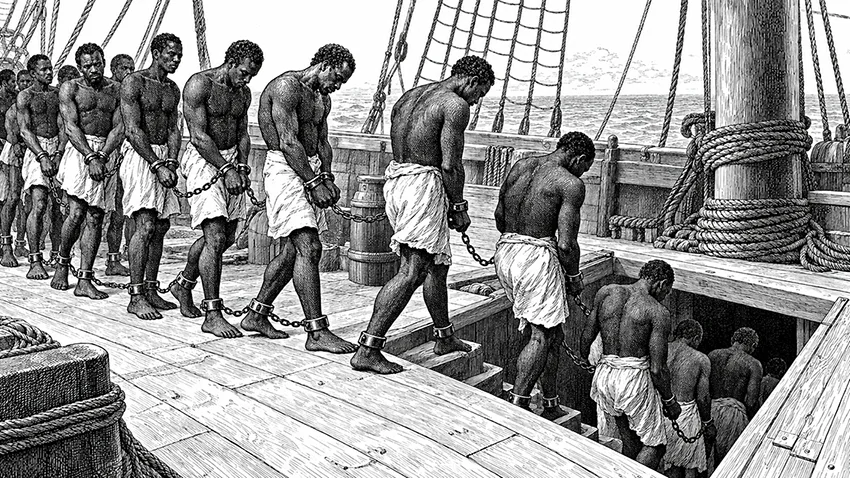
The transatlantic slave trade carries millions into captivity
The SlaveVoyages estimates indicate that approximately 12.5 million captive Africans embarked on transatlantic voyages and about 10.7 million survived to disembark. Ships carried them to plantations and other destinations in the Americas, where their labor produced commodities for international markets. The difference between the estimates represents roughly 1.8 million deaths during the crossing alone. It excludes deaths during capture, journeys to the coast and enslavement after arrival. The figures are reconstructions from incomplete records, not a complete register of the people taken.
1526
Afonso of Kongo protests unauthorized enslavement
King Afonso I of Kongo complained to the Portuguese crown that traders were seizing and selling people whose freedom he was supposed to protect. His letters described a commercial demand for captives that was undermining his authority over his subjects. Afonso ruled a slaveholding society and was not calling for general abolition. He was contesting who could be enslaved and whether Portuguese traders would respect the limits he sought to impose.
1542
Spain restricts the enslavement of Indigenous people
The Spanish crown’s New Laws prohibited Indigenous enslavement and challenged aspects of colonial labor control. Settlers resisted the restrictions, owners defended existing claims, and imperial authorities later authorized exceptions for particular populations and circumstances. Enforcement depended on officials whose decisions could preserve the relationships the laws were supposed to dismantle.
c. 1570–1700
The Manila galleon trade carries Asian captives to Mexico
People seized or sold in parts of Asia crossed the Pacific through the Manila galleon network. In colonial Mexico, the broad label chinos grouped together people of different origins. They worked, formed families and challenged their enslavement within the Spanish legal system. From 1672, recognition as Indigenous vassals of the crown opened routes to freedom for people previously held under that category.
c. 1600–1695
Palmares sustains a community beyond slaveholders’ control
People escaping slavery in Brazil established quilombos, settlements beyond slaveholders’ immediate control. Palmares became one of the largest and most enduring, supported by cultivated land and organized defense. Its leader Zumbi resisted repeated colonial attacks. Forces captured its principal settlement in 1694, and Zumbi was killed the following year. Other quilombos continued to form as people escaped slavery elsewhere in Brazil.
c. 1600–1900
Colonial plantations expand coerced labor around the Indian Ocean
European empires entered an Indian Ocean world already connected by long-distance trade and the movement of captives. Colonial plantations, including those in Mauritius, drew on enslaved labor and later on workers recruited under indenture. People arrived from African and Asian regions under different forms of compulsion and contract. Indenture was legally distinct from slavery, although deception, penalties and restrictions on movement could make contractual work coercive in practice.
1619
Captive Africans arrive in English Virginia
An English privateering vessel brought captive Africans to Point Comfort after taking them from a slave ship bound for Spanish America. Colonists acquired them in exchange for provisions. The landing became a defining date in the history of English North America, although enslavement elsewhere in the Americas long preceded it. Virginia’s system of racial and hereditary slavery developed through subsequent practices and laws.
1641
Massachusetts gives slavery legal recognition
The Massachusetts Body of Liberties specified circumstances in which slavery was permitted, giving human ownership a place within the colony’s written law. Slaveholding was therefore established in New England as well as in the plantation colonies farther south.
1662
Virginia makes a child’s status follow the mother’s
Virginia’s legislature ruled that a child would be free or enslaved according to the mother’s status. Children born to enslaved women became an owner’s property, including those fathered by English men. The law made a woman’s captivity the basis for enslaving her descendants and protected slaveholders’ claims to children born through sexual exploitation.
1672
The Royal African Company receives a royal charter
Charles II granted the Royal African Company a monopoly over English trade along a large part of the west African coast. Trading in enslaved Africans was central to its business. The charter placed royal authority behind a commercial enterprise that required investors, ships and markets in which captives could be sold. English involvement in the trade was organized through institutions of state and finance as well as individual merchants.
1685
The Code Noir regulates slavery in French colonies
Louis XIV’s edict prescribed Catholic instruction, regulated marriage and family relationships, and authorized punishments within French colonial slavery. It also required certain provisions for people who were sick or elderly. Such obligations left ownership intact. The code restricted the lives of enslaved people and confirmed that children inherited their mother’s status.
1688
The Germantown petition challenges Quaker slaveholding
Four Quakers in Germantown, Pennsylvania, petitioned their religious community against slavery. They condemned the seizure and sale of people, the separation of families and the use of skin color to justify conduct Europeans would reject for themselves. The petition passed through several levels of Quaker deliberation before the Yearly Meeting declined to take a position. Its arguments confronted slaveholding within the petitioners’ own religious community.
1739
Enslaved people rebel at Stono
Enslaved people in South Carolina seized weapons and moved south, gathering supporters along the way. White militia suppressed the rebellion, and the colonial authorities tightened restrictions on enslaved people’s lives. Much of the surviving account was written by people defending slaveholding, which limits what can be recovered about the rebels’ individual experiences and intentions.
1772
James Somerset defeats an attempt to send him out of England
James Somerset challenged his enslaver’s attempt to send him forcibly out of England. Lord Mansfield ruled against the removal, a judgment that encouraged antislavery campaigners and other people seeking freedom. Its reach was narrower than later accounts sometimes suggest: it did not abolish slavery throughout the British Empire. Somerset had successfully contested a specific exercise of his enslaver’s power.
1780
Pennsylvania begins gradual abolition
Pennsylvania ended hereditary enslavement for children born after the law’s passage, but required them to serve until age 28. Many people already enslaved remained in bondage. The statute broke with perpetual slavery while preserving owners’ access to labor for decades. Within one family, children could face a long wait for freedom that the law did not promise their parents.
1781
Elizabeth Freeman wins her freedom in court
Elizabeth Freeman, then known as Bett, and another enslaved person, Brom, successfully sued John Ashley for their freedom in Massachusetts. Their case followed the state’s adoption of a constitution declaring human freedom and equality. Freeman brought that language to bear on the man who claimed to own her. The case helped establish slavery’s incompatibility with the new constitution.
1781–1783
The Zong killings become an insurance claim
Crew members aboard the British slave ship Zong killed more than a hundred captive Africans by throwing them overboard. The owners claimed compensation from their insurers, arguing that a shortage of drinking water had necessitated the killings. Litigation in 1783 treated the losses as insured property, while abolitionists sought criminal accountability. The owners were asking a court to establish the financial value of people their crew had deliberately killed.
1787
British campaigners organize against the slave trade
Thomas Clarkson, Granville Sharp and other campaigners formed a committee to end the slave trade. They collected testimony, organized petitions and brought evidence before Parliament. Black abolitionists and people who had experienced enslavement supplied arguments and testimony to the wider movement. The immediate legislative goal was to prohibit the trade; ending slaveholding in the colonies required a further struggle.
1789
Olaudah Equiano publishes his life story
Olaudah Equiano published an account of enslavement, maritime work and the purchase of his freedom. The Interesting Narrative combined autobiography with an argument against the slave trade, bringing a Black author’s account of his own life into the abolition campaign. Equiano addressed readers whom merchants and slaveholders were also trying to persuade, using publication to contest their account of what the trade meant for the people caught in it.
1791
Enslaved people rise against plantation rule in Saint-Domingue
An uprising in the French colony of Saint-Domingue challenged a wealthy plantation economy built on enslaved labor. Rebels fought as white colonists disputed political power and free people of color demanded equal rights. Toussaint Louverture emerged as a leading military and political figure during a conflict that drew in rival European powers. Enslaved people had forced emancipation into a struggle that officials in France could no longer resolve on their own terms.
1794
Revolutionary France abolishes colonial slavery
France’s National Convention decreed abolition after emancipation had already been proclaimed in parts of Saint-Domingue in 1793. The decree recognized freedom and citizenship across the colonies in principle, although its application was uneven. Revolt and warfare had helped force the decision. The legal protection won under the revolutionary government would be reversed in parts of the empire under Napoleon.
1802
Napoleon preserves and restores colonial slavery
Napoleonic policy preserved slavery in some French possessions and restored it where abolition had taken effect, including Guadeloupe. A French expedition sought to recover control of Saint-Domingue and deported Toussaint Louverture to France, where he died in prison in 1803. The prospect of reenslavement intensified resistance. French forces failed to restore colonial control, and the struggle continued under leaders including Jean-Jacques Dessalines.
1804
Haiti declares independence
Jean-Jacques Dessalines declared Haitian independence after the defeat of French forces. A revolution begun by enslaved people had destroyed French colonial rule and created a sovereign state. Independence prevented France from restoring slaveholding, but diplomatic isolation persisted. The United States did not recognize Haiti until 1862, and France would demand an indemnity in return for recognition in 1825.
1807
Britain abolishes its slave trade
After years of campaigning and parliamentary defeats, Britain passed legislation prohibiting its slave trade. Petitions, testimony and political organizing had brought sustained pressure to bear on Parliament. The act left people already enslaved in British colonies under their owners’ control. Plantation production continued through the labor of people whom the legislation did not free.
1808
The United States bans the importation of enslaved people
A federal ban on importing enslaved people took effect in the United States. Slaveholding and the domestic trade remained lawful. Owners could still sell people away from their families and move them within the country, supplying an expanding plantation economy through internal markets. The border restriction did not diminish their legal power over those already enslaved.
1815
European powers condemn the slave trade at Vienna
At the Congress of Vienna, European powers adopted a declaration condemning the slave trade. They did not agree on an immediate, common timetable for ending it. The declaration made abolition an international diplomatic commitment while leaving governments room to protect their own commercial and colonial interests.
1820–1860
Cotton expansion drives the domestic slave trade in the United States
Roughly a million enslaved people were forcibly moved toward the Deep South and westward as cotton cultivation expanded. Traders bought people in the Upper South, confined them for sale and transported them by road and water. Auctions and private transactions separated families. The domestic trade supplied expanding plantation regions after the United States had closed its legal overseas trade in captives.
1823
Enslaved people rebel in Demerara
Enslaved people in Demerara, now part of Guyana, rose against the plantation system. Colonial forces suppressed the rebellion, and executions followed. Reports of the repression reached Britain and intensified the struggle over emancipation. The authorities were defending a plantation economy whose workers were demanding release from it.
1823
Chile abolishes slavery
Chile enacted final abolition after an earlier law had granted freedom to children born to enslaved women. The new measure extended emancipation to people whom that gradual approach had left in bondage. Other independent Latin American states would end slavery on different timetables.
1825
France imposes an independence debt on Haiti
With French warships off its coast, Haiti agreed to an indemnity of 150 million francs in exchange for French recognition of its independence. The money was intended to compensate former colonists for losses following the revolution. Repayment and the borrowing needed to finance it burdened the country for generations. People who had defeated slavery were made to finance claims by those who had profited from it.
1829
Vicente Guerrero decrees abolition in Mexico
President Vicente Guerrero abolished slavery by decree, following antislavery commitments made during Mexico’s independence struggle. Texas, then Mexican territory, obtained an exemption. A further law in 1837 abolished slavery throughout the republic without that exception. Mexico’s successive measures increasingly placed it at odds with the slaveholding United States to the north.
1831
Mary Prince publishes her account of enslavement
Mary Prince narrated her life in slavery in Bermuda, Grand Turk and Antigua for a book published in Britain. Susanna Strickland transcribed her account and Thomas Pringle edited it. Prince had left her enslavers’ household in London, but her husband remained in Antigua, where she risked reenslavement if she returned. Her testimony described the violence of slavery and the personal cost of a freedom that did not allow her to go home safely.
1831–1832
Samuel Sharpe organizes resistance in Jamaica
Samuel Sharpe, an enslaved Baptist leader, used religious networks to organize a refusal to work after Christmas unless workers’ demands were met. The action developed into an armed rebellion across western Jamaica. Colonial forces suppressed it, and hundreds of enslaved people died in the fighting and reprisals. Sharpe was hanged in 1832. The uprising added pressure for emancipation by demonstrating the scale of resistance on the plantations themselves.
1833–1838
Britain compensates slaveholders and imposes apprenticeship
Britain’s Slavery Abolition Act passed in 1833 and took effect across most of its slaveholding colonies in 1834. The government allocated £20 million to compensate slaveholders; the people they had enslaved received no equivalent payment. Many adults were required to keep working under an apprenticeship system that preserved compulsory labor for former owners. Apprenticeship ended in 1838, four years after the act began taking effect.
1834
Mauritius becomes a center of Indian indentured labor
The British government selected Mauritius for an experiment in replacing enslaved plantation labor with workers recruited on contracts. Over subsequent decades, large numbers of Indians passed through the immigration system associated with Aapravasi Ghat. Some sought better livelihoods, while others were recruited through deception or accepted terms they did not fully understand. Penal enforcement and restrictions on leaving work could turn a contract into an instrument of coercion.
1845
Frederick Douglass publishes his account of slavery
Frederick Douglass’s Narrative described how violence, enforced illiteracy and the power to separate families sustained slavery. His writing and public speaking challenged slaveholders’ explanations of the institution with an account of his own experience. Publication also brought danger: a man who had escaped slavery was identifying himself to a national readership while still vulnerable to recapture.
1846
Tunisia decrees abolition
Ahmad Bey abolished slavery after earlier measures had restricted slave markets and freed children born to enslaved parents. The decree confronted resistance where households and employers depended on enslaved labor. Abolition emerged here through North African political and religious debate, as well as pressure from abroad.
1848
France abolishes colonial slavery again
The French provisional government decreed abolition across its colonies and possessions. More than half a century had passed since the revolutionary decree of 1794, and Napoleon’s policies had preserved or restored slavery in parts of the empire. The 1848 measure ended the legal ownership and sale of people in territories where emancipation had been withheld or reversed.
1849–1860
Harriet Tubman returns to help others escape
After escaping slavery in 1849, Harriet Tubman returned to Maryland about 13 times and helped roughly 70 relatives and others reach freedom. Her journeys depended on local knowledge, trusted contacts and the willingness of those escaping to risk capture. The Underground Railroad was a collection of overlapping networks, not a single organization. Tubman used those connections to reach people still held in the place she had left.
1850
The Fugitive Slave Act extends slaveholders’ reach
The United States strengthened federal procedures for capturing people who had escaped slavery and returning them to their enslavers. The law penalized people who assisted escape and increased the risk of wrongful seizure for free Black people. Residence in a free state offered no dependable protection. Some freedom seekers continued to Canada, beyond the reach of US enforcement.
1851–1852
Colombia enacts emancipation
Colombia passed an abolition law in 1851 that took effect in 1852. Earlier measures had restricted the slave trade and addressed the status of children born to enslaved women. Final abolition extended freedom to people whom those partial reforms had left enslaved.
1853
Argentina prohibits slavery in its constitution
Argentina’s constitution declared slavery abolished, following an earlier measure granting freedom to children born to enslaved women. Emancipation became a constitutional principle, decades after the first steps toward ending hereditary enslavement.
1854
Peru and Venezuela abolish slavery
Peru and Venezuela enacted abolition in the same year, following earlier restrictions on the trade and measures affecting children born into slavery. Across much of independent Latin America, legal slaveholding was ending. Cuba and Brazil would retain it for more than three further decades.
1857
The Supreme Court rejects Dred Scott’s claim to freedom
Dred and Harriet Scott had sought freedom through the courts after living in territory where slavery was prohibited. In Dred Scott v. Sandford, the US Supreme Court rejected his claim and ruled that Black people descended from enslaved Africans were excluded from US citizenship, whether free or enslaved. It also denied Congress the authority to prohibit slavery in federal territories. The decision strengthened slaveholding interests as conflict over slavery’s expansion intensified.
1861
Russia emancipates privately owned serfs
Alexander II’s reforms ended the legal bondage of roughly 23 million privately owned serfs. Their inherited status had given landowners extensive control over their labor and movement. Emancipation granted civil rights and fundamentally changed that legal relationship, although the terms of access to land and rural livelihoods remained contested. Serfdom and Atlantic chattel slavery were distinct institutions with different systems of ownership and obligation.
1863
The Emancipation Proclamation makes freedom a Union war objective
Abraham Lincoln declared freedom for enslaved people in designated territories rebelling against the United States. The proclamation did not cover every slaveholding area, and enforcement advanced with Union military control. It also provided for Black enlistment in Union forces. People escaping slavery and serving in the military helped turn the declaration into a change in who controlled their lives and labor.
1863
Dutch abolition leaves compulsory labor in Suriname
The Netherlands abolished slavery in Suriname and its Caribbean colonies. In Suriname, many formerly enslaved people had to continue plantation work under state supervision for another ten years. The arrangement restricted workers’ choices while protecting the labor supply of former owners. For those subjected to it, release from compulsory service came in 1873.
1863–1904
Pacific Islanders are taken into Australian labor systems
Recruiters brought Pacific Islanders to Queensland and other parts of Australia for plantation, pastoral and maritime work. The trade included kidnapping and deception, as well as recruitment under contracts. Queensland records contain more than 62,000 contracts, including repeat engagements, rather than that number of individual workers. People who settled and formed communities later faced deportation under Australia’s racially restrictive immigration policies.
1865
Union troops announce emancipation in Texas
Union general Gordon Granger’s order announced freedom for enslaved people in Texas, more than two years after the Emancipation Proclamation. The arrival of federal military authority challenged slaveholders who had continued to exercise control despite the declaration. The announcement became the basis of Juneteenth commemorations.
1865
The Thirteenth Amendment makes abolition national law
Ratification of the Thirteenth Amendment prohibited slavery and involuntary servitude throughout the United States, extending beyond the Emancipation Proclamation’s wartime limits. Its text retained an exception for punishment following conviction of a crime. That provision would be used to justify compulsory prison labor, while discriminatory policing helped bring Black people into the systems that supplied it.
1865 onward
Convict leasing supplies forced labor after emancipation
Southern states and local authorities leased prisoners to private employers, extracting revenue from work in mines, agriculture and other industries. Discriminatory laws and policing placed disproportionately large numbers of Black people in these systems. Minor offenses could lead to imprisonment and labor under brutal conditions. Public authorities supplied workers to businesses through criminal punishment after private slaveholding had become unconstitutional.
1873
Zanzibar prohibits the slave trade
A treaty required Zanzibar to prohibit the slave trade and close its public slave markets. The island occupied an important position in Indian Ocean commerce, but clandestine trading continued after the agreement. The prohibition did not free people already enslaved in households or on plantations. Their legal status would be addressed through later measures.
1885–1908
Forced labor sustains Leopold II’s Congo Free State
Officials and commercial enterprises in the Congo Free State imposed violent demands for labor and commodities, especially rubber. Communities were compelled to produce for a colonial regime ruled by Belgium’s King Leopold II. Roger Casement’s report, published in 1904, helped expose the abuses internationally. A colonial system established decades after major Atlantic abolition laws was obtaining labor through coercion and violence.
1886
Cuba ends compulsory service under patronato
Cuba’s transition away from slavery had imposed patronato, requiring formerly enslaved people to continue serving their former owners. A royal decree ended the system in 1886, earlier than its original timetable. This completed legal abolition in a major sugar-producing society where employers had sought to retain compulsory labor during the transition.
1888
Brazil passes the Golden Law
Brazil’s Golden Law abolished slavery, making it the last country in the Americas to end the legal institution. Its passage followed years of resistance, escape and abolitionist organizing. Hundreds of thousands of people were still enslaved when the law extinguished their owners’ claims. It provided no comprehensive settlement of the unequal access to land, education and income that people carried into freedom.
1894
Korea abolishes hereditary slave status
The Gabo reforms abolished laws governing public and private slaves and prohibited the slave trade. They also removed inherited distinctions that had shaped access to office and treatment before the courts. Abolition was part of a wider restructuring of government and society under intense domestic and foreign pressure.
1897–1909
Zanzibar dismantles slave status through successive laws
Zanzibar’s 1897 order allowed enslaved people to obtain freedom through the government, but left some forms of enslavement unresolved. Further legislation in 1909 completed the legal abolition of slave status. More than three decades separated the prohibition of the trade in 1873 from the removal of the remaining legal status under which people were held.
1904
Governments agree to cooperate against trafficking in women
An international agreement organized cooperation against the procurement of women and girls for sexual exploitation abroad. Its title used the racially selective term “white slave traffic.” Participating governments undertook information gathering and other administrative measures across borders. The agreement’s narrow focus left exploitation in agriculture, domestic work and colonial labor systems largely outside the emerging international trafficking framework.
1905
Siam advances the gradual abolition of slavery
King Chulalongkorn’s law freed children born to enslaved parents, prohibited the enslavement of people who were free and required monthly reductions in debts that held others in bondage. It followed reforms begun earlier in his reign. Territorial exceptions and the gradual reduction of existing debts meant that the law did not release every person in Siam, now Thailand, on a single date.
1910
A trafficking convention requires criminal penalties
The International Convention for the Suppression of the White Slave Traffic required participating states to punish specified acts of procuring women and girls. It went beyond the administrative cooperation agreed in 1904 by creating obligations to prosecute through national law. Sexual exploitation remained its central concern, leaving many other forms of coercive labor outside its scope.
1912
Parliament investigates forced labor in the Putumayo rubber trade
Reports from the Putumayo region of the Amazon exposed violent exploitation of Indigenous communities in rubber production. Roger Casement’s investigation and British parliamentary scrutiny linked those abuses to a company registered in London. The inquiry followed a commodity from the people compelled to produce it to the commercial interests selling it internationally.
1917–1920
Overseas Indian indenture comes to an end
The government of India ended recruitment for overseas indentured labor in 1917, and the remaining system ended in 1920. For generations, contracts had carried Indian workers to plantations across the British Empire and beyond, often with restrictions on movement and severe penalties for breaking their terms. Ending indenture removed those obligations, while the communities established through it remained in societies shaped by plantation ownership.
1921
A new convention covers trafficking in women and children
The League of Nations’ International Convention for the Suppression of the Traffic in Women and Children dropped the racially restrictive wording of earlier agreements. Its provisions included children of both sexes and extended international cooperation through the League. Trafficking legislation was still developing separately from treaties directed at slavery and compulsory labor.
1926
The Slavery Convention defines slavery in international law
The Slavery Convention defined slavery by the exercise of powers associated with ownership over a person. Participating states committed to suppress the slave trade and bring about the abolition of slavery. The definition gave later courts and treaty bodies a basis for examining how someone was controlled, rather than relying solely on the legal name assigned to the relationship.
1930
The ILO adopts the Forced Labour Convention
The International Labour Organization defined forced labor through work demanded under threat of a penalty and not offered voluntarily. Convention No. 29 required its suppression, but originally allowed transitional use of compulsory labor under specified conditions. These provisions reflected the colonial systems within which the agreement was negotiated. They remained in the text until the 2014 Protocol removed them.
1930s
Stalin expands the Gulag
The Soviet forced-labor camp system expanded dramatically under Stalin. Prisoners worked in mining, forestry, construction and other sectors, often in remote regions under severe conditions. Political repression supplied labor to an economic system directed by the same state that imprisoned them.
1930s–1945
Japan’s military subjects women and girls to sexual slavery
The Japanese military’s “comfort stations” subjected women and girls from Korea and other occupied or affected territories to systematic sexual exploitation. Recruitment involved coercion and deception, and many were prevented from leaving. Survivors later spoke publicly about their experiences and sought acknowledgment and redress. Their testimony challenged the euphemism “comfort women” and the attempts to minimize what had been done to them.
1933–1945
Nazi Germany organizes forced labor across occupied Europe
Nazi authorities compelled Jews, prisoners of war, deported civilians and other persecuted people to work in concentration camps and across the wartime economy. Conditions varied between the systems of confinement and recruitment, but could be lethal. State institutions and private businesses used this labor. Forced labor served military production and economic demands while also forming part of the regime’s persecution and mass murder.
1942
Ethiopia enacts a comprehensive abolition law
Following the restoration of Haile Selassie’s government after Italian occupation, Ethiopia issued a proclamation abolishing slavery. Earlier measures had restricted the trade and aspects of slaveholding without ending the institution. The 1942 law prohibited enslavement and supplied a new legal basis for ending relationships that had survived those partial reforms.
1945–1946
Nuremberg establishes individual liability for enslavement
The charter of the International Military Tribunal included enslavement among crimes against humanity and deportation for slave labor among war crimes. The Nuremberg proceedings examined the Nazi state’s forced-labor system and the responsibility of senior officials. International prosecution could now reach individuals who organized these crimes, alongside the existing treaty obligations placed on states.
1946
France prohibits forced labor in its overseas territories
The Houphouët-Boigny law outlawed forced or compulsory labor in France’s overseas territories. African political organizing had challenged a system that enabled colonial authorities to obtain workers for public projects and private production. Employers and officials who depended on compulsory recruitment then faced the loss of that legal power, although changing established labor practices remained contested.
1948
The Universal Declaration prohibits slavery and servitude
Article 4 of the Universal Declaration of Human Rights prohibited slavery, servitude and the slave trade in every form. The General Assembly adopted these protections as rights belonging to everyone. The declaration was not a binding treaty, but it established a standard that informed later treaties, national constitutions and legal challenges.
1949
A UN convention addresses trafficking and exploitation of prostitution
The Convention for the Suppression of the Traffic in Persons and of the Exploitation of the Prostitution of Others consolidated earlier agreements. It required punishment for specified acts of procuring or exploiting another person in prostitution, even with that person’s consent. Its approach remained focused on prostitution; the broader international definition of trafficking adopted in 2000 would distinguish more explicitly between the acts, means and purpose involved.
1956
A supplementary convention addresses debt bondage and servitude
The Supplementary Convention on the Abolition of Slavery targeted debt bondage, serfdom, specified servile marriage practices and the transfer of children for exploitation. Its definition of debt bondage covered arrangements in which work was not properly credited against a debt, or the length and nature of the service were not limited and defined. A debt could therefore be examined as a means of holding someone in compulsory service, even without a formal claim to own them.
1957
The ILO prohibits forced labor used for repression and discipline
Convention No. 105 prohibited forced labor for political coercion, economic development, labor discipline, punishment for strikes and discrimination. It supplemented the 1930 convention by addressing particular uses of compulsory work by governments. States could not rely on those purposes to justify forcing people to labor.
1962
Saudi Arabia abolishes slavery
A royal decree abolished slavery in Saudi Arabia and provided compensation to former owners. Domestic servitude and trading in people had persisted into the twentieth century. The decree ended legal ownership in a country where slavery had survived long after abolition in many other states.
1966
The civil and political rights covenant prohibits slavery
Article 8 of the International Covenant on Civil and Political Rights prohibited slavery, the slave trade, servitude and forced or compulsory labor, with specified exceptions for the last category. Adopted in 1966, the covenant entered into force in 1976. Its obligations were binding on states that became parties, carrying the earlier human rights declaration into treaty law.
1976
India abolishes bonded labor by statute
India’s Bonded Labour System (Abolition) Act released people from bonded-labor obligations and liability for bonded debts. The legislation operated from October 1975. An alleged debt could no longer lawfully justify the relationships the act prohibited. Implementation required identifying workers still in bondage and providing rehabilitation, including support for livelihoods after release.
1979
The women’s rights convention requires action against trafficking
The Convention on the Elimination of All Forms of Discrimination against Women required states to suppress trafficking in women and the exploitation of prostitution of women. These duties sat alongside obligations concerning education, employment, political participation and family life. Protection against exploitation formed part of a broader claim to equal rights.
1981
Mauritania formally abolishes slavery
Mauritania issued an ordinance abolishing slavery in a society where inherited status could determine whether a person was treated as property. The measure did not establish an effective criminal enforcement system, and inherited servitude continued. Campaigners pressed for prosecutions and practical protection for people seeking to leave. A law criminalizing slavery would follow in 2007.
1989
The Convention on the Rights of the Child addresses exploitation
The UN adopted a treaty requiring protection against children’s economic and sexual exploitation, abduction, sale and trafficking. It placed these duties within a broader recognition of children’s rights, rather than leaving their protection solely to adults claiming authority over them. Governments also undertook responsibilities for prevention and cooperation across borders.
1998
The Rome Statute includes enslavement and sexual slavery
The Rome Statute established the International Criminal Court and included enslavement among crimes against humanity when committed as part of a widespread or systematic attack on a civilian population. It also included sexual slavery in its provisions on crimes against humanity and war crimes. Its definition of enslavement expressly encompassed powers of ownership exercised in trafficking. Adopted in 1998, the statute entered into force in 2002.
1999
The ILO requires action against the worst forms of child labor
Convention No. 182 required urgent action against child slavery, trafficking, debt bondage and forced recruitment for armed conflict. It also covered commercial sexual exploitation, illicit activities and hazardous work. Governments committed to eliminating these practices as a priority. The categories remain distinct: hazardous child labor does not automatically constitute trafficking.
2000
The United States passes the Trafficking Victims Protection Act
The Trafficking Victims Protection Act brought criminal enforcement, prevention and assistance for victims into a federal framework addressing sexual exploitation and forced labor. It extended the US response beyond earlier laws aimed at particular offenses. Reporting, diplomatic pressure and funding also made the legislation an instrument of foreign policy. Subsequent reauthorizations revised and expanded its provisions.
2000
The Palermo Protocol establishes the modern trafficking definition
The UN Trafficking in Persons Protocol linked acts such as recruitment, transportation and harboring to coercive or deceptive means and a purpose of exploitation. The purposes covered include forced labor, sexual exploitation, slavery and organ removal. Where a child is involved, proof of those means is not required. Trafficking does not require a border crossing or the buying and selling of a person. The definition allowed authorities to address recruitment into exploitation even where the circumstances bore little resemblance to a slave market.
2000–2002
Nepal prohibits Kamaiya bonded labor
Nepal announced the abolition of Kamaiya bonded labor in 2000 and enacted legislation in 2002. Debts had tied agricultural workers and their families to landlords. Abolition released them from those relationships but often left families without secure land, housing or income. Rehabilitation had to address how people would live after leaving the work and accommodation controlled by a landlord.
2002
UN principles put trafficked people’s rights first
The UN human rights office issued principles and guidelines centering the rights of trafficked people, including migrants. They warned against responses that caused further harm and addressed non-punishment for unlawful conduct arising from exploitation. Identifying a person as a trafficking victim could change their treatment from detention or prosecution to protection and assistance.
2005
The Council of Europe adopts a trafficking convention
The Council of Europe’s convention created obligations for prevention, investigation and victim protection, covering trafficking within countries and across borders. It established independent monitoring through the expert body GRETA. Opened for signature in 2005 and in force from 2008, the convention subjected governments’ treatment of victims to scrutiny alongside their efforts to investigate traffickers.
2005
Siliadin establishes a duty to protect against domestic servitude
In Siliadin v. France, the European Court of Human Rights examined the case of a young Togolese woman made to work without pay in a French household. It found that she had experienced servitude and forced labor and that French criminal law had failed to protect her adequately. A government could violate its human rights duties by failing to provide effective protection against exploitation by private individuals.
2007
Mauritania criminalizes slavery
Mauritania made slavery a criminal offense, more than a quarter of a century after formal abolition. The law created a basis for prosecuting enslavement, but campaigners continued to demand access to justice and protection from retaliation. People trying to leave inherited servitude needed the prohibition to be enforced against those still exercising control over them.
2010
Rantsev confirms state duties to combat trafficking
In Rantsev v. Cyprus and Russia, the European Court of Human Rights considered the death of a Russian woman who had traveled to Cyprus for work. It held that trafficking fell within Article 4 of the European Convention on Human Rights. The judgment addressed protection and investigation and clarified duties of cooperation between states. Governments’ responsibilities extended beyond prosecuting a trafficker after the harm had occurred.
2011
Domestic workers gain an international labor convention
The ILO’s Convention No. 189 set standards for domestic workers’ hours, rest, employment terms and protection from abuse. Work inside a private home could leave a person isolated from inspections and other sources of help. The convention affirmed that domestic employment carried labor rights and obligations, including where the workplace was also the employer’s household.
2014
The ILO strengthens protection and remedies for forced labor
A new protocol to the Forced Labour Convention required prevention, protection and access to remedies, including compensation. It also removed the convention’s original transitional provisions allowing certain compulsory labor. The obligations addressed what should happen after a worker was identified, as well as how forced labor should be prohibited: release needed to be followed by support and access to justice.
2014
ISIS enslaves Yazidi women and children
ISIS attacked the Yazidi community in northern Iraq, killing and abducting people and enslaving women and children. Survivors described confinement, sexual violence and repeated sale or transfer between captors. UN investigations documented enslavement among the crimes committed against the community, including genocide. Survivors would later bring their testimony into international campaigns for prosecution, acknowledgment and support.
2015
The Modern Slavery Act consolidates offenses in England and Wales
The Modern Slavery Act combined slavery and trafficking offenses and introduced enforcement and protection measures. Its main criminal provisions apply to England and Wales; some provisions, including supply-chain transparency requirements, reach more widely across the UK. Scotland and Northern Ireland enacted separate laws. Qualifying businesses had to publish annual statements about steps taken against slavery and trafficking in their operations and supply chains. The requirement did not guarantee that those supply chains were free of abuse.
2015
The Sustainable Development Goals set targets against exploitation
The UN’s 2030 Agenda committed governments to eradicating forced labor and ending modern slavery and human trafficking. Target 8.7 set an earlier deadline, 2025, for ending child labor in all its forms. That timetable became a benchmark for measuring progress, linking protection from exploitation to governments’ wider development commitments.
2016
The Brasil Verde judgment holds Brazil responsible for exploitation
Workers at the Brasil Verde farm had been trapped through recruitment, debt and restrictions on movement. The Inter-American Court of Human Rights addressed their treatment as contemporary slavery and trafficking and found Brazil responsible for failures to prevent and respond to the abuse. Its judgment examined how poverty and discrimination exposed particular workers to repeated exploitation.
2017
Reports from Libya expose the sale of migrants
Reports of migrants being sold in Libya prompted international condemnation and demands for investigation. People traveling toward Europe faced detention, extortion, forced labor and sexual violence amid fragmented political authority. A journey undertaken to find safety or work could expose someone to successive exploiters, including after they had escaped an earlier abusive situation.
2018
Nadia Murad and Denis Mukwege receive the Nobel Peace Prize
Nadia Murad, who escaped sexual slavery under ISIS, shared the Nobel Peace Prize with Congolese physician Denis Mukwege for their work against sexual violence in conflict. Murad had publicly recounted her experiences and campaigned for accountability, becoming a UN goodwill ambassador for the dignity of trafficking survivors. Mukwege treated survivors in the Democratic Republic of Congo and challenged impunity for the crimes committed against them.
2020
The pandemic disrupts the detection of trafficking
The COVID-19 pandemic interrupted inspections, support services and livelihoods. Subsequent UN analysis recorded fewer detected trafficking victims in 2020, while warning that reduced detection did not establish a decline in exploitation. People could become harder for authorities and support workers to reach. At the same time, lost income increased the pressure to accept risky recruitment offers or remain in abusive employment.
2020
Every ILO member state ratifies the child labor convention
Tonga’s ratification made Convention No. 182 the first ILO convention accepted by every member state at the time. All had formally committed to eliminating the worst forms of child labor. Universal ratification still required national implementation through inspections, education, family support and protection for children already being exploited.
2021–2022
The United States restricts imports linked to Xinjiang
The Uyghur Forced Labor Prevention Act was signed in December 2021, with its central import provisions taking effect in June 2022. Goods made wholly or partly in Xinjiang, or by certain listed entities, were presumed to have been produced with forced labor and barred from entry under US law. Importers seeking an exception had to satisfy stringent requirements. The rule required businesses to account for production throughout the relevant supply chain.
2022
Global estimates identify 49.6 million people in modern slavery
The ILO, Walk Free and the International Organization for Migration estimated that 49.6 million people were living in modern slavery on any given day in 2021. The total comprised 27.6 million people in forced labor and 22 million in forced marriage. Published in 2022, these were modeled estimates for 2021, not a current count of identified victims. The report used “modern slavery” as an umbrella term for distinct forms of coercion.
2023
INTERPOL warns of trafficking into online scam centers
False job offers were drawing people into operations where captors compelled them to defraud others online. INTERPOL issued a global warning about this pattern of trafficking. Threats, confinement and violence could keep workers at computers carrying out fraud. Investigators needed to distinguish those directing the operations from people forced to perform the scams, while also responding to the losses suffered by the people being defrauded.
2024
The ILO estimates forced labor profits at $236 billion a year
The ILO estimated that forced labor in the private economy generated $236 billion in illegal profits annually. The estimate measured financial gains from exploiting workers, not the total revenue of every business involved, and did not cover state-imposed forced labor. Withheld wages and coercive control enabled employers and criminal groups to retain income that should have gone to workers.
2024
The European Union bans products made with forced labor
The EU adopted a regulation prohibiting products made with forced labor from being placed on its market or exported from it, whether produced inside the EU or elsewhere. Its main rules are scheduled to apply from December 14, 2027. Adoption established the prohibition in law, with time allowed for guidance and enforcement arrangements before the ban becomes applicable.
2024
UN data record more detected trafficking victims
The UN Office on Drugs and Crime reported that detected trafficking victims in 2022 were 25 percent more numerous than in 2019 in the data used for its comparison. Children accounted for 38 percent of detected victims in 2022. These figures describe people identified by authorities. They do not measure the entire population experiencing trafficking or establish an equivalent rise in its underlying prevalence.
2025
Child labor estimates expose a missed global target
The ILO and UNICEF estimated that nearly 138 million children were in child labor in 2024, including about 54 million in hazardous work. Published in 2025, the figures confirmed how far the world remained from the target of ending child labor that year, despite a decline since 2020. Child labor is broader than trafficking or forced labor, so these totals cannot be substituted for estimates of either.
2025
Recruitment into scam centers reaches across continents
INTERPOL reported that people from 66 countries had been trafficked into online scam centers, based on information available by March 2025. Most identified victims were taken to centers in Southeast Asia, while similar operations were spreading elsewhere. Recruitment drew on a global pool of people seeking employment, extending the reach of criminal operations far beyond the countries in which workers were confined.
2026
A UN report documents harm after escape from scam operations
Published in February, the UN human rights office’s A Wicked Problem examined trafficking into cyber-scam operations and the abuse people could face even after release. It called for identification and protection of victims and respect for the principle that people should not be punished for unlawful acts they were compelled to commit. The report also examined deceptive recruitment and the part played by corruption and official responses in sustaining exploitation.
2026
The UN adopts a declaration on transatlantic slavery
On March 25, the General Assembly adopted Ghana’s resolution describing the trafficking and racialized chattel enslavement of Africans as “the gravest crime against humanity.” It passed with 123 votes in favor, three against and 52 abstentions, and called for reparatory justice. Resolution 80/250 was a political declaration, not a court judgment awarding compensation or establishing individual criminal liability.
2026
African and Caribbean reparations bodies coordinate their work
In June, African Union and Caribbean Community reparations bodies held their first joint meeting. They agreed to coordinate research, legal strategy and diplomatic work concerning the consequences of slavery and colonialism. Their agenda included the CARICOM Ten Point Plan for Reparatory Justice. The meeting brought African and Caribbean institutions into a shared process for pursuing redress.
2026
The European Commission sets out a new trafficking strategy
On October 16, the European Commission announced a strategy addressing technology-enabled trafficking, financial investigations and victim protection. An accompanying report recorded more than 20,000 registered victims in the EU during 2023–2024, up 16.1 percent from 2021–2022. The increase concerned identified cases, not a measure of all trafficking. Proposed action included closer cooperation between labor inspectors and stronger involvement of businesses in detecting exploitation.
2026
A European operation identifies potential victims at work
On October 23, Europol reported results from a September operation against labor exploitation involving 34 countries. Authorities had identified 248 potential victims and made 27 arrests linked to trafficking. These were preliminary identifications and arrests, not final court findings. Investigators looked for coercion in agriculture, construction, hospitality, and businesses providing massage and cosmetic services.
Sources and credits
References follow the order of the timeline. Historical scholarship and contemporary records are listed alongside treaty texts, court materials and institutional reports. Statistics refer to the years specified in the entries; detected cases and modeled estimates are different measures.
c. 3000–2000 BCE · Written records document slavery in Mesopotamia. Lorenzo Verderame, Slavery in third-millennium Mesopotamia.
c. 1750 BCE · Hammurabi records judgments governing a slaveholding society. Louvre, The Code of Hammurabi; Yale Avalon Project, The Code of Hammurabi, translated by L. W. King.
c. 1637 BCE · A Babylonian tablet records the sale of a person. Metropolitan Museum of Art, tablet recording the sale of an enslaved person.
c. 594 BCE · Solon restricts debt enslavement in Athens. Aristotle, The Athenian Constitution, translated by Frederic G. Kenyon (Yale Avalon).
c. 500–300 BCE · Enslaved labor supports Athenian democracy. Aristotle, The Athenian Constitution, translated by Frederic G. Kenyon (Yale Avalon); George Tridimas, Choice of slavery institutions in Ancient Greece (2023).
c. 300 BCE–500 CE · Roman conquest supplies markets for enslaved people. Keith Bradley, Slavery and Society at Rome (1994), publisher overview; The Cambridge World History of Slavery, volume 1, introduction (2011); British Museum, funerary relief of Lucius Antistius Sarculo and Antistia Plutia.
206 BCE–9 CE · Western Han China uses state and private slavery. Industrial Slavery in China During the Former Han Dynasty, The Journal of Economic History; Metropolitan Museum of Art, Han Dynasty, chronology of the Western and Eastern Han.
73–71 BCE · Spartacus leads an uprising against Rome. Appian, Civil Wars 1.116–120, translated by John Carter (Livius).
c. 300–900 CE · Chinese law regulates inherited slavery. Slavery in Medieval China (Chapter 11) – The Cambridge World History of Slavery.
c. 500–1500 CE · South Indian records document slavery and other forms of dependence. Slavery and Dependency in Medieval South India (Chapter 13) – The Cambridge World History of Slavery.
c. 700–900 CE · Enslaved people are traded across the Sahara. Berbers and Blacks: Ibāḍī Slave Traffic in Eighth-Century North Africa | The Journal of African History; Regional study: trans-Saharan trade (Chapter 24) – The Cambridge World History.
c. 800–1100 CE · Viking raids supply markets for enslaved people. Slaves and thralls.
869–883 · The Zanj rebellion challenges the Abbasid caliphate. Zanj Revolt in the Abbasid Caliphate (Iraq) | Oxford Research Encyclopedia of African History | Oxford Academic; Philip Grant, study of the Zanj revolt, Edinburgh University Press, p. 340.
1250 · Formerly enslaved soldiers establish Mamluk rule in Egypt. The Art of the Mamluk Period (1250–1517) – The Metropolitan Museum of Art.
c. 1300–1800 · Ottoman slavery supplies households and institutions of state. Enslavement in the Ottoman Empire in the Early Modern Period (Chapter 2) – The Cambridge World History of Slavery; Slave Empire: Ottoman Islamic Slavery and State Formation | International Studies Quarterly | Oxford Academic.
1441–1444 · Portuguese expeditions carry African captives to Europe. The Portuguese Slave Trade – Universidade NOVA de Lisboa.
1492 onward · European conquest expands Indigenous enslavement in the Americas. Why Indigenous Slavery Continued in Spanish America after the New Laws of 1542 | The Americas.
1501–1866 · The transatlantic slave trade carries millions into captivity. Estimates: Trans-Atlantic Slave Trade; The Transatlantic Slave Trade Database | National Endowment for the Humanities.
1526 · Afonso of Kongo protests unauthorized enslavement. Linda M. Heywood, Slavery and Its Transformation in the Kingdom of Kongo: 1491–1800 (2009).
1542 · Spain restricts the enslavement of Indigenous people. Why Indigenous Slavery Continued in Spanish America after the New Laws of 1542 | The Americas.
c. 1570–1700 · The Manila galleon trade carries Asian captives to Mexico. Asian Slaves in Colonial Mexico.
c. 1600–1695 · Palmares sustains a community beyond slaveholders’ control. Quilombo, Fundação Cultural Palmares; Fundação Cultural Palmares, Dandara e Zumbi.
c. 1600–1900 · Colonial plantations expand coerced labor around the Indian Ocean. How UNESCO supports Mauritius in preserving the memory of slavery and; Aapravasi Ghat – UNESCO World Heritage Centre.
1619 · Captive Africans arrive in English Virginia. Arrival of the First Africans in 1619 (U.S. National Park Service).
1641 · Massachusetts gives slavery legal recognition. Timeline – Underground Railroad Online Handbook.
1662 · Virginia makes a child’s status follow the mother’s. Finding Freedom Timeline – Museum of the American Revolution.
1672 · The Royal African Company receives a royal charter. The transatlantic slave trade – The National Archives.
1685 · The Code Noir regulates slavery in French colonies. Code Noir (U.S. National Park Service).
1688 · The Germantown petition challenges Quaker slaveholding. Germantown Quaker Petition Against Slavery (U.S. National Park Service); Germantown Friends’ First Protest Against Slavery, 1688 (U.S. National Park Service).
1739 · Enslaved people rebel at Stono. Today in History – September 9.
1772 · James Somerset defeats an attempt to send him out of England. Timeline – Underground Railroad Online Handbook; Abolition: the argument – UK Parliament.
1780 · Pennsylvania begins gradual abolition. Abolition of Slavery | PHMC > Our Documentary Heritage; Avalon Project – Pennsylvania – An Act for the Gradual Abolition of Slavery, 1780.
1781 · Elizabeth Freeman wins her freedom in court. Massachusetts Constitution and the Abolition of Slavery | Mass.gov.
1781–1783 · The Zong killings become an insurance claim. Abolition: the argument – UK Parliament.
1787 · British campaigners organize against the slave trade. 1807 Abolition of the Slave Trade – UK Parliament.
1789 · Olaudah Equiano publishes his life story. Olaudah Equiano, The Interesting Narrative (1789), University of Virginia edition; University of Oxford, The Interesting Narrative by Olaudah Equiano.
1791 · Enslaved people rise against plantation rule in Saint-Domingue. 1794 : la première abolition – Assemblée nationale; US Department of State, The United States and the Haitian Revolution, 1791–1804.
1794 · Revolutionary France abolishes colonial slavery. 1794 : la première abolition – Assemblée nationale; Assemblée nationale Esclavage.
1802 · Napoleon preserves and restores colonial slavery. 1802-1804 – Rétablissement progressif de l’esclavage – Assemblée nationale; Smithsonian NMAAHC, Toussaint Louverture.
1804 · Haiti declares independence. 1802-1804 – Rétablissement progressif de l’esclavage – Assemblée nationale; Élysée, presidential declaration on relations between France and Haiti (April 17, 2025); Smithsonian NMAAHC, Toussaint Louverture; US Department of State, The United States and the Haitian Revolution, 1791–1804.
1807 · Britain abolishes its slave trade. 1807 Abolition of the Slave Trade – UK Parliament; Parliament abolishes the slave trade – UK Parliament.
1808 · The United States bans the importation of enslaved people. Timeline – Finding Ancestors in the Anti-Slavery Movement and Underground Railroad – Research Guides at Library of Congress.
1815 · European powers condemn the slave trade at Vienna. Journée nationale des mémoires de la traite négrière, de l’esclavage et de leurs abolitions – Assemblée nationale.
1820–1860 · Cotton expansion drives the domestic slave trade in the United States. Smithsonian NMAAHC, Business of the Trade; The Slave Trade | National Museum of American History.
1823 · Enslaved people rebel in Demerara. Martyrdom and freedom – Department of Public Information, Guyana.
1823 · Chile abolishes slavery. World Bank, Afro-descendants in Latin America: Toward a Framework of Inclusion (2018), abolition chronology.
1825 · France imposes an independence debt on Haiti. Élysée, presidential declaration on relations between France and Haiti (April 17, 2025); UN News, How Haiti paid for its freedom twice over (April 19, 2025).
1829 · Vicente Guerrero decrees abolition in Mexico. Mexican government, decree commemorating Vicente Guerrero, with historical account; Mexico’s National Human Rights Commission, historical note on Guerrero’s abolition decree.
1831 · Mary Prince publishes her account of enslavement. The life story of Mary Prince | London Museum.
1831–1832 · Samuel Sharpe organizes resistance in Jamaica. Samuel Sharpe – Jamaica Information Service; Sam Sharpe Remembered May 23 – Jamaica Information Service.
1833–1838 · Britain compensates slaveholders and imposes apprenticeship. The Transatlantic Slave Trade – Heritage Collections UK Parliament; The National Archives, the Slavery Abolition Act 1833; Slavery After 1807 – Ending Slavery | Historic England.
1834 · Mauritius becomes a center of Indian indentured labor. Aapravasi Ghat – UNESCO World Heritage Centre; Indian indentured laborers – The National Archives.
1845 · Frederick Douglass publishes his account of slavery. Library of Congress, Frederick Douglass: In His Own Words; Smithsonian Libraries, Narrative of the Life of Frederick Douglass (1845).
1846 · Tunisia decrees abolition. Ministère de la Justice : Abolition de l’esclavage.
1848 · France abolishes colonial slavery again. 27 avril 1848 – L’abolition de l’esclavage – Assemblée nationale.
1849–1860 · Harriet Tubman returns to help others escape. HTubman – Harriet Tubman Underground Railroad National Historical Park (U.S. National Park Service).
1850 · The Fugitive Slave Act extends slaveholders’ reach. Compromise of 1850 (1850); Avalon Project – Fugitive Slave Act 1850.
1851–1852 · Colombia enacts emancipation. World Bank, Afro-descendants in Latin America: Toward a Framework of Inclusion (2018), abolition chronology.
1853 · Argentina prohibits slavery in its constitution. World Bank, Afro-descendants in Latin America: Toward a Framework of Inclusion (2018), abolition chronology.
1854 · Peru and Venezuela abolish slavery. World Bank, Afro-descendants in Latin America: Toward a Framework of Inclusion (2018), abolition chronology.
1857 · The Supreme Court rejects Dred Scott’s claim to freedom. Dred Scott v. Sandford (1857).
1861 · Russia emancipates privately owned serfs. Monuments of Imperial Russian Law: Emancipation of the Serfs | Lillian Goldman Law Library.
1863 · The Emancipation Proclamation makes freedom a Union war objective. Emancipation Proclamation (1863).
1863 · Dutch abolition leaves compulsory labor in Suriname. Slavery Memorial Year | Government.nl; Afschaffing slavernij in Suriname en het Caribisch gebied (1863) | Nationaal Archief.
1863–1904 · Pacific Islanders are taken into Australian labor systems. Australian South Sea Islanders in Queensland – Stories from the Archives; South Sea Islanders | naa.gov.au.
1865 · Union troops announce emancipation in Texas. National Archives Safeguards Original ‘Juneteenth’ General Order.
1865 · The Thirteenth Amendment makes abolition national law. 13th Amendment to the U.S. Constitution: Abolition of Slavery (1865).
1865 onward · Convict leasing supplies forced labor after emancipation. The Convict Leasing System: Slavery in its Worst Aspects | Inside Adams; Smithsonian NMAAHC, Convict Leasing.
1873 · Zanzibar prohibits the slave trade. US diplomatic correspondence, Zanzibar slave-trade treaty (1873); The Central Slave and Ivory Trade Route – UNESCO World Heritage Centre.
1885–1908 · Forced labor sustains Leopold II’s Congo Free State. British parliamentary papers, Casement’s Congo report and correspondence (1904), transcription; National Library of Ireland, Casement telegram on publication of the Congo report (1904).
1886 · Cuba ends compulsory service under patronato. Timeline of Emancipation – UM Clements Library.
1888 · Brazil passes the Golden Law. US diplomatic correspondence, text of Brazil’s Golden Law (1888); 4. The decline and fall of slavery in Brazil (1850–88) | Brazil | University of London Press.
1894 · Korea abolishes hereditary slave status. Korean Citation Index, Discontinuity and Continuity in the Traditional Korean Judicial System, 1894–1905.
1897–1909 · Zanzibar dismantles slave status through successive laws. Developing Workers: Coerced and “Voluntary” Labor in Zanzibar, 1909–1970 | International Labor and Working-Class History; Slavery, Tanganyika (Abolition Ordinance) – Hansard – UK Parliament.
1904 · Governments agree to cooperate against trafficking in women. Library of Congress, text of the 1904 international agreement.
1905 · Siam advances the gradual abolition of slavery. US diplomatic correspondence, text of Siam’s slavery abolition act (1905); UNESCO, archives of King Chulalongkorn and the transformation of Siam.
1910 · A trafficking convention requires criminal penalties. UN Treaty Collection, International Convention of May 4, 1910.
1912 · Parliament investigates forced labor in the Putumayo rubber trade. Putumayo (Rubber Industry). (Hansard, 7 May 1912); Putumayo Rubber District. (Hansard, 16 December 1912).
1917–1920 · Overseas Indian indenture comes to an end. Commemorating Indian Arrival Day: 30 May 2017 | National Archives of Trinidad and Tobago; The Abolition of Indentured Labour Migration | Coolitude.
1921 · A new convention covers trafficking in women and children. UN Treaty Collection, International Convention of September 30, 1921.
1926 · The Slavery Convention defines slavery in international law. UN Treaty Collection, Slavery Convention (1926).
1930 · The ILO adopts the Forced Labour Convention. Convention C029 – Forced Labour Convention, 1930 (No. 29); What is forced labor? | International Labour Organization.
1930s · Stalin expands the Gulag. Library of Congress, Revelations from the Russian Archives: Internal Workings of the Soviet Union.
1930s–1945 · Japan’s military subjects women and girls to sexual slavery. On the Issue of "Comfort Women" | Ministry of Foreign Affairs of Japan; UN Human Rights Committee, concluding observations on Japan (2014), paragraph 14.
1933–1945 · Nazi Germany organizes forced labor across occupied Europe. Forced Labor: In Depth | Holocaust Encyclopedia; Forced Labor: An Overview | Holocaust Encyclopedia.
1942 · Ethiopia enacts a comprehensive abolition law. Abolition of Slavery in Ethiopia | In Custodia Legis; Ethiopia – Hansard – UK Parliament.
1945–1946 · Nuremberg establishes individual liability for enslavement. International Military Tribunal, Charter provisions, Article 6 (Yale Avalon).
1946 · France prohibits forced labor in its overseas territories. Cambridge University Press, Counting Workers in Côte d’Ivoire (1946–1960).
1948 · The Universal Declaration prohibits slavery and servitude. Universal Declaration of Human Rights | United Nations.
1949 · A UN convention addresses trafficking and exploitation of prostitution. OHCHR, Convention on trafficking and exploitation of prostitution (1949), treaty text.
1956 · A supplementary convention addresses debt bondage and servitude. United Nations, Supplementary Convention on the Abolition of Slavery (1956).
1957 · The ILO prohibits forced labor used for repression and discipline. United Nations / ILO, Abolition of Forced Labour Convention, No. 105 (1957).
1962 · Saudi Arabia abolishes slavery. University of Nottingham, Antislavery in Domestic Legislation: Saudi Arabia.
1966 · The civil and political rights covenant prohibits slavery. OHCHR, International Covenant on Civil and Political Rights, Article 8; UN Treaty Collection, covenant adoption and entry into force.
1976 · India abolishes bonded labor by statute. India Code, Bonded Labour System (Abolition) Act, 1976.
1979 · The women’s rights convention requires action against trafficking. Convention on the Elimination of All Forms of Discrimination against Women (CEDAW) Articles – GOV.UK.
1981 · Mauritania formally abolishes slavery. OHCHR, Report 2022, Mauritania country material.
1989 · The Convention on the Rights of the Child addresses exploitation. United Nations, Convention on the Rights of the Child, treaty text.
1998 · The Rome Statute includes enslavement and sexual slavery. Rome Statute of the International Criminal Court | International Criminal Court; Rome Statute of the International Criminal Court, 1998.
1999 · The ILO requires action against the worst forms of child labor. ILO Child Labour Convention achieves universal ratification | International Labour Organization.
2000 · The United States passes the Trafficking Victims Protection Act. Public Law 106 – 386 – Victims of Trafficking and Violence Protection Act of 2000 – PLAW-106publ386 | Content Details | GovInfo; Human Trafficking | Key Legislation.
2000 · The Palermo Protocol establishes the modern trafficking definition. OHCHR, Protocol to Prevent, Suppress and Punish Trafficking in Persons (2000); Trafficking in Persons & Smuggling of Migrants Module 13 Key Issues: International legal frameworks and definitions of TIP and SOM.
2000–2002 · Nepal prohibits Kamaiya bonded labor. US Department of State, Nepal human rights report for 2002; Breaking bonded labor and gender roles in Nepal | International Labour Organization.
2002 · UN principles put trafficked people’s rights first. OHCHR, Recommended Principles and Guidelines on Human Rights and Human Trafficking (2002).
2005 · The Council of Europe adopts a trafficking convention. Council of Europe, trafficking convention (2005), official texts; Council of Europe, CETS No. 197: signature and entry-into-force dates.
2005 · Siliadin establishes a duty to protect against domestic servitude. Council of Europe, Article 4 case law: Siliadin v. France.
2007 · Mauritania criminalizes slavery. OHCHR, Report 2022, Mauritania country material.
2010 · Rantsev confirms state duties to combat trafficking. European Court of Human Rights, Rantsev v. Cyprus and Russia (2010).
2011 · Domestic workers gain an international labor convention. Convention C189 – Domestic Workers Convention, 2011 (No. 189).
2014 · The ILO strengthens protection and remedies for forced labor. Protocol P029 – Protocol of 2014 to the Forced Labour Convention, 1930.
2014 · ISIS enslaves Yazidi women and children. UN report details testimony of Yezidi survivors of ISIL atrocities in Iraq | United Nations in Iraq; UNITAD, public report on ISIL crimes against the Yazidi community in Sinjar.
2015 · The Modern Slavery Act consolidates offenses in England and Wales. UK legislation, Modern Slavery Act 2015, section 60 (territorial extent).
2015 · The Sustainable Development Goals set targets against exploitation. Transforming our world: the 2030 Agenda for Sustainable Development | Department of Economic and Social Affairs; Goal 8 | Department of Economic and Social Affairs.
2016 · The Brasil Verde judgment holds Brazil responsible for exploitation. UNODC SHERLOC, Trabalhadores da Fazenda Brasil Verde v. Brazil (2016).
2017 · Reports from Libya expose the sale of migrants. Statement by the Secretary-General on reported news of slavery in Libya | UNSMIL.
2018 · Nadia Murad and Denis Mukwege receive the Nobel Peace Prize. Norwegian Nobel Committee, Nobel Peace Prize announcement (October 5, 2018).
2020 · The pandemic disrupts the detection of trafficking. UNODC, Global Report on Trafficking in Persons 2022.
2020 · Every ILO member state ratifies the child labor convention. ILO Child Labour Convention achieves universal ratification | International Labour Organization.
2021–2022 · The United States restricts imports linked to Xinjiang. Implementation of the Uyghur Forced Labor Prevention Act – United States Department of State.
2022 · Global estimates identify 49.6 million people in modern slavery. ILO, Walk Free and IOM, Global Estimates of Modern Slavery (2022).
2023 · INTERPOL warns of trafficking into online scam centers. INTERPOL issues global warning on human trafficking-fueled fraud.
2024 · The ILO estimates forced labor profits at $236 billion a year. Annual profits from forced labor amount to US$ 236 billion, ILO report finds | International Labour Organization.
2024 · The European Union bans products made with forced labor. European Commission, Forced Labour Regulation.
2024 · UN data record more detected trafficking victims. UNRIC / UNODC, Global Report on Trafficking in Persons 2024.
2025 · Child labor estimates expose a missed global target. ILO / UNICEF, Child Labour: Global Estimates 2024, figures published in 2025.
2025 · Recruitment into scam centers reaches across continents. INTERPOL releases new information on globalization of scam centers.
2026 · A UN report documents harm after escape from scam operations. OHCHR, A Wicked Problem (2026).
2026 · The UN adopts a declaration on transatlantic slavery. United Nations, 2026 remembrance observance and General Assembly vote; United Nations, General Assembly Resolution 80/250.
2026 · African and Caribbean reparations bodies coordinate their work. African Union, first joint AU–CARICOM reparations meeting (2026).
2026 · The European Commission sets out a new trafficking strategy. New strategy on combating trafficking in human beings – Migration and Home Affairs.
2026 · A European operation identifies potential victims at work. Europol, 27 arrests and 248 potential victims identified in action week (October 23, 2026); European Labour Authority, results of the operation against labor exploitation (October 23, 2026).
By Nick Thackray for Not For Sale
Updated October 30, 2026
Not For Sale
A global movement fighting modern-day slavery and ecocide in 33 countries. Building on the frontlines since 2007.