Fast Fashion: The Human and Environmental Price of Cheap Clothing
Fast fashion has changed the relationship between people and clothes. New styles arrive quickly, prices encourage frequent purchases, and garments can become…

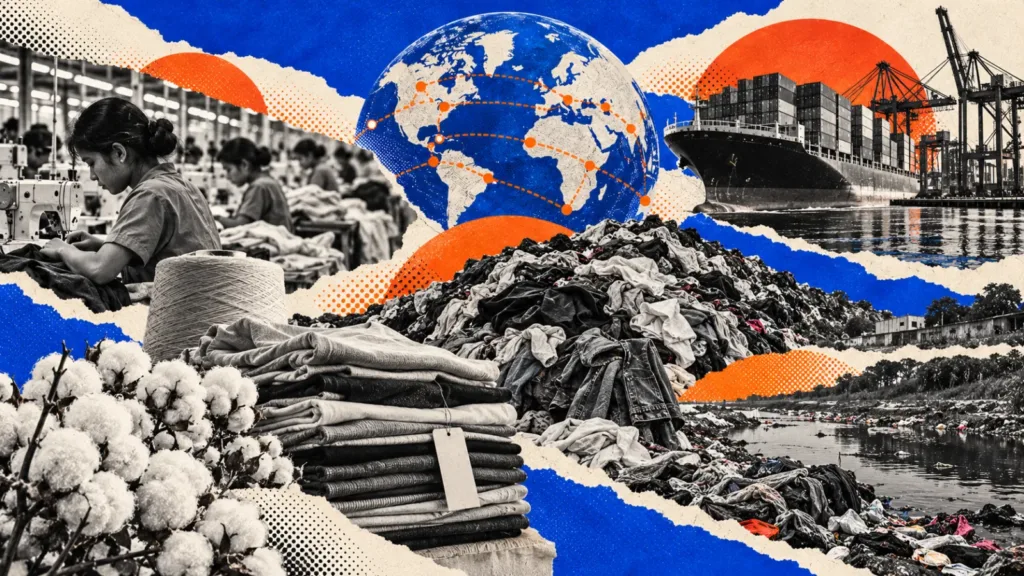
Fast fashion has changed the relationship between people and clothes. New styles arrive quickly, prices encourage frequent purchases, and garments can become disposable before they have worn out. The costs that do not appear on a price tag are harder to see: the water and energy used to make fabrics, the pollution created during production and disposal, and the working conditions of people across sprawling supply chains. A useful account of fast fashion must examine the business model linking these pressures, not merely blame shoppers for buying inexpensive clothes.
The issue is not that every low-priced garment is made through forced labor, or that every expensive brand protects workers and the environment. Neither is true. The central question is how prices, production volumes, procurement practices and weak accountability affect labor and ecological outcomes. By studying those mechanisms, we can separate documented harms from claims that every item of clothing carries the same social or environmental cost.
What This Article Covers
- What fast fashion means and how its business model operates.
- The environmental consequences of textile production, use and disposal.
- Why labor exploitation risks extend through recruitment and subcontracting.
- What evidence shows about forced labor without assuming all poor work is trafficking.
- How brands, governments and consumers can respond more effectively.
Key Takeaways
- Fast fashion combines rapid production cycles, frequent new styles and a business model that can encourage high consumption.
- UNEP estimates the textile industry produces approximately 2 to 8 percent of global greenhouse gas emissions.
- Forced labor is a documented risk in parts of garment and textile supply chains, but not every low-paid job meets the legal definition.
- Product labels and supplier audits cannot by themselves demonstrate that all workers are protected.
- A credible response needs purchasing reform, worker voice, enforceable labor rights, lower waste and longer product use.
What Fast Fashion Actually Means
Fast fashion describes a commercial approach in which companies translate trends into products quickly and sell frequently changing assortments at accessible prices. The model grew alongside globalized manufacturing, sophisticated logistics and the ability to gather information about demand almost instantly. Digital retail can accelerate these processes further, but there is no single legal definition that neatly separates every fast-fashion company from every other clothing retailer.
The distinction matters because discussions often reduce the industry to a few famous brands. Fashion supply chains contain cotton growers, fiber manufacturers, yarn spinners, dyeing facilities, mills, garment factories, transporters, warehouses, distributors and sellers. A company may control design and retail while outsourcing much of the physical work. Even when a supplier’s main factory is known, production can move to subcontractors or informal home-based workshops during surges in demand.
Low prices alone do not prove wrongdoing. Scale, efficient production and lower overhead can reduce costs legitimately. But when buying practices require exceptionally rapid delivery, frequent changes and narrow margins, suppliers may seek savings through excessive hours, unauthorized subcontracting, reduced safeguards or insecure employment. The proper investigative question is what commercial pressures exist and who absorbs them when things go wrong.
The Environmental Cost Begins Before a Shirt Is Sold
Clothing has an environmental footprint across multiple stages. Fibers require land, water or fossil-fuel-derived feedstocks. Yarn preparation, weaving, knitting, dyeing and finishing consume energy and chemicals. Garments are shipped, washed, worn and eventually repaired, resold, recycled, incinerated or discarded. A credible environmental comparison must identify the part of the lifecycle being measured and not compare incompatible numbers.
The United Nations Environment Programme reports that the textile industry accounts for approximately 2 to 8 percent of global greenhouse gas emissions. The wide range reflects differences in system boundaries and methods. It should not be recited as a precise percentage attributable exclusively to fast fashion. All textile production is included in broad sector estimates, and the impact of one garment depends on materials, manufacture, transport and use.
Water use is another major concern. Natural fibers may depend heavily on irrigation in water-stressed regions, while dyeing and finishing processes can produce polluted wastewater if treatment is inadequate. Synthetic fibers raise different issues, including dependence on fossil-derived materials and microfiber shedding. No fabric is environmentally perfect in every context. Claims that one material is always greener need to account for location, production practice, durability and end-of-life management.
The European Commission has described textile consumption as one of the European Union’s most consequential consumption categories for environmental pressure. UNEP’s 2025 work on circularity similarly points to a largely linear system of making, using and discarding products. Waste grows when clothes are designed for short use, consumers are encouraged to buy repeatedly, and collection systems cannot reuse or recycle the volume arriving at their doors.
Exporting secondhand garments is not automatically recycling. Some clothing can be reused productively in another market, but poor-quality items can overwhelm local waste systems and impose disposal costs on communities that did not produce or profit from the original consumption. The distinction between reuse and waste export matters, especially when a company’s recycling message relies on collecting clothes without demonstrating what happens next.
The Labor Behind the Price Tag
The garment sector provides employment to large numbers of people and can offer vital livelihoods. It would be inaccurate to describe the entire workforce as enslaved. Nevertheless, the sector also has documented risks of wage underpayment, unsafe working conditions, excessive hours and forced labor. The OECD’s guidance on responsible garment and footwear supply chains identifies the complexity of sourcing and subcontracting as central difficulties in protecting workers.
At one stage, workers may sew garments in a registered factory. At another, cotton or other raw materials may be harvested through recruitment systems that receive less scrutiny. Someone who is told that a job requires substantial fees may enter employment already carrying debt. Workers may then be threatened with penalties, experience confiscation of documents or be told they cannot leave until a debt is repaid. These are potential indicators of coercion and forced labor. A low wage or long shift, however unacceptable it may be under labor law, does not on its own prove trafficking.
A factory audit offers a snapshot at a particular time and often at one location. It may miss informal subcontractors, abusive recruitment agents or workers who fear retaliation if they speak honestly. A report showing no violations should therefore be examined for its scope and method. Did investigators interview workers independently? Were interpreters available? Were employment records compared with testimony? Did the brand investigate worker concerns outside the audited premises?
Purchasing practices can undermine assurances. A company might publicly promise safe conditions while setting delivery times that encourage excessive overtime or refusing prices that make lawful wages feasible. Preventing exploitation is therefore not only a supplier-management exercise. Brand executives and procurement teams need to account for the commercial decisions that shape conditions throughout the chain.
Forced Labor, Human Trafficking and the Difference Between Them
The phrase ‘sweatshop labor’ is often used loosely, and its legal meaning is not fixed. Human trafficking has a specific international definition involving acts, prohibited means for adults and an exploitation purpose, while forced labor is defined around involuntary work performed under menace of a penalty. Overlaps are substantial, but not every garment worker who experiences poverty, low wages or unsafe conditions is legally a trafficking victim.
These distinctions do not excuse abuses. They help determine which protections and legal remedies apply. Wage theft, occupational injury and discrimination can demand urgent action even where trafficking elements are not established. When workers are threatened, trapped by debt or prevented from leaving, the possibility of forced labor calls for specialist investigation and protection. Brands and journalists should avoid claiming that a named supplier or company used forced labor without reliable evidence supporting the allegation.
The broader economic link deserves attention. Exploitation of people and environmental damage may result from purchasing systems that reward the lowest short-term cost while overlooking harms borne elsewhere. A river polluted by textile processing and a worker paid unlawfully are not necessarily harmed by the same actor, but both can be affected by supply chains with weak accountability. The relationship must be investigated, not asserted as an automatic causal fact.
Can Better Materials Solve Fast Fashion?
Material substitution can reduce particular impacts, but the answer depends on how garments are produced and used. Recycled polyester may reduce demand for some virgin inputs yet still shed microfibers. Organic cotton may address some agricultural inputs while retaining water and land impacts. Lower-impact dyeing can matter, but its contribution depends on the energy mix, treatment systems and monitoring. A garment’s environmental performance cannot reliably be inferred from one word on a label.
Durability and use are often overlooked. Keeping a garment in service longer can reduce demand for replacement, especially if the item is genuinely worn instead of merely stored. Repair, alteration and secondhand use can be useful, but they are not a license to accelerate buying because resale is available. Renting clothing can offer advantages in some circumstances and disadvantages in others when transport and cleaning are included. Context matters more than fashionable claims.
A more fundamental change is to address production volume and incentives for unnecessary consumption. Companies can offer fewer but more durable products, make repairs accessible and design for reuse. Governments can improve producer responsibility rules, chemical safeguards and standards for textile waste. Workers and communities should have a voice in how transitions are implemented so that environmental reforms do not simply destroy livelihoods without creating better alternatives.
How Brands Should Be Held Accountable
The OECD sets out a continuing due-diligence process: identify potential and actual harms, prevent or mitigate them, track responses, communicate appropriately and participate in remedy. That is more demanding than issuing a supplier code of conduct. A brand needs to know where critical inputs originate, how recruitment works and whether workers can raise concerns without losing their income or safety.
Brands should disclose meaningful supply-chain information and explain what they have done when abuses were found. Perfect claims are less credible than specific reporting about risks, remediation and measurable progress. Policies should address employment contracts, freedom of association, legal wages, excessive overtime and responsible purchasing. Independent unions, worker representatives and community organizations have knowledge that supplier questionnaires often miss.
Environmental accountability also requires evidence. Companies should explain the basis for emissions, water and recycling claims, avoiding comparisons that use inconsistent boundaries. Product take-back schemes need data on actual reuse and disposal. Laws and rules differ by jurisdiction, so consumers should be cautious about assuming a promotional sustainability statement carries a uniform legal guarantee.
What Shoppers Can Do, Without Taking All the Blame
Buying less, choosing clothing likely to be worn repeatedly, repairing usable items and checking credible brand disclosures can help reduce waste and create pressure for better practices. Yet consumers cannot independently inspect a multinational supply chain. A person with limited income should not be made morally responsible for problems that businesses and regulators are better placed to address.
The most meaningful personal actions may also be civic and collective: supporting labor rights organizations, asking employers and institutions to procure responsibly, backing stronger due-diligence laws and questioning exaggerated environmental claims. Practical change depends on workers having rights and companies being required to honor them, not only on shoppers making isolated purchases.
Not For Sale works on the broader intersection of exploitation, livelihoods and environmental harm, including efforts to build dignified economic alternatives in vulnerable communities. This is relevant to the systems discussed here, although the organization should not claim direct influence over garment factories or branded fashion supply chains without evidence. Its approach suggests an important question: who receives the value created by a product, and how can the people at the beginning of the chain gain genuine control over their work and future?
Cheap clothing is not inherently a moral failure, nor are expensive clothes automatically ethical. The real test is whether an industry’s speed and pricing depend on passing unacceptable costs to workers, communities and ecosystems that have the least power to refuse them. That question belongs in every serious account of fast fashion.
Frequently Asked Questions
What is fast fashion?
It is a business model characterized by rapid production, frequent new styles and relatively accessible prices, often designed to respond quickly to changing demand.
Why is fast fashion bad for the environment?
High production volumes, material inputs, energy, chemicals, water use and disposal can create significant environmental pressures. The size of the impact depends on the supply chain and garment lifecycle.
Is fast fashion made with forced labor?
Forced labor is a documented risk in parts of textile and garment supply chains, but it would be wrong to assume every fast-fashion garment is made through coercion.
How much does fashion contribute to emissions?
UNEP cites an estimated 2 to 8 percent of global greenhouse gas emissions for the textile industry. The range is not an exact figure solely for fast-fashion retailers.
Is expensive fashion more ethical?
Not necessarily. Price alone reveals little about labor conditions, recruitment practices or environmental impacts.
Is secondhand clothing always sustainable?
Reuse can extend product life, but outcomes depend on whether clothing is genuinely reused and how transport and disposal are handled.
How can clothing brands reduce forced labor risk?
Through supply-chain due diligence, fair purchasing, recruitment oversight, worker voice, independent grievance systems and remedy when harm occurs.
What is the most effective thing consumers can do?
Buy with longevity in mind when possible, use garments longer and support stronger institutional standards; consumers cannot replace business and government accountability.
Sources
- UNEP, Minimizing fashion’s environmental footprint, Annual Report 2025: https://www.unep.org/annualreport/2025/stories/minimizing-fashions-environmental-footprint
- UNEP, Transforming the Textile Industry, 2025: https://wedocs.unep.org/items/670a5193-66c3-4c85-9b45-a97a51cddb36
- OECD, Due diligence essentials for responsible garment and footwear, 2026: https://www.oecd.org/en/publications/responsible-business-conduct-spotlights_03a75bf9-en/due-diligence-essentials-for-responsible-garment-and-footwear_c7ae4e4a-en.html
- OECD, Responsible garment and footwear supply chains: https://www.oecd.org/en/topics/sub-issues/due-diligence-guidance-for-responsible-business-conduct/responsible-garment-and-footwear-supply-chains.html
- European Commission, EU Strategy for Sustainable and Circular Textiles: https://environment.ec.europa.eu/strategy/textiles-strategy_en
- UNODC, The crime of trafficking in persons: https://www.unodc.org/e4j/en/tip-and-som/module-6/key-issues/crime-of-trafficking-in-persons.html
- Not For Sale, Social innovation: https://wearenotforsale.org/learn/what-is-social-innovation/
Not For Sale
A global movement fighting modern-day slavery and ecocide in 33 countries. Building on the frontlines since 2007.