Illegal Gold Mining in Munduruku Territory: An Ecocide Story in the Amazon
A new federal police operation in Brazil’s Munduruku Indigenous Territory has exposed the persistence of illegal gold mining, mercury contamination and forest destruction. The crisis shows why environmental crime in the Amazon cannot be treated as a series of isolated raids.

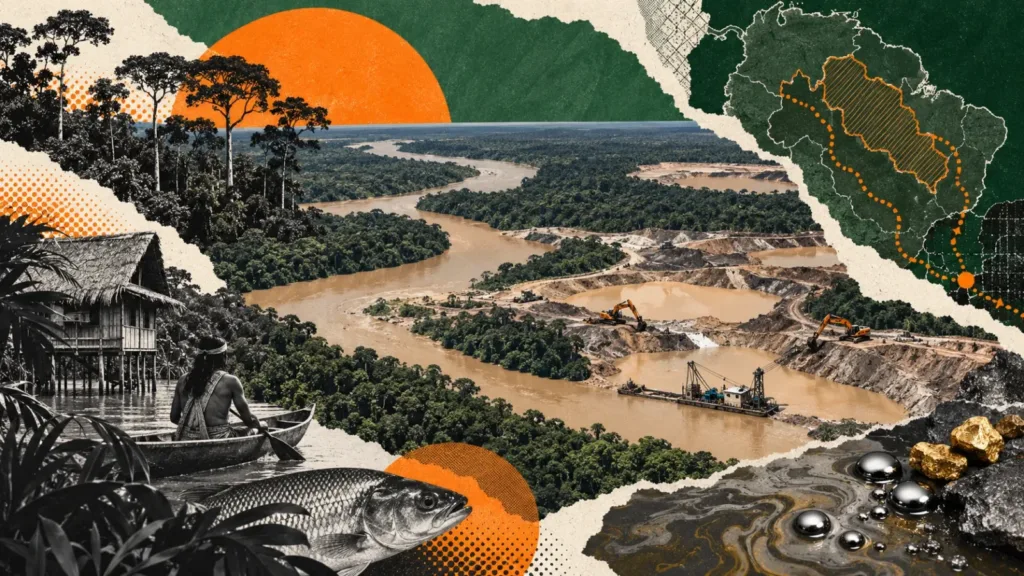
Illustrative artwork; it does not depict a specific documented incident.
A river can carry gold and poison at the same time. In Brazil’s Munduruku Indigenous Territory, illegal gold mining has turned that contradiction into a daily reality. Mining tears open forest, diverts waterways and introduces mercury into ecosystems that communities depend on for food, transport and cultural continuity. The damage is not contained to a pit in the ground. It travels through water, fish, soil and the wider landscape. That is why a new federal police operation in Pará matters far beyond the equipment that officers destroyed. Between September 14 and 18, 2026, Brazil’s Federal Police, supported by the Pará Military Police, targeted recurring illegal mining points inside Munduruku Indigenous Territory. The operation disabled dredges, an excavator, diesel engines and support structures, causing an estimated R$5 million in losses to those responsible. The police said the action had been planned because mining activity persisted in areas that had already been inspected before. That detail changes the meaning of the raid. This is not simply an enforcement success. It is evidence of a system resilient enough to return after enforcement, re-establish infrastructure and continue extracting value from protected land. At the same time, new research and reporting show that gold mining has expanded dramatically across Indigenous territories in the Amazon, while mercury pollution, deforestation and climate pressure compound the risks communities face. The question is no longer only how many illegal operations can be dismantled. It is whether the underlying economy of destruction can be dismantled with them.
Why Munduruku matters now
The latest operation comes at a moment when the scale of mining pressure on Indigenous lands is becoming clearer. A 2026 technical analysis by the Amazon Environmental Research Institute, IPAM, found that the area directly affected by gold mining in the Legal Amazon increased twentyfold between 1985 and 2024. Inside Indigenous territories, the increase was even greater: twenty fourfold over the same period. IPAM reported that mining inside Indigenous lands expanded from roughly 1,500 hectares in 1985 to more than 36,000 hectares in 2024. The burden is not spread evenly. According to IPAM, the Kayapó, Munduruku and Yanomami territories account for 89 percent of the area affected by mining inside Indigenous lands in Brazil. Munduruku therefore sits at the center of a much larger pattern. Illegal extraction is repeatedly pushing into territories that are legally protected, ecologically important and central to the survival of communities whose relationship with the forest extends far beyond economics. In September, the Environmental Investigation Agency also published new evidence of widespread illegal gold mining across Munduruku territory. Using high-resolution satellite imagery, the organization documented mining activity despite a long-running federal crackdown. The report, titled The Poisoning of Munduruku Land, focused particularly on mercury contamination and the effects of illegal mining on water and food systems. Munduruku organizations have been using geospatial monitoring to document incursions and share evidence with Brazilian authorities and international human-rights bodies. Taken together, these developments show why the story cannot be reduced to another illegal mining raid. The mining is persistent, geographically extensive and connected to wider systems of financing, logistics and trade. The environmental damage is equally systemic. Forest is removed to reach mineral deposits. Rivers are disrupted and polluted. Mercury enters food chains. Communities are left to absorb consequences that can remain long after a mining camp has been dismantled.
Why Munduruku is more than a local enforcement story
Each layer of the crisis points to a different part of the same system: extraction, ecological damage, public health, weak traceability and repeated re-entry after enforcement.
| Issue | What is happening | Why it matters |
|---|---|---|
| Illegal mining | Federal police are repeatedly returning to active mining points inside protected Munduruku territory. | Enforcement is disrupting operations, but activity is reappearing. |
| Ecological damage | Forest clearance, dredging and river disturbance accompany gold extraction. | The effects extend beyond the mine site into whole ecosystems. |
| Mercury pollution | Mercury used to separate gold can enter water, sediment and fish. | Contamination creates long-term risks for health and food security. |
| Gold traceability | Illegally mined gold can be laundered through permits and commercial intermediaries. | Environmental crime can enter legal markets once its origin becomes obscured. |
On smaller screens, swipe across the table to read all three columns.
Mercury turns extraction into a public-health crisis
Gold mining in the Amazon is especially destructive because mercury is often used to separate gold from ore. In artisanal and small-scale mining, mercury binds with gold to form an amalgam. When that amalgam is heated, the mercury evaporates and the gold remains. The process is cheap and effective, which is why it is widely used in informal mining economies. It is also deeply dangerous. The United Nations Environment Programme identifies artisanal and small-scale gold mining as the largest source of human-caused mercury releases worldwide. UNEP estimates that the sector accounts for roughly 37 percent of global mercury releases from human activity. Much of that mercury enters the air, water and soil. Because mercury does not simply disappear, it can move through ecosystems and accumulate in food chains. The World Health Organization warns that mercury is toxic to the nervous, digestive and immune systems, as well as the lungs, kidneys, skin and eyes. Exposure is especially dangerous during pregnancy and early childhood because mercury can affect neurological development. In river-based communities, the risk becomes particularly difficult to escape when contamination enters fish, one of the routes through which methylmercury can reach people. In the Amazon, this turns an environmental crime into something more intimate. A damaged river is not only an ecological loss. It can become a route through which contamination reaches meals, pregnancies and children. When gold mining pollutes the same waterways that communities depend on for fish, drinking water and movement, ecological damage becomes inseparable from health and cultural survival.
A mining site can be dismantled in days. Mercury can remain in an ecosystem for years.
When a forest becomes an extraction zone
Illegal gold mining also reshapes the land itself. Mining strips vegetation, opens access routes, moves sediment and alters waterways. Unlike some forms of forest loss, mining damage is often concentrated along rivers and floodplains, which means disruption can spread through connected aquatic systems rather than remaining within a single cleared area. This is one reason the language of ecocide has become increasingly relevant to cases like Munduruku. The term is used to describe severe and widespread or long-term environmental destruction, although its precise legal status differs between jurisdictions and international proposals. Applying the term responsibly requires care. Not every environmental offense is ecocide. The significance of Munduruku lies in the scale, persistence and depth of the harm being documented. The damage reaches beyond trees. River systems are changed. Fish and wildlife are exposed to contamination. Communities face pressure on food security and health. The territory itself becomes fragmented by roads, machinery and illegal infrastructure. When this happens repeatedly inside an Indigenous territory, the harm is not simply environmental in a narrow sense. It affects the social and cultural systems built around the land. Not For Sale has previously examined how illegal gold mining in Peru combines environmental destruction with exploitation, and how organized crime can turn Amazon extraction into a wider criminal economy. Munduruku reflects the same underlying problem. The mine site is only the visible point where a much larger system touches the ground.
The environmental crime does not end at the mine
Illegal mining persists because gold has somewhere to go. Once extracted, it enters a commercial chain in which origin can become increasingly difficult to verify. Traders, refiners, permits and paperwork can separate the physical metal from the landscape in which it was mined. That gap creates the opportunity for illegal gold to acquire a legal-looking history. Earlier in 2026, Reuters reported on a Greenpeace investigation into so-called ghost permits in the Brazilian Amazon. Greenpeace examined permitted mining areas near protected lands and found numerous sites where official permits existed but little or no visible mining activity took place. Those permits were nevertheless associated with significant volumes of gold sales. The concern is that legal documentation can be used to justify gold that was actually extracted elsewhere, including in protected or Indigenous territories. That is why enforcement focused only on excavators and dredges can never be enough. Destroying machinery interrupts extraction, but it does not necessarily dismantle the financial and commercial infrastructure that makes the activity profitable. If buyers remain available, if permits can be manipulated, and if gold can be blended into legal markets, miners have a reason to return. The current Munduruku operation is revealing precisely because the police described the targeted sites as recurrent. Activity had returned to places that had already faced intervention. This is what a resilient criminal economy looks like: it absorbs enforcement as a cost, reorganizes and continues.
Climate pressure makes the damage harder to survive
Mining is also colliding with a more unstable climate. IPAM’s 2026 research examined mining alongside droughts, floods, wildfires and landslides affecting municipalities that contain Indigenous territories. The institute found that these pressures overlap rather than occur in isolation. Communities dealing with mining-related contamination and forest degradation are often confronting climate extremes at the same time. For Indigenous communities, those combined risks affect water, food, transportation and access to healthcare. A river already contaminated by mining becomes more dangerous when drought concentrates pollutants or when floods redistribute contaminated sediment. Forest degradation can reduce ecological resilience while climate extremes place additional stress on crops, wildlife and infrastructure. IPAM’s analysis found that 147 Indigenous territories in the Amazon, around 37 percent of the total, lie within watersheds affected by mining. Nineteen contain mining activity inside their boundaries. The research also found that 40 percent of mining areas outside Indigenous territories are located within 50 kilometers of their borders. This means territorial protection cannot be understood only as a line on a map. Environmental damage upstream or nearby can still reach communities through water, roads and criminal networks.
Repeated raids show both progress and failure
Brazil’s federal government has invested significant resources in trying to remove illegal mining from Munduruku land. A major de-intrusion operation launched in late 2024 brought together federal ministries, the armed forces, police, environmental agencies and Indigenous affairs bodies. By early 2025, officials said the first phase had carried out 523 enforcement actions and caused R$112.3 million in losses to illegal mining operations. Authorities destroyed camps, boats, heavy machinery, engines and large quantities of fuel. Mercury and gold were also seized. Those actions matter. They raise the cost of illegal mining and make operating inside protected territory more difficult. The new September 2026 operation shows, however, that suppression is not the same as elimination. The return of mining activity raises an uncomfortable question. If enforcement repeatedly destroys the physical tools of extraction but the underlying market remains intact, how long before equipment returns? The answer depends on whether the response moves beyond territorial raids into finance, traceability, corruption, logistics and demand.
Indigenous monitoring is part of the answer
The people living inside Munduruku territory are not passive witnesses to this destruction. Indigenous organizations have been documenting illegal mining, mapping incursions and using geospatial evidence to pressure authorities. The Environmental Investigation Agency’s recent work highlights how satellite imagery and territorial monitoring can give communities stronger evidence when reporting environmental crime. This matters because official enforcement is often intermittent. Indigenous monitoring is continuous. Communities see changes in water, access routes, machinery and forest loss before they appear in national statistics. Their knowledge is not supplementary to environmental protection. It is part of the infrastructure required to make protection work. The same principle applies to long-term recovery. Mercury contamination, degraded fisheries and damaged rivers cannot be repaired simply by removing miners. Environmental remediation, healthcare and sustained territorial protection require years of work. Communities need resources and political power not only to stop extraction, but to restore what extraction has damaged.
Support the work behind the story
Help challenge the systems that make destruction profitable
Stories like Munduruku show that ecocide is not only about damaged land. It is about the economic and political systems that allow environmental destruction to continue while communities carry the cost. Not For Sale works at the intersection of exploitation, environmental harm and social innovation, supporting approaches that strengthen people and places under pressure.
Your support helps sustain that wider work and the long-term partnerships behind it.
The gold market has to carry responsibility too
The persistence of illegal mining in the Amazon exposes a broader weakness in environmental accountability. Consumers rarely see the landscape behind a piece of gold. By the time gold reaches a jewelry store, investment product or industrial supply chain, it has often passed through refiners and traders that make its geographic origin difficult to see. Better traceability is therefore part of environmental protection. Brazil has begun using forensic techniques to analyze the chemical composition of gold and help determine where it came from. Federal police researchers have developed methods often described as gold fingerprinting, using scientific analysis to compare samples with known geological sources. These approaches cannot solve illegal mining by themselves, but they make it harder for paperwork alone to erase origin. Permitting systems also need stronger verification. If a license exists for an area with little or no actual extraction, yet large quantities of gold are being attributed to it, that discrepancy should trigger scrutiny. Environmental enforcement becomes much stronger when satellite imagery, financial records, permits and forensic testing can be compared rather than assessed separately.
Why this is an ecocide story
Ecocide is ultimately about scale, severity and persistence. It asks whether environmental destruction has become so extensive that the ecosystem itself, and the communities dependent on it, are being subjected to serious and lasting harm. Munduruku territory presents many of the conditions that make that question unavoidable. The mining is illegal. It is occurring inside protected Indigenous territory. It is damaging forest and rivers. Mercury contamination creates risks that can persist long after individual mining sites close. The activity is tied to a lucrative gold economy capable of surviving repeated enforcement. At the same time, the territory is facing wider climate pressures that make ecological degradation harder for communities to absorb. Calling this an ecocide story does not require pretending that a court has already made a legal finding. It means recognizing that the environmental destruction documented here is not incidental, temporary or geographically trivial. It is systematic enough to threaten the ecological foundations of life in the territory. That distinction matters because language shapes response. If illegal mining is treated primarily as a series of unauthorized economic acts, the solution appears to be police raids. If it is understood as environmental destruction embedded in a transnational commercial system, then enforcement has to widen. Gold buyers, refiners, permit systems, financial networks and supply-chain transparency all become part of the story.
The real measure of success
The September operation in Munduruku territory is a sign that Brazilian authorities are still willing to act. Equipment was destroyed. Illegal infrastructure was removed. Financial losses were imposed on those operating inside protected land. Those are meaningful interventions. The real measure of success, however, is whether the same sites remain empty months and years later. It is whether rivers recover, whether mercury exposure falls, whether gold becomes harder to launder and whether Indigenous communities gain more control over the future of their territory. A raid is an event. Protection is a condition that has to endure. Munduruku therefore offers a broader lesson about ecocide in the modern economy. Environmental destruction is rarely sustained by one actor. It survives because many systems make it possible: extraction, finance, logistics, weak oversight and distant demand. When those systems remain intact, destroyed machinery can be replaced. The challenge is to make the destruction itself unprofitable. Until that happens, the forest will continue to absorb costs that the gold market does not.
Frequently Asked Questions
What is happening in Munduruku Indigenous Territory?
Brazilian federal police carried out a new operation in September 2026 against recurring illegal gold mining sites inside Munduruku Indigenous Territory in Pará. Officers destroyed mining equipment and support structures in areas where illegal activity had returned after earlier enforcement.
Why is illegal gold mining considered an ecocide issue?
Illegal gold mining can cause extensive forest loss, river disruption, mercury contamination and long-term harm to ecosystems and Indigenous communities. Ecocide is used to describe severe and widespread or long-term environmental destruction, although its precise legal status varies by jurisdiction.
Why is mercury used in illegal gold mining?
Mercury binds with gold and helps miners separate it from crushed ore. The process is inexpensive, but mercury can contaminate air, soil and water and accumulate in fish, creating serious risks to human health.
How much has gold mining expanded on Indigenous lands in the Amazon?
IPAM reported in 2026 that the area affected by mining inside Indigenous territories in the Legal Amazon grew twenty fourfold between 1985 and 2024, reaching more than 36,000 hectares.
Why does mining return after police operations?
Mining can reappear when the financial incentives and commercial networks behind it remain intact. Equipment can be replaced, workers can return and illegally mined gold can still find buyers if traceability and financial enforcement are weak.
How does illegal mining affect rivers?
Mining can disturb riverbeds, increase sediment, damage aquatic habitat and introduce mercury into waterways. Contaminants can then move through fish and food chains, creating environmental and public-health risks beyond the mine site itself.
What is gold laundering?
Gold laundering occurs when illegally mined gold is given documentation that makes it appear to come from a legal source. This can involve false declarations, manipulated permits or mixing illicit gold with legally produced material.
What role do Indigenous communities play in monitoring illegal mining?
Indigenous organizations monitor territorial incursions, environmental changes and mining activity and increasingly use satellite and geospatial evidence to document illegal operations. This local monitoring can help authorities and courts understand what is happening between formal enforcement actions.
Can illegal gold mining be stopped by raids alone?
Raids can disrupt illegal operations, but long-term success also requires stronger gold traceability, financial investigations, permit oversight, environmental restoration, health monitoring and sustained protection of Indigenous territories.
Topics in this story
See all topicsNot For Sale
A global movement fighting modern-day slavery and ecocide in 33 countries. Building on the frontlines since 2007.