


From Survival to Strength: How One Young Woman’s Journey in Northern Thailand Shows the Power of Safe Spaces for Girls
7.4 MIN READ
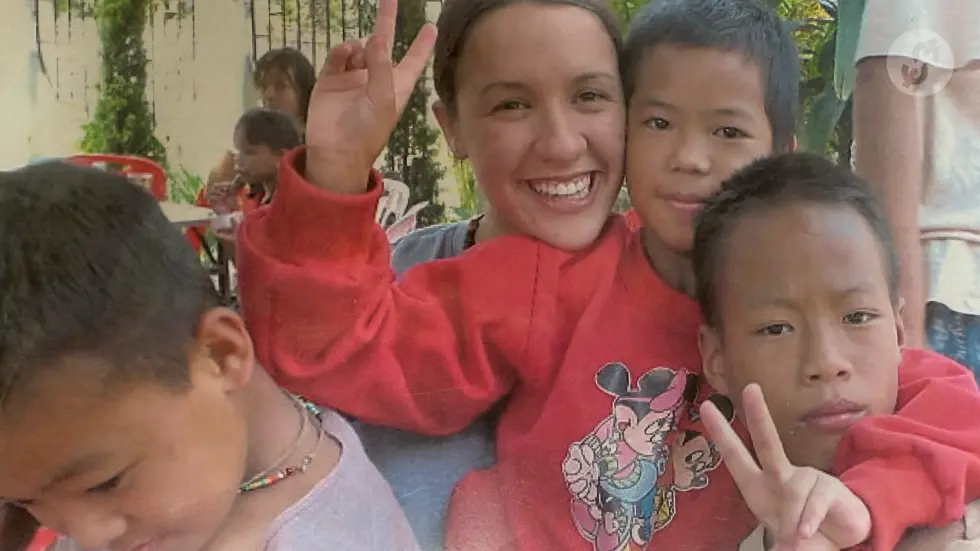
Raised in a borderland shadowed by exploitation, Lina’s story reveals how education, safety, and compassion can transform not only a life, but a family, and why the next step must be a girls-only dormitory in the Not For Sale Thailand village.
The Beginning: A Childhood on the Edge
Northern Thailand’s Mae Sai District is often described in travel brochures as lush, mountainous, and culturally rich. Yet beyond the scenic beauty lies another reality: villages perched on the Thai-Myanmar border, where poverty collides with drug trafficking, constant displacement due to war, and exploitation.
It was here that Lina, a young girl from the Akha hill tribe, began her life. Her childhood was marked not by the playfulness we often associate with those years, but by uncertainty. Her mother struggled with drug addiction, unable to provide care or stability. Her older brother, beaten and chased away by soldiers while begging, had already fled to seek help at Not For Sale’s Rescue Center where he encountered Kru Nam, the tireless leader of Not For Sale Thailand.
Seeing her brother finally given a chance to attend school and grow up in safety stirred something in Lina. She, too, wanted that chance, to be more than a statistic, more than another girl lost to the margins of society. And so, as a young child, she joined her brother at Not For Sale Thailand’s home.
She was one of the first kids Kru Nam ever welcomed to Baan Kru Nam (translates as “Kru Nam’s Home”, a community started by Not For Sale and Kru Nam for vulnerable children on the Thai-Myanmar-Laos border).
A Home That Offered More Than Shelter
For the next eight years, Lina grew up in the care of Kru Nam and the staff at Baan Kru Nam She attended the local Doi Chan School.
Traditionally education was not a given for Akha girls, many families, strapped for resources, saw daughters as helpers in fields or households rather than students in classrooms. But here, Lina found the support to dream bigger.
Completing primary school, she advanced to secondary school in nearby Loei Province, an accomplishment in itself for a girl from her background. Education gave her not just literacy and skills but a sense of dignity. She was no longer a child surviving on the periphery; she was a student with goals, surrounded by peers, books, and mentors who believed in her.
Equally important, Baan Kru Nam did not forget her mother. While Lina studied, the foundation helped her mother access drug rehabilitation in Mae Sai. For the first time, the possibility of family healing began to take shape.
Stepping Into Adulthood
By age 18, after graduating, Lina had entered the workforce in Chiang Rai to support her recovering mother. She soon married a kind and hardworking man, integrating into his family’s agricultural life. While this transition might sound ordinary, for Lina it represented something extraordinary: stability. Her husband’s family welcomed her wholeheartedly, valuing her resilience and willingness to contribute to the family farm.
But life, as it often does, presented new trials. Lina’s first child was born with a congenital heart defect. The costs, financial, emotional, and logistical, were crushing. Once again, she turned to Kru Nam and Not For Sale Thailand. They intervened, coordinating with government agencies to secure the legal rights and medical care her child desperately needed. Surgery was arranged in Chiang Rai. Her child survived.
That moment crystallized the deeper meaning of Kru Nam and Not For Sale Thailand’s work. This was no longer only about helping a young girl escape hardship; it was about enabling her to raise a healthy family, to carry resilience into the next generation.
A Family Transformed
Today, Lina is 30 years old, living with her husband, her two children, and, remarkably, her mother, who is now sober. Together, they farm vegetables, cassava, and corn in Mae Chan District. Their lives are far from easy, but they are stable, hopeful, and rooted in dignity.
When Kru Nam visited the family, she found them thriving.
A Mother’s Day Surprise
August 10, 2025 was Mother’s Day in Thailand. Lina surprised Kru Nam by traveling back to Baan Kru Nam to see her, this time with her mother by her side. Her mother’s words left a mark: gratitude for those who had cared for her daughter when she could not, and for helping her family find a path away from the cycles of poverty and addiction.
The most striking detail? Lina’s eldest child, now ten years old, wants to become a doctor. When asked why, she explained simply:
“Because I want to heal my mother and my grandmother.”
That aspiration reflects the deepest ripple effect of change. One girl’s education becomes her children’s inspiration. One mother’s rehabilitation becomes a granddaughter’s purpose. Violence and abandonment are replaced with ambition and care.
Why Safe Spaces for Girls Matter
Lina’s story is not an isolated case; it is a vivid example of what happens when a girl is given safety, education, and encouragement. Without intervention, she might have followed a common trajectory for hill tribe girls: child labor, early marriage without choice, or trafficking.
Across the globe, studies reinforce what her life demonstrates. According to UNESCO, each additional year of education for a girl increases her future earnings by up to 20%. Girls who receive secondary education are far less likely to be child brides and far more likely to raise healthy children. UNICEF research shows that educated mothers are twice as likely to send their own children to school.
But education cannot flourish without safety. In borderland regions like Mae Sai, where trafficking networks prey on vulnerability, safe housing is the critical first step. A secure dormitory does more than provide a bed, it gives a girl freedom from fear, the stability to attend school, and the confidence to imagine a future beyond survival.
The Next Step: Building a Girls’ Dorm
For more than 20 years, Kru Nam and the Not For Sale Thailand community have built safe havens for children at risk. The success is visible in lives like Lina’s. Yet, the work is far from over. Our next challenge focuses on constructing a girls-only dormitory in the Thailand village.
Why specifically for girls? Because the risks they face are uniquely severe. Girls are disproportionately targeted for exploitation and trafficking. They often shoulder the burden of caring for younger siblings when parents are absent or incapacitated. In many tribal communities, boys are prioritized for schooling while girls are expected to remain at home.
A girls-only dorm creates an environment where these young women can bond, learn, and grow without fear. It offers privacy, security, and mentorship tailored to their needs. Most importantly, it communicates a powerful message: your life, your dreams, and your future matter.
What Lina Teaches Us
Lina’s journey underscores three essential truths:
Education changes generations. Lina’s years in school reshaped her path. Now her daughter aspires to become a doctor, a dream unthinkable without that early access to learning.
Family healing is possible. When Lina’s mother received rehabilitation, it broke a cycle of addiction that had threatened to consume the family. Recovery is not only for individuals but for entire lineages.
Safe communities spark sustainability. A girl rescued from hardship becomes a woman supporting her family, contributing to agriculture, and raising children who dream of service. This is sustainability in action, not charity as a bandage, but as a catalyst for long-term change.
It’s easy, when faced with the vastness of global issues like trafficking, to feel powerless. But stories like Lina’s remind us that targeted interventions work. A dormitory may seem like just a building, yet within its walls lies the power to change hundreds of lives.
From Borderlands to Bright Futures
On the Thai-Myanmar-Laos border, where uncertainty often defines childhood, Lina’s story shines as a testament to resilience and hope. From a young girl fleeing instability to a mother raising two children in a stable home, her life embodies the transformation that safe spaces, education, and compassion make possible.
Her daughter’s dream of becoming a doctor is not just about medicine, it is about healing across generations, about proving that dignity is not reserved for the privileged but earned by every child given a chance.
As Not For Sale Thailand looks ahead to building a girls-only dormitory, the vision is clear: multiply Lina’s story. Ensure that every girl, no matter how precarious her beginnings, has the safety, food, education, and love needed to thrive.
Because when one girl rises, so too does her family, her community, and, ultimately, society itself.
Sources:
UNESCO. “The Benefits of Girls’ Education.”
UNICEF. “Education and Gender Equality.”
World Bank. “Missed Opportunities: The High Cost of Not Educating Girls.”
Published on October 14, 2025

Sign Up to our Newsletter
Join our movement and get the latest updates, stories, and ways to take action, straight to your inbox.