How financial records help investigators uncover human trafficking
Public records, digital traces and financial evidence can help investigators establish exploitation independently, reducing reliance on survivors to recount and prove everything that happened to them.

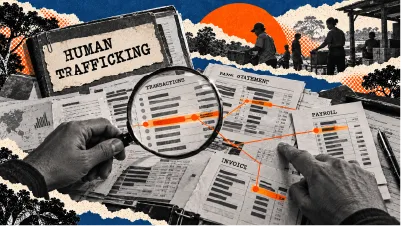
That distinction is the subject of an analysis published by Thomson Reuters Institute on October 8. It examines how investigators can connect information beyond financial transactions to develop leads and corroborate exploitation. Its significance lies in the responsibility such an approach places on institutions: a survivor’s account may be essential, but investigators should also seek evidence that does not depend on that person explaining every part of the crime. Thomson Reuters Institute
This is an analysis of investigative practice, rather than a newly announced operation or a study demonstrating a particular increase in convictions. Its central proposition nevertheless addresses a longstanding difficulty. When a case rests heavily on testimony, the person who has already endured exploitation may also be expected to sustain the investigation through fear, uncertainty and a lengthy legal process.
Independent evidence cannot remove every burden. It can distribute the work of establishing the facts more fairly, while helping investigators identify the people and arrangements behind the exploitation.
What This Article Covers
- What investigators need to establish in a human trafficking case.
- How records and digital traces can corroborate exploitation.
- Why an investigative signal is different from proof.
- How evidence can reduce reliance on survivor testimony.
- Why privacy, support and fair treatment matter throughout an investigation.
- What readers and organizations can do without placing people at further risk.
Key Takeaways
- Human trafficking investigations must establish the relevant legal elements, rather than infer exploitation from a suspicious association.
- Financial records become more informative when examined alongside other evidence.
- Independent sources can support a survivor’s account and reveal connections beyond their knowledge.
- A digital match or shared address is a lead requiring verification, not a finding of guilt.
- Some cases can proceed without survivors testifying, depending on the available evidence and applicable law.
- Survivor assistance should not be made conditional on participation in a prosecution.
Why this analysis matters now
The October analysis brings attention to a practical question: how much can investigators establish before asking a survivor to supply the missing explanation? It identifies six categories of information beyond transaction monitoring, including public records, online advertising and social media. Used carefully, these can help investigators examine relationships and patterns that individual records leave unexplained. Thomson Reuters Institute
The underlying approach predates today’s digital tools. UNODC’s Toolkit to Combat Trafficking in Persons, published in 2006, describes proactive investigations that seek evidence independently of victim testimony. Its examples concern the infrastructure trafficking operations need, including premises, advertising, transportation, and financial arrangements. The technology has changed considerably since then; the investigative principle remains useful.
A person experiencing exploitation may know who threatened them without knowing who leased the building, managed the accounts or recruited other workers. Investigators can pursue those questions through records and cooperation between agencies. Doing so broadens the case beyond what any one survivor could reasonably be expected to know.
What investigators must establish
Under the UN Trafficking in Persons Protocol, trafficking involving adults comprises an act, prohibited means and an exploitative purpose. Acts include recruitment, transfer, harboring or receipt of a person. Means include coercion, deception and abuse of vulnerability. For children, the international definition does not require proof of those means, although the act and exploitative purpose still matter.
Trafficking does not require an international border crossing. National laws determine the precise offenses and evidentiary requirements in each jurisdiction, so a general explanation cannot settle whether the elements of a particular charge have been proven.
These distinctions shape what evidence is needed. Records showing recruitment may help establish how someone entered an arrangement, while communications or financial arrangements may illuminate the pressure that kept them there. Evidence must connect those circumstances to exploitation and the responsibility of the accused.
For a broader introduction, Not For Sale’s 50 Essential Facts About Human Trafficking explains recruitment, coercion, domestic trafficking and the differences between trafficking and related offenses. Not For Sale
The records that can reveal an operation
The Thomson Reuters analysis identifies the following information sources. The table distinguishes their potential investigative value from the conclusions they cannot establish alone.
| Information source | What it can help investigators examine | What still requires verification |
|---|---|---|
| Public records | Connections between properties, addresses and business interests. | Who exercised control and whether the connection concerns exploitation. |
| Records concerning suspected illicit massage businesses | Possible relationships between establishments and operators. | Whether offenses occurred; a massage business is not inherently a trafficking operation. |
| Online commercial-sex advertisements | Repeated contact details, locations or identities. | Who posted the material, the person’s circumstances and any coercion or exploitation. |
| IP-address information concerning child exploitation | Technical leads associated with suspected online offending. | Attribution to a user and whether trafficking is involved. |
| Social media information | Relationships and communications relevant to an inquiry. | Authenticity, context and who controlled an account. |
| News and regulatory information | Previous allegations, enforcement actions and potential connections. | The underlying facts and the distinction between allegations and established findings. |
The same discipline applies across these categories. A connection can direct attention toward a useful question without answering it. Investigators still need to establish the source, timing and meaning of a record, and to examine reasonable explanations that do not involve trafficking.
Following the money still matters
Looking beyond transactions should strengthen financial investigation rather than displace it. UNODC’s toolkit describes financial inquiries as an important part of proactive work, including establishing the arrangements and proceeds associated with suspected trafficking.
The question is what a transaction means in context. Payment into an account does not necessarily establish that the worker controlled the money. A transfer out does not explain whether it was voluntary, required under a legitimate agreement or compelled through threats.
Evidence of who accessed an account, what deductions were imposed and what the worker had been promised can help clarify that context. These are questions to investigate, not reasons to assume that a particular banking pattern establishes exploitation.
Financial evidence may also reach beyond an individual’s experience. Where records support it, investigators can examine who received the proceeds, whether payments connected different locations and how an operation was maintained. That can help identify responsibility outside the immediate relationship between a survivor and the person directly controlling them.
Corroboration means more than repetition
Corroboration is evidence that supports or verifies another part of an account. Its value depends on quality and independence, not simply on the number of places where a claim appears.
Three websites repeating one allegation do not provide three independent accounts. Several databases drawing from the same original record may reproduce the same error. An impressive network diagram can therefore exaggerate confidence if the sources behind its connections are not examined.
The questions are straightforward: where did the information originate, when was it recorded and what does it actually establish? Investigators also need to consider contradictory material. Evidence that weakens an initial theory is part of a proper investigation, rather than an inconvenience to be excluded.
The difference becomes clearer when records are considered against specific questions:
| Investigative question | Evidence that may help answer it | Important limit |
|---|---|---|
| What was the person promised? | Recruitment communications, advertisements or contracts. | The promise must be connected to the person and the relevant period. |
| Who organized accommodation or work? | Leases, business records, messages and witness accounts. | Ownership or association does not automatically establish criminal responsibility. |
| Who controlled earnings? | Account records, payment instructions and evidence of access. | The named account holder may not be the person exercising control. |
| What prevented refusal or departure? | Threatening messages, evidence of imposed debt or restrictions, and contextual accounts. | Conditions must be assessed together under the applicable legal test. |
| Who benefited from exploitation? | Financial flows and evidence linking people to the operation. | Receipt of money requires context; it does not alone prove trafficking. |
The distinction protects both survivors and the integrity of a case. Evidence should help establish what happened, rather than make a preexisting suspicion look more elaborate.
Reducing the burden without silencing survivors
A survivor may be able to describe coercion that a document only partly reveals. Independent evidence should support that account and reduce unnecessary reliance on repeated disclosure, while preserving the person’s opportunity to explain what the records mean.
There are substantial reasons why participation can be difficult. Research published in May 2025 by the Modern Slavery and Human Rights Policy and Evidence Centre identified fear of reprisals, concerns about arrest or deportation, poor support, language barriers and lengthy proceedings among obstacles to survivor engagement. The research drew primarily on practitioner perspectives and called for greater use of corroborative financial and digital evidence. Barriers to prosecutions and convictions under…
Those findings complicate the familiar question of why a survivor is reluctant to cooperate. The more useful question may be whether the system has made participation safe and manageable. An appointment is difficult to attend without reliable transportation or child care; an interview is difficult to understand without suitable language support; an investigation may feel dangerous if the person fears retaliation.
Better evidence gathering cannot resolve those conditions by itself. It should operate alongside practical support and clear communication, so that reducing the evidentiary burden does not become an excuse to neglect the person affected.
Can a human trafficking case proceed without testimony?
Sometimes it can. In England and Wales, Crown Prosecution Service guidance says early consideration should be given to whether a case can be prosecuted when victims or witnesses are unable or unwilling to testify. It also addresses measures that can help vulnerable or intimidated witnesses participate. The Crown Prosecution Service
That is not a guarantee that every case can proceed without testimony. The available evidence must still satisfy the relevant charging and trial requirements. Records may establish parts of an operation while leaving important questions about coercion, knowledge or responsibility unresolved.
The objective should be to avoid making a case unnecessarily dependent on one person. Where testimony remains important, the investigation should have already pursued other reasonable sources of evidence. Where sufficiently strong evidence exists without it, prosecutors can assess the lawful options.
“Evidence-led” therefore describes a responsibility to develop the case thoroughly. It should not imply that survivors are irrelevant to the process or that their wishes and safety can be disregarded.
When the evidence can also prevent wrongful blame
A person may appear in financial, employment or digital records because someone else required them to participate. Understanding control can therefore matter when investigators encounter apparent offending as well as when they identify a possible victim.
CPS guidance addresses the non-punishment of identified victims, the statutory Section 45 defense and other relevant principles in England and Wales. It requires attention to trafficking circumstances, including where a suspect has not independently disclosed exploitation. These protections are subject to legal conditions and are not blanket immunity. The Crown Prosecution Service
The wider investigative lesson is that recorded activity does not explain freedom of choice. An account, message or transaction must be assessed in context before responsibility is assigned. A thorough inquiry should seek evidence capable of distinguishing the person directing an operation from someone compelled to carry out its tasks.
Who is most at risk of being overlooked?
The visibility of evidence is uneven. An approach concentrated on online advertising may be useful for some investigations while contributing little to exploitation occurring in private homes or workplaces with limited public records.
The National Crime Agency identifies trafficking and modern slavery across settings including agriculture, construction, domestic servitude and sexual exploitation. It also describes control through withheld earnings, confiscated identity documents and threats. Those circumstances require attention beyond the most readily searchable digital material. National Crime Agency
Investigative priorities should therefore be informed by the different ways exploitation operates. A lack of digital traces cannot be treated as a lack of harm. Labor inspection, specialist services, witness accounts and financial inquiries may provide different routes toward understanding a situation.
People facing language barriers, insecure status or limited access to services may also struggle to make their experience legible to institutions. The response should improve access and assessment, rather than expect every survivor to present a complete, immediately recognizable account.
More information creates responsibilities as well as opportunities
Connecting records can reveal an operation, but it can also expose someone’s location, relationships or history to people who do not need that information. A system intended to support investigations must account for those risks.
Hope for Justice’s description of a data-protection pilot illustrates one attempt to address the problem: identifying potential matches between organizations’ case records while protecting sensitive underlying information. The project’s stated aims demonstrate why secure collaboration matters; they should not be treated as proof of a measured improvement in convictions or survivor safety. hopeforjustice.org
Access should follow a defined purpose and lawful basis, with attention to security, accuracy and appropriate retention. Survivors also need understandable information about what is being recorded and how it may be shared. Public availability does not make every use of personal information proportionate.
For investigators, an automated match should prompt verification. The consequences of a mistaken identity or misleading association can be substantial, particularly when a person is already vulnerable. Human review must examine the underlying records rather than merely approve a system’s output.
What institutions need to improve
The 2025 Policy and Evidence Centre research identified resource shortages, gaps in specialist understanding and the complexity of investigations as barriers to prosecution. Its recommendations included training, multidisciplinary partnerships and stronger support for survivors. These findings suggest that access to more data is only one part of a workable response. Barriers to prosecutions and convictions under…
Investigators need time and expertise to interpret records, establish connections and pursue alternative explanations. Prosecutors need evidence tied to the elements of the offense. Support organizations need the resources to maintain assistance through a process that may be prolonged.
Cross-border cases add another layer. UNODC’s toolkit explains the value of coordinated investigations that gather evidence in different jurisdictions, including evidence concerning recruitment and transportation. Cooperation requires arrangements that make the resulting material usable and protect the people involved.
The priority is a system in which these responsibilities connect. A useful lead should reach someone qualified to assess it; a safeguarding concern should receive an appropriate response; a survivor should understand who is responsible for the next step.
What Not For Sale’s perspective adds
For Not For Sale, the quality of a trafficking response must be judged partly by what happens to the person whose exploitation prompted it. A prosecution matters, but so do safety, recovery and the practical ability to avoid further exploitation.
UNODC’s toolkit makes a clear distinction between the value of assistance for an investigation and the right to receive it. Support and protection should not be conditional on a person’s capacity or willingness to cooperate in proceedings. That principle prevents recovery from becoming a service offered in exchange for testimony.
Our 50 Essential Facts About Human Trafficking considers the same relationship between justice, support and prevention. The circumstances that allow someone to refuse exploitation deserve attention alongside the evidence that explains how it occurred.
An investigation built on independent evidence can contribute to that approach. It recognizes that establishing the facts is institutional work, while allowing survivors’ knowledge to inform the process without making them responsible for holding every part of it together.
What readers can do safely
Members of the public can report a concern without attempting to establish a case themselves. Observations are more useful when they distinguish what was directly seen or heard from what is assumed. Confronting suspected traffickers, contacting people through suspicious advertisements or publishing identifying details can create risks.
In the UK, the Modern Slavery & Exploitation Helpline is 08000 121 700. At the time of writing, its website states that telephone hours are temporarily 8 a.m.–6 p.m., Monday to Sunday, and provides an online reporting option. In immediate danger, call 999. Readers elsewhere should consult verified local services. modernslaveryhelpline.org
Organizations handling relevant records can review whether concerns reach trained staff and whether sensitive information is protected. The aim should be an appropriate referral and response, rather than a public accusation based on a pattern that has not been verified.
Justice should not depend on one person carrying everything
The promise of independent evidence is practical. It can establish parts of an operation outside a survivor’s knowledge, test an account against other records and help investigators pursue responsibility beyond the person directly enforcing control.
That promise depends on care. Associations must be verified, privacy protected and the legal elements established. Survivors need support whether or not their participation produces a conviction.
The October analysis returns attention to who does the work of uncovering exploitation. A survivor may have crucial knowledge, but the responsibility to investigate belongs to institutions equipped and authorized to do it. The stronger response is one that gathers the evidence thoroughly while leaving the person affected with more safety and choice.
Frequently Asked Questions
How do investigators uncover human trafficking?
They examine evidence of recruitment, control and exploitation through sources such as witness accounts, communications, financial records and business or property information. The evidence must establish the requirements of the relevant offense.
Can public records prove human trafficking?
Public records can help establish addresses, ownership and connections. Those facts may support an investigation, but an association alone does not establish trafficking or criminal responsibility.
What is corroborating evidence?
Corroborating evidence supports or verifies another part of an account. Its strength depends on authenticity, relevance and independence; repeated copies of one claim do not become separate confirmation.
Why is financial evidence not always enough?
Transactions show money moving, but may not explain who controlled an account or whether work and payments were voluntary. Other evidence can help establish those circumstances.
Can investigators build a case without survivor testimony?
Sometimes. In England and Wales, CPS guidance supports considering that possibility early. Whether a prosecution can proceed depends on the evidence and applicable legal requirements.
Does an online advertisement establish trafficking?
No. It may provide a lead, but investigators must establish its authenticity, attribution and context. The fact that an advertisement exists does not itself establish exploitation.
Is all online child exploitation human trafficking?
No. Child exploitation can involve trafficking, but the categories are not interchangeable. Investigators must establish the relevant facts and offenses.
Why might a survivor find participation difficult?
Fear of retaliation, inadequate support, language barriers and lengthy proceedings can obstruct participation. Institutions should address those conditions rather than assume reluctance means an account is untrue.
Should assistance depend on helping a prosecution?
UNODC’s guidance says support and protection should not be conditional on a person’s capacity or willingness to cooperate. The availability of particular services also depends on the relevant national arrangements.
How can I report a concern?
Use a verified specialist service or the appropriate authorities. In an immediate emergency, contact the local emergency service. Avoid confronting suspected offenders or posting identifying information online.

Katie Wilde
More from Katie Wilde