How Cotton Linked to a Forced-Labor Blacklist Can Still Reach U.S. Clothing Supply Chains
A Reuters investigation shows how quickly the origin of cotton can become difficult to establish once it moves through international manufacturers, suppliers and borders. The findings expose a central weakness in forced-labor enforcement: banning a source is easier than tracing its material through the global apparel industry.

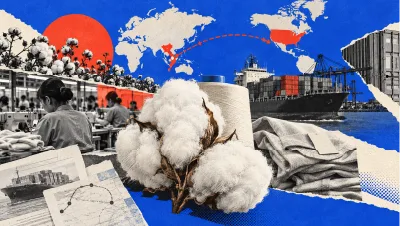
A cotton shirt can carry a simple label and still have a complicated history. It may be cut and sewn in Vietnam, sold by a brand headquartered elsewhere, and shipped into the United States with paperwork that identifies the final manufacturer clearly. Yet the cotton itself may have traveled through farms, gins, traders, spinning mills and textile plants across several countries before it reached the factory floor. By the time the garment is finished, the place where it was assembled can be much easier to identify than the place where its fiber began.
That gap sits at the center of a new Reuters investigation into garment manufacturers in Vietnam with longstanding corporate and commercial links to Chinese textile group Esquel. Three Vietnamese manufacturers continued exporting cotton clothing to the United States after Esquel was added to the U.S. government’s Uyghur Forced Labor Prevention Act Entity List in November 2024. Reuters also found that the manufacturers continued receiving large quantities of cotton from Esquel. However, it could not establish whether the specific garments exported to the United States contained Esquel cotton or cotton grown in Xinjiang.
That uncertainty is not a footnote to the story. It is the story. Forced-labor laws can prohibit goods linked to a named region or entity, but enforcement becomes far harder once raw materials move through multiple companies and manufacturing stages. A supply chain can remain commercially visible while the origin of the material inside the finished product becomes progressively harder to prove.
A supply chain that becomes harder to see
On September 25, 2026, Reuters reported that An Loi Apparel, Tessellation Binh Duong and Tessellation Hoa Binh had continued exporting cotton garments to the United States after Esquel Group was placed on the U.S. forced-labor entity list. The companies had previously operated under variations of the name Esquel Garment Manufacturing Vietnam before being rebranded in 2022. Corporate records reviewed by Reuters also showed that former Esquel chief executive Edgar Tung had appeared as an owner’s representative at the businesses.
Shipment data examined by Reuters showed that Esquel sent about 70 percent of the $34 million in cotton it exported from China between November 2024 and June 2026 to the three Vietnamese manufacturers. During the same period, the manufacturers continued supplying the U.S. market, exporting at least $5 million in cotton goods to the United States. The companies also sourced cotton from other suppliers, which is why Reuters could not determine the fiber composition of individual U.S.-bound garments.
Among the customers identified in the investigation were Japanese retailer Muji and New Zealand menswear company Rodd & Gunn. Both confirmed that they sourced clothing from the Vietnamese manufacturers. Muji told Reuters it had not known about links between its supplier and Esquel and planned to audit one plant during 2026. Rodd & Gunn said it had not known about the connection either, and said its suppliers are required to use cotton from the United States, Brazil and Australia while maintaining chain-of-custody documentation.
Those responses point to a wider problem for the apparel industry. A brand may know which factory sewed its clothes. It may also require approved cotton origins, collect declarations and commission audits. Even then, establishing the physical origin of every fiber can remain difficult. The further upstream the material travels, the harder it becomes to test whether the paperwork and the product tell the same story.
A garment can tell you where it was sewn without telling you where its cotton was grown.
Why Esquel is on the U.S. forced-labor list
The Uyghur Forced Labor Prevention Act, known as the UFLPA, was enacted in 2021 and took effect in June 2022. It created a rebuttable presumption that goods mined, produced or manufactured wholly or partly in Xinjiang, or by an entity on the UFLPA Entity List, are prohibited from entering the United States unless the importer can satisfy the law’s evidentiary requirements. U.S. Customs and Border Protection is responsible for applying that presumption at the border.
The law was designed to address a practical enforcement problem. Under older forced-labor rules, authorities often had to establish a specific link between a shipment and prohibited labor before stopping the goods. The UFLPA shifts part of that burden for covered products. If a shipment falls within the law’s scope, the importer must provide evidence strong enough to overcome the presumption that it should not enter the country.
Esquel has been part of the U.S. government’s forced-labor enforcement system for years. Reuters reported that one of the company’s Xinjiang mills was sanctioned by U.S. authorities in 2020 over alleged use of Uyghur forced labor. Esquel challenged that designation in federal court. The broader Esquel Group was later added to the UFLPA Entity List in November 2024. Esquel has consistently denied allegations that it uses forced labor.
The distinction between regulatory status and proven conduct in a specific shipment matters. Inclusion on the UFLPA Entity List is a fact. It does not mean that every garment connected indirectly to a listed company has been proven to contain material made with forced labor. That is why Reuters was careful to separate what its investigation could establish from what remained unknown.
The missing history inside a finished product
Cotton illustrates why this is so difficult. After harvest, raw cotton is ginned to separate fiber from seed. It may then be sold through traders, combined with cotton from other farms or regions, spun into yarn, woven or knitted into fabric, dyed, finished and eventually delivered to a garment manufacturer. Each step can occur under a different company name and in a different jurisdiction.
Blending is normal within the textile industry. From a manufacturing perspective, combining cotton from multiple sources can be routine. From a traceability perspective, however, it can make the history of a finished garment much harder to reconstruct. The label inside a shirt usually tells a buyer where the garment was made, not the full journey of the fiber used to make it.
This is the same structural problem that appears across other high-risk commodities. Not For Sale recently examined forced labor risks in tuna supply chains, where the final product can pass through vessels, processors, traders and importers before reaching a supermarket shelf. The commodity changes, but the enforcement challenge is similar: once goods are processed, mixed or moved through intermediaries, responsibility can become easier to distribute and harder to pin down.
How visibility changes along a cotton supply chain
The closer a product gets to the consumer, the easier it can be to identify the final manufacturer and the harder it can become to verify the full history of the raw material.
| Stage | Usually visible | Can become harder to verify |
|---|---|---|
| Garment factory | Where the clothing was cut and sewn | The origin of the yarn and cotton used |
| Fabric or spinning mill | Who produced the fabric or yarn | Whether fiber from multiple sources was blended |
| Trader | Commercial seller and shipment records | The farm, region or labor conditions behind the cotton |
| Finished import | Exporter, importer and country of manufacture | The complete labor history of the raw material |
On smaller screens, swipe across the table to read all three columns.
A traceability system therefore has to preserve information as the product changes form. It is not enough to know who sold the finished shirt. Companies need to know which mills supplied the yarn, which businesses supplied the cotton, whether materials were blended, and whether documentary claims about origin can be independently tested.
Where forced labor enters the picture
Forced labor is not defined by the nationality of a company or the geography of a supply chain. It concerns the conditions under which people work. As Not For Sale explains in its human trafficking terms and definitions, coercion can take many forms, including threats, debt, withheld wages, document confiscation and restrictions that prevent a person from leaving work freely.
That matters because supply-chain due diligence can become overly focused on documents and geography while losing sight of workers themselves. A company may be able to map the movement of cotton while knowing very little about recruitment practices, freedom of movement, discrimination, wage withholding or whether workers were able to refuse or leave employment. Material traceability and labor-rights investigation are related, but they are not the same thing.
The strongest systems need both forms of evidence. They need to show where materials came from, but they also need to show what happened to the people who produced them. A supply chain can be mapped perfectly on paper and still contain exploitation if nobody is examining working conditions with the same rigor.
The law is strong only if the evidence can follow the product
The UFLPA gives U.S. authorities a stronger legal mechanism than many forced-labor regimes elsewhere, but the law still depends on practical enforcement. Customs officers cannot physically inspect the history of every fiber entering a port. They rely on targeting, shipment data, importer documentation, intelligence and evidence supplied by businesses and investigators.
U.S. Customs and Border Protection publishes UFLPA enforcement statistics and has repeatedly said that preventing goods made with forced labor from entering the U.S. market is an enforcement priority. The volume of international trade, however, is vast. That creates an unavoidable resource problem: the number of potentially relevant shipments is much larger than the number that can be examined in depth.
Reuters reported that between November 2024 and June 2026, CBP detained approximately $2.6 million worth of apparel from Vietnam for inspection under the UFLPA. During that same period, roughly $28 billion in apparel was shipped from Vietnam to the United States. More than half of the detained goods, measured by value, were subsequently released.
Those figures should not be read as evidence that the remaining trade involved forced labor. They show something different: how small the inspected fraction can be when set against the scale of legitimate commerce moving through the same channels. Laws may be written at the level of entire supply chains, while enforcement still has to operate shipment by shipment.
Audits, declarations and the limits of paperwork
Corporate due diligence often relies on a familiar set of tools: supplier codes of conduct, sourcing requirements, audits, certificates and declarations. Each can be useful, but none is sufficient on its own.
An audit can tell a brand a great deal about the factory being inspected, including working hours, safety practices, payroll systems and management procedures. It may say very little about cotton purchased by an upstream mill hundreds or thousands of miles away. A supplier declaration can record an approved origin, but it remains only as reliable as the system used to verify the declaration. Chain-of-custody documentation can be powerful when records are complete and testable, yet gaps can emerge as materials are traded, blended or transformed.
This is why Not For Sale’s earlier Free2Work initiative focused on what sits behind consumer products rather than treating the final brand name as the only meaningful point of accountability. Supply-chain transparency is useful because exploitation is rarely confined to the final factory. Risk can enter through recruitment, raw-material extraction, agriculture, processing, subcontracting or informal work long before a product reaches the company whose logo appears on it.
The lesson is not that audits or supplier rules are useless. It is that compliance cannot stop at the first tier of production. A brand that knows only its final garment factory knows only the last visible part of the story.
Support the work behind the story
Help build systems that make exploitation harder to hide
Stories like this show why forced labor cannot be addressed only at the point where a finished product reaches the market. Not For Sale works on the conditions that allow exploitation to take hold, from frontline prevention and survivor-centered support to social innovation and more transparent economic systems.
Your support helps sustain that wider work and the long-term partnerships behind it.
Why Vietnam matters, and why the problem is larger than Vietnam
Vietnam is one of the world’s major garment manufacturing centers and a crucial supplier to the U.S. market. That makes it an important location for enforcement, but there is nothing uniquely Vietnamese about the traceability challenge revealed by the Reuters investigation. The same structural issue appears whenever a raw material associated with a high-risk region can move through intermediate countries before reaching its final market.
Moving assembly from one country to another does not necessarily move the origin of the raw material. A garment manufactured in Vietnam, Bangladesh, Turkey or elsewhere may contain cotton grown, traded or spun in a completely different place. This is why country-of-origin labels, while useful for customs and consumers, cannot by themselves answer modern forced-labor questions.
That distinction also matters for public debate. It is easy to turn complicated supply chains into simple national stories: China, Vietnam, the United States. The reality is a network of companies, mills, traders, logistics providers, importers and brands operating across borders. Effective enforcement depends on following those commercial relationships without assuming that proximity or association alone proves exploitation.
Better traceability means asking harder questions
For clothing companies, the practical standard should be higher than simply asking a supplier to certify that prohibited cotton was not used. Businesses sourcing cotton apparel need visibility into textile mills, yarn suppliers and raw-material traders. They need records that can be reconciled across purchases and shipments, and they need a process for escalating inconsistencies when supplier declarations do not match other available evidence.
Independent verification also matters. In higher-risk supply chains, brands may need documentary testing, origin analysis and other technical methods that can assess whether stated sourcing claims are plausible. No single technology can solve forced labor, and no forensic test can establish working conditions by itself. These tools are most useful when combined with credible labor-rights due diligence and worker-centered information.
Companies also need to ask what happens when visibility fails. If a supplier cannot demonstrate where a raw material came from, does the buyer simply accept the declaration, suspend the shipment, investigate further or change suppliers? A traceability policy only becomes meaningful when uncertainty produces a real decision.
The question is not only whether a company knowingly buys goods made with forced labor. It is whether it knows enough about its own supply chain to discover forced labor if it is there.
The broader lesson for forced-labor enforcement
The Reuters investigation is important precisely because it stops short of claiming more than the evidence supports. It found significant historical and commercial links between Esquel and the Vietnamese manufacturers. It also found that those manufacturers continued receiving cotton from Esquel after the group was listed under the UFLPA, while continuing to export cotton garments to the United States. What it did not prove was which cotton was inside the specific garments that entered the U.S. market.
That gap reveals the central challenge. A government can prohibit goods linked to forced labor. A regulator can list an entity. A brand can impose sourcing rules. Yet all three measures depend on the ability to preserve evidence as materials move through the global economy.
This is why forced labor is not simply a question of finding a bad factory. It is a systems problem. The systems that move cotton efficiently around the world are also capable of separating a finished product from the social and geographic history of the material inside it. The more fragmented the supply chain becomes, the more deliberate traceability has to be.
Consumers cannot personally reconstruct those networks, nor should responsibility be shifted onto individual shoppers. Governments, importers and brands have far greater access to the data required to investigate suppliers and enforce labor standards. Consumers can still ask useful questions, particularly whether companies disclose mills and upstream suppliers, how they verify raw-material origin, and what they do when documentation cannot be independently confirmed.
The real test of forced-labor regulation is not whether a prohibited supplier can be named. It is whether the history of a product can still be followed after that product has crossed another border, changed hands and changed form. If that history disappears somewhere between the cotton field and the clothing rail, enforcement becomes a matter of inference. Stronger traceability is what turns it back into evidence.
Frequently Asked Questions
What did Reuters find about Esquel and clothing imported into the United States?
Reuters found that three Vietnamese garment manufacturers with longstanding corporate and commercial links to Esquel Group continued exporting cotton clothing to the United States after Esquel was added to the U.S. Uyghur Forced Labor Prevention Act Entity List. Reuters reported that the manufacturers exported at least $5 million in cotton goods to the U.S. after the listing.
Did Reuters prove that the clothing contained Xinjiang cotton?
No. Reuters said it could not establish whether the garments exported to the United States contained cotton supplied by Esquel or cotton produced in Xinjiang. The Vietnamese manufacturers also sourced cotton from other suppliers, so the composition of individual garments could not be determined from the records Reuters reviewed.
What is the Uyghur Forced Labor Prevention Act?
The UFLPA is a U.S. law that creates a rebuttable presumption against importing goods mined, produced or manufactured wholly or partly in Xinjiang, or by entities on the UFLPA Entity List. Importers seeking to overcome that presumption must satisfy the evidentiary requirements applied by U.S. Customs and Border Protection.
Why is cotton difficult to trace?
Cotton can pass through farms, gins, traders, spinning mills, fabric manufacturers and garment factories before reaching a retailer. Fiber from different sources can also be blended during production, making it difficult to establish the precise origin of every part of a finished garment without strong chain-of-custody systems.
Does a “Made in Vietnam” label show where the cotton was grown?
No. A country-of-origin label for a garment generally identifies where the finished clothing was manufactured according to applicable customs rules. It does not necessarily identify where the cotton was grown, ginned, spun or woven.
Are supplier audits enough to prevent forced labor?
Audits can provide valuable information about conditions at a particular facility, but they do not automatically establish where upstream raw materials originated or how workers were treated elsewhere in the supply chain. Effective due diligence requires both material traceability and credible investigation of labor conditions.
What is forced labor?
Forced labor is work performed involuntarily under the threat of a penalty. Coercion can include violence, threats, debt, withheld wages, document confiscation, restrictions on movement or other measures that prevent a worker from freely leaving employment.
What should clothing companies do to reduce forced-labor risk?
Companies can map suppliers beyond final garment factories, verify raw-material origin, reconcile purchasing and shipment records, investigate inconsistencies, build effective worker grievance systems and publish meaningful information about how they respond when risks are identified. The strongest systems combine traceability with worker-centered labor-rights due diligence.
Topics in this story
See all topicsNot For Sale
A global movement fighting modern-day slavery and ecocide in 33 countries. Building on the frontlines since 2007.