

Charity in action: Stories from Thailand’s children’s village
4.6 MIN READ
When charity takes root in action, it transforms lives. In northern Thailand, children once trafficked, forced into karaoke clubs and brothels, now speak of education, friendship, and possibility. Their words tell the story of what happens when communities open their hearts and act together.
The beginnings of a children’s village
The story began with Kru Nam, an artist in Chiang Mai who asked street children to paint their stories on blank canvases. What emerged shocked her: drawings of abuse, trafficking, and fear. Many of these children were not from Thailand but from Burma, Laos, Cambodia, and Vietnam, all trafficked into brothels and karaoke clubs.
Moved by righteous anger, Kru Nam started pulling children out of these environments. She had no facilities, no organization, only courage. Yet she managed to rescue more than 100 children, building a safe community in bamboo, thatched-covered huts where they learned to cook, plant rice, and look after one another.
“At first, she had very low expectations of me or Not For Sale,” David Batstone, Not For Sale’s co-founder, recalls. “I gave her my email, and she turned to her assistant and asked, ‘What’s email?’ He shrugged and said: ‘Don’t worry, you’ll never see that guy again.’ But that meeting became the foundation of our first project, serving 150 children.”
Education and farming: Tools of healing
Life in the village grew through charity in action. What began with simple bamboo huts became a robust children’s village with dormitories, classrooms, a clinic, a fish pond, and farmland. The impact this support network has on the lives of young people cannot be overstated.
One rescued child shares: “Since I have been here, I have had the opportunity to study and get a good education. I’ve learned to plant vegetables and play sports.”
Another explains how “Kru Nam rescued me from the border. Now I don’t have to beg. She has given me a beautiful home, and now I have food to eat.”
For children once denied citizenship and rights, something as simple as harvesting rice became revolutionary.
“The kids grew 250 kilograms of rice in their first harvest,” David Batstone remembers. “It lasted only a week for 120 children, but the pride they felt was immense.”
Building a community through sports and play
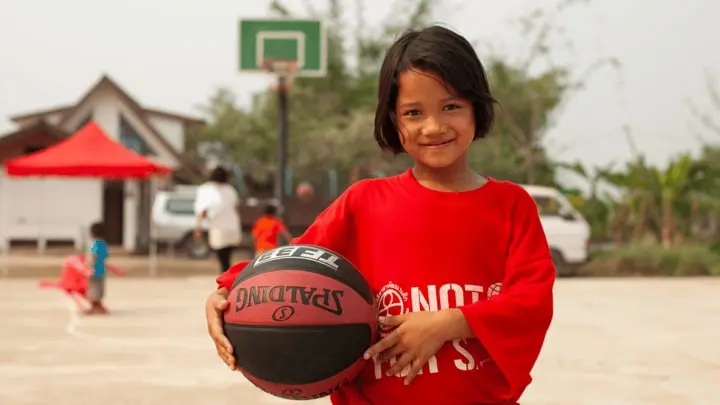
Charity created space not just for survival, but for joy. With support from Not For Sale and its donors, Kru Nam’s village now has a basketball court, playgrounds, and farmland for self-sufficiency. Its continued growth means that more children can grow and learn in safety, further contributing to not just their own safety but the livelihood and benefit of others, too.
Kru Nam explained: “Thanks to Not For Sale, we now have three houses, a meeting place, and a clinic for the sick. We have a basketball court so the kids can exercise. We also have a pig, fish, and chicken farm, and we are building another dormitory.”
That power of an open heart and what makes charity possible, through sports, farming, and education, provides structure for healing. These tangible outcomes show what happens when charitable giving turns into action.
From rescue to rights: A lasting impact
Beyond the village, Kru Nam’s work has changed the system itself. She has influenced laws in northern Thailand, helping children who were once considered “stateless” gain the right to education and, in some cases, higher education.
“She has rescued thousands of children in northern Thailand,” explains David Batstone. “And she’s rewritten laws to protect them.
“These children once had no rights, no citizenship. Now they’re part of a community graduating as the first stateless people in Thai history to earn university degrees.”
Why charity in action matters
This village proves that charity is not passive giving, but an investment in futures. When people chose to support Kru Nam, they built more than dormitories. They built hope.
At Not For Sale, we believe that charity in action builds lasting change. In Thailand, that change is visible in classrooms, rice fields, basketball courts, and the eyes of children who no longer see themselves as victims but as leaders of tomorrow.
“Charity, when coupled with action, builds futures,” says David Batstone. “What was once a place of fear has become a village of potential.”
Donate today to drive more positive change through charity in action.
Q&A: Charity in action and Thailand’s children’s village
What is Not For Sale’s Children’s Village?
It is a community started by Kru Nam, an artist-turned-abolitionist, who in partnership with Not For Sale started Baan Kru Nam (meaning Kru Nam’s Home). It provides housing, education, healthcare, and opportunities for trafficked and stateless children in northern Thailand.
Who is Kru Nam?
Kru Nam is a Thai artist who began rescuing children from brothels and karaoke clubs in Chiang Mai. With no formal organization at the start, she built a safe village where children could heal and grow.
What outcomes has the village achieved?
Thousands of children have been supported over the last 20 years. Tens of thousands of extended community members in at-risk areas have been supported through out-reach programs. And dozens of young adults have graduated from university, a feat previously unheard of for stateless and previously-exploited children in Thailand.
Why is this story important?
It shows that charity, when turned into action, has tangible results: freedom from exploitation, education for the future, and systemic change that rewrites laws and opportunities for generations.
Published by NOT FOR SALE September 10, 2025


Sign Up to our Newsletter
Join our movement and get the latest updates, stories, and ways to take action, straight to your inbox.