Esther Mamboleo: Transforming lives through leadership
Can you imagine living on $300 a year and starting off your new life living in a mud hut with a tarp…

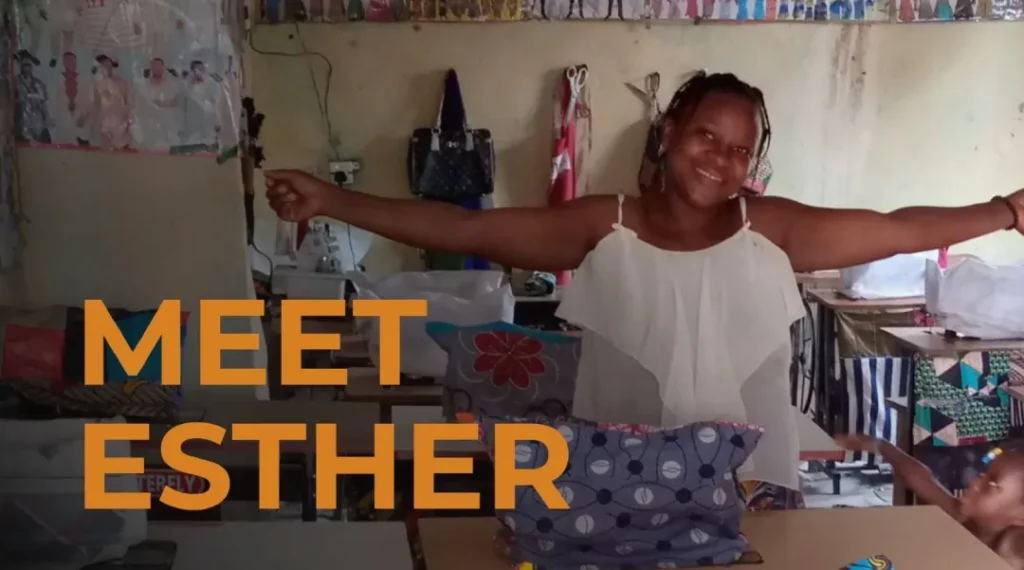
Can you imagine living on $300 a year and starting off your new life living in a mud hut with a tarp as a roof? This is a story of Esther Mamboleo starting with nothing, to succeeding in the Not For Sale Entrepreneurship Challenge and being a catalyst for change in her community.
Even with humanitarian aid for food, housing, and basic needs assistance from NGOs, income for anyone living in a refugee camp is low. Then there are the challenges refugees face when it comes to earning, such as barriers to formal employment, or limited access to tools, training, and capital.
Your contribution to the work that Not For Sale does will help position individuals to not only earn, but raise their communities and teach them skills for life. Below is a stand-out example of just how much impact entrepreneurship can have.
Not For Sale and the Entrepreneurship Challenge
Meet Esther Mamboleo, a professional tailor and designer, chairwoman, and founder of Upendo Wamama, based in Rwamwanja Refugee Settlement in Uganda.
After taking part in the Not For Sale Entrepreneurship Challenge, Esther was among the winners of the initiative. She successfully developed and pitched her business before walking away with funding of 4.5 million Ugandan Shillings (UGX). That’s over four times what many refugees receive in a year!
Esther Mamboleo and her business
Upendo Wamama provides refugee vulnerable women and young people with fashion, design and tailoring skills. Since being founded during the Entrepreneurship Challenge, the business has equipped over 200 women and young people refugees with tailoring skills that enable them to forge a new direction in Uganda.
In addition to helping herself by making and selling high end clothing, Esther also aspires to help others.
Not For Sale paid it forward to her; now she’s paying it forward to her community. Her desire and commitment to this is a major reason she was successful in the Entrepreneurial Challenge. She saw the power in her own community.
The business strives to connect the alumni with employers, and offers mentorship to those who establish their enterprises. This means that they can network with tailoring workshops or specialists in fashion and design.
The group also encourages the members to savings and lending activities that enable them start their own enterprise. The best bit? The program is free of charge.
Saving and lending for success
The business’ own savings and lending activities helped the training centre to acquire six sewing machines, along with other important tools and materials. It has also supported 120 alumni in affording a new sewing machine after 18 months of savings.
Through continual growth and with support of Not for Sale, the training centre has acquired new machines and shifted its number of trainees from 8 to 25. This means that Esther and her teams can continue to drive further development in order to support more people in acquiring new skillsets and realizing their entrepreneurial dreams.
Think back to that $300 a year. Imagine now 25 people starting to double or triple their annual income, and the effect is multiplied.
Children in families that once had to work on the family farm can now go to school. This results in the next generation stepping up another key rung of the economic ladder.
Instilling the confidence to grow a business and share knowledge
“Participating in the Not For Sale Entrepreneurship Challenge was an important event in my life,” explains Esther.
“It gave me the confidence to grow my tailoring business and share my knowledge with others in my community.
“I am proud to help others learn this craft, which brings hope and opportunity to all of us.”
Passion and commitment of East African business leaders
“Esther is an incredible example of the entrepreneurial spirit found in every one of these challenges,” explains Mark Wexler, co-founder of Not For Sale.
“With the vision of her tailoring and African fashion design centre, Esther pitched her business to scale the enterprise and employ even more women following her challenge success.
“To launch her business, she’d sold half of her food ration aid to afford six yards of cloth. Now, she’s built something that’s vital to so many people, providing training for those that don’t have any skills, in addition to creating and selling clothing.
“Nobody can deny the passion and commitment, both of the upcoming and the established entrepreneurs. The challenge brings out something special in, and for, the people of Uganda.”
To find out more, read Inside the Not For Sale Entrepreneurship Challenge.
NOT FOR SALE
Related Articles